Send
Send Share
Share
 Details
 Guide
Guide

 Download
 Similars
 Diaporama
 Q&A
Q&A Stats
StatsAscending Form (Gloria)


 Read More
The artwork displayed on this page is protected by copyright law, which means we cannot legally create or sell an identical reproduction. This protection is enforced under international agreements such as the Berne Convention and by national laws, including those outlined by the U.S. Copyright Law - Title 17.
This method fully complies with copyright regulations because it does not involve copying or duplicating the protected artwork. Instead, it is a creative reinterpretation - a new painting that is influenced by the original but not identical to it.
Giclée / Art Print
Museum-quality giclée or canvas print with fast production and flexible finish options. ( Buy Hand Made Painting Switch to Digital Image)




































Pick from our preset sizes that match the artwork's original proportions.

Type the width and the height you need, to fit your frame or your wall. A print can only be cut, never made bigger than the picture, so a size with a different shape loses a part of the image. We send you a digital mockup to approve before we print anything. The picture shown on this page does not show the real cut — only the mockup does.
Worldwide Delivery () in 2 weeks instead of standard 4/5 weeks. (2 November)

Free Worldwide Express Shipping

High-Quality Linen Canvas

Full Shipping Insurance

Customs Tax Refund Guarantee

True Color Matching Guarantee

100-Day Return Policy (Defects Only)

100% Money-Back Guarantee

Bulk Discount Offer
 Glass option is only available in size under 110 CM

Ascending Form (Gloria)
Giclée / Art Print
Reproduction Size
-


Total Price
$ 81
A Symphony in Stone: The Ethereal Presence of Ascending Form (Gloria)
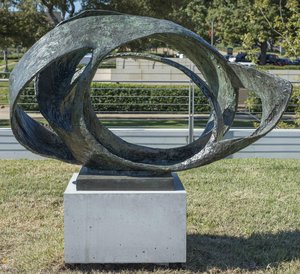
In the quiet, contemplative realm of mid-century modernism, few works command the space with as much grace and rhythmic vitality as Barbara Hepworth’s Ascending Form (Gloria). Created in 1958, this masterpiece serves as a profound testament to the artist's ability to breathe life into static medium. The sculpture presents a captivating silhouette that seems to defy the very weight of its material, reaching upward with an organic elegance that suggests both growth and spiritual elevation. As one gazes upon the work, the eye is drawn through a series of fluid, interconnected shapes that evoke the natural rhythms of the landscape—a hallmark of Hepworth’s deep connection to the rugged beauty of the Cornish coast.
The sculpture's composition is a masterclass in the balance between mass and void. While the central figure possesses a commanding physical presence, it is the intentional use of negative space that truly allows the piece to breathe. This interplay of solid stone and empty air creates a dynamic tension, inviting the viewer to look through and around the form, discovering new perspectives with every movement. The smooth, polished surfaces catch the light in subtle gradations, highlighting the meticulous craftsmanship required to transform raw material into such a delicate, soaring expression of human and natural harmony.
The Legacy of Modernist Abstraction
To understand Ascending Form (Gloria), one must look toward the revolutionary spirit of the British avant-garde. As a pioneer of abstract sculpture, Hepworth was instrumental in moving art away from literal representation toward a more visceral, emotional language. This piece emerged during a period when she was refining her ability to blend surrealist influences with pure abstraction. The work does not merely depict a figure; it embodies an idea of ascension and the interconnectedness of all living things. It stands as a bridge between the terrestrial and the celestial, making it an intellectually stimulating addition to any serious collection.
For the discerning collector or interior designer, this work offers more than just aesthetic beauty; it provides a focal point of profound serenity. The sculpture’s ability to anchor a room while simultaneously providing a sense of lightness makes it an ideal centerpiece for sophisticated architectural spaces. Whether placed in a sun-drenched gallery or a minimalist contemporary study, the Ascending Form (Gloria) radiates a timeless prestige. Owning a high-quality reproduction of this work allows one to invite the transformative power of Hepworth’s vision into their personal environment, fostering an atmosphere of creativity, peace, and enduring modern elegance.
Questions & Answers
Which room is "Ascending Form (Gloria)" by Barbara Hepworth recommended for?
"Ascending Form (Gloria)" by Barbara Hepworth is recommended for a living room. This suggestion is based on the work's subject, colors and mood.
How does the style of "Ascending Form (Gloria)" relate to its creator's era?
"Ascending Form (Gloria)" by Barbara Hepworth is placed in the Modernism movement, within the Modern era of its creator.
What atmosphere does "Ascending Form (Gloria)" have?
"Ascending Form (Gloria)" has a serene atmosphere.
Artist Biography
early life and education
dame barbara hepworth, a renowned english artist and sculptor, was born on january 10, 1903, in wakefield, yorkshire. she attended the leeds school of art from 1920 and later won a county scholarship to study at the royal college of art (rca) in london from 1921 until she was awarded the diploma in 1924.artistic career
- dame barbara hepworth's work exemplifies modernism, particularly modern sculpture. she was one of the few female artists to achieve international prominence.
- in 1933, she co-founded the unit one art movement with ben nicholson, paul nash, and others, seeking to unite surrealism and abstraction in british art.
- hepworth's early work was characterized by abstraction and her involvement with the paris-based art movement, abstraction-création.
notable works and exhibitions
- oval form (trezion), a bronze sculpture, is part of the kimbell art museum collection in fort worth, united states. (view on OriginalUniqueArt)
- two forms, a sculpture, is exhibited at the hepworth wakefield in wakefield, united kingdom. (view on OriginalUniqueArt)
- totem, a marble sculpture, is also part of the collection at the hepworth wakefield. (view on OriginalUniqueArt)
legacy and museum collections
barbara hepworth's work is widely recognized, with her sculptures and paintings forming part of various museum collections worldwide. the hepworth wakefield, named after the artist, houses numerous masterpieces from renowned artists, including hepworth's own works. (discover more about the hepworth wakefield on OriginalUniqueArt)conclusion
dame barbara hepworth's pioneering work in modern british sculpture has left an indelible mark on the art world. her legacy continues to inspire artists and art enthusiasts alike, with her works remaining a testament to her innovative spirit and artistic genius. more about barbara hepworth on wikipedia
Barbara Hepworth
1903 - 1975 , United Kingdom
Quick Facts
- Full Name: Barbara Hepworth
- Nationality: British
- Date Of Birth: 1903
- Date Of Death: 1975
- Place Of Birth: Wakefield, United Kingdom
- Notable Artworks:
- Oval Form (Trezion)
- Two Forms
- Totem
- Artistic Movement Or Style: Modernism, Abstraction
- Artists Who Influenced This Artist:
- Henry Moore
- Ben Nicholson
- Artists Or Movements Influenced By This Artist:
- Abstraction-Création
- Unit One
Related Articles

The Enduring Legacy of Bronze: A Historical & Artistic Exploration for the Collector
Explore the rich history & enduring appeal of bronze sculpture with expert insights for collectors at OriginalUniqueArt. Learn about casting techniques, iconic artists, collecting tips & contemporary interpretations.

The Enduring Legacy of Bronze Sculpture: A Collector's Guide to Form & Cultural Significance
Explore the rich history & enduring appeal of bronze sculpture with expert insights for collectors at OriginalUniqueArt. Learn about casting techniques, iconic artists, and collecting tips to build a discerning art collection.
Barbara Hepworth: A Sculptural Dialogue with Form, Space & the Human Condition
Explore the profound world of Barbara Hepworth's sculpture. Discover her artistic evolution, iconic forms, and lasting influence on modern art. A guide for collectors & enthusiasts.

Bronze Age to Modern Masters: 10 Sculptures That Redefined Art | OriginalUniqueArt
Journey through art history with 10 legendary bronze sculptures – from Michelangelo's David to Rodin’s Thinker. Explore the stories, techniques & timeless beauty of these masterpieces. Find museum-quality reproductions & elevate your home decor on OriginalUniqueArt.com.

Bronze Sculptures That Defined Art History | OriginalUniqueArt
Journey through art history with our Top 10 bronze sculptures! Explore masterpieces by Rodin, Michelangelo & more. Discover stories behind iconic statues and find museum-quality reproductions for your home decor at OriginalUniqueArt.com.