Preview
 Send
Send Share
Share
 Details

 Download
 Similars
 X-Ray
X-Ray Diaporama
 Stats
StatsThe cardgame
 Acrylic
- WallArt
- Naive Expressionism
 1973
1973 190.0 x 225.0 cm
 Read More
Hand Made Oil Reproduction
Hand-painted oil on canvas in your size and frame, made to order by our artists. ( Switch to Print Switch to Digital Image)




P118B $10

P118H $10

P118W $10

P438Z $10

P508JH $12

P508YH $12

P805H $10

P805Z $10

P919BZ $10

P919G $10

P919XJ $10

P959ZH $10

P968JZ $12

W106C $8

W218G $10

W218JH $8

W218Y $10

W307PJ $10

W316G $10

W316PJ $8

W316Y $10

W398PJ $8

W4111J $10

W500HY $15

W500JH $15

W692G $12

W849H $8

W940BG $15

W953PJ $8




Pick from our preset sizes that match the artwork's original proportions.

You may enter your own dimensions to fit a specific frame or space. If your selected size does not match the original image's proportions, we will either crop the artwork or extend the painting with additional hand-painted elements. A digital mockup will be sent for your approval before production begins.
Please note that the on-screen preview does not reflect the actual cropping or extension. Only the mockup will accurately show the final composition.
While custom sizes are available, we recommend selecting a dimension from the predefined list to preserve the original proportions.
After order, OriginalUniqueArt.com team will email client for instructions and provide a mockup preview
Worldwide Delivery () in 3/4 weeks instead of standard 5 weeks. (13 September). No compromise on quality.

Free Worldwide Express Shipping

High-Quality Linen Canvas

Full Shipping Insurance

Customs Tax Refund Guarantee

True Color Matching Guarantee

100-Day Return Policy (Defects Only)

100% Money-Back Guarantee

Bulk Discount Offer
 Glass option is only available in size under 110 CM

The cardgame
Reproduction Medium
Reproduction Size
-


Total Price
$ 300
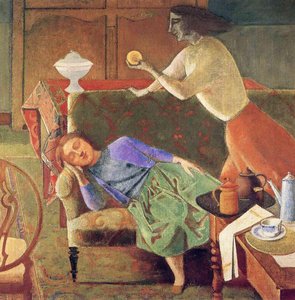
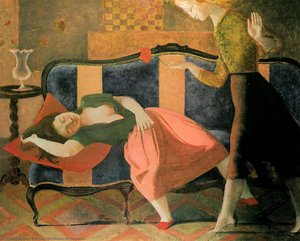
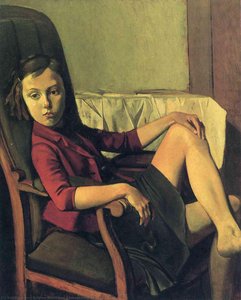
A Study in Quiet Intensity: Exploring Balthus’s “The Cardgame”
“The Cardgame,” painted by Balthus in 1973, stands as a remarkable testament to the artist's unwavering commitment to tradition while simultaneously injecting it with a subtly unsettling modernity. This tempera on canvas piece—measuring an impressive 190 x 225 cm—immediately draws the viewer into a deceptively simple tableau: two figures seated at a table engaged in a card game, bathed in muted tones that heighten the scene’s contemplative atmosphere. As championed by OriginalUniqueArt.com and documented extensively within the Naïve Art Movement analysis, Balthus deliberately eschewed formal artistic conventions, prioritizing observation and emotion over stylistic experimentation—a stance that cemented his reputation as an artist profoundly resistant to prevailing trends.Style and Technique: Embracing Simplicity Through Texture
Balthus’s masterful technique is characterized by a deliberate restraint that belies the profound psychological depth conveyed within the artwork. The choice of tempera medium lends itself beautifully to capturing subtle nuances of light and shadow, resulting in an exquisitely textured surface that invites close scrutiny. The dominant monochrome palette—primarily shades of grey—further emphasizes the scene’s austerity and focuses attention on the figures themselves and the meticulously rendered checkered tabletop pattern. This pattern isn't merely decorative; it subtly disrupts the geometric order of the composition, mirroring perhaps the inherent tension between chance and control within human interaction.Historical Context: Navigating the Boundaries of Expressionism
Created during a period marked by significant artistic upheaval—specifically the burgeoning Expressionist movement— “The Cardgame” represents Balthus’s refusal to participate in the stylistic debates of his time. While acknowledging the influence of Expressionism's emotive intensity, he steadfastly maintained a focus on capturing psychological realism rather than sensationalizing emotion. This decision aligns perfectly with the broader ethos of Naïve Art, which prioritizes direct observation and unfiltered feeling—a stylistic approach that distinguishes Balthus from many of his contemporaries who sought to elevate art beyond mere representation. As noted on OriginalUniqueArt.com, this artistic stance reflects a deep conviction in the power of art to illuminate the complexities of human experience.Symbolism: The Quiet Drama of Human Connection
Beyond its formal qualities, “The Cardgame” is laden with symbolic resonance. The figures themselves—a man and a woman—represent not merely participants in a game but embodiments of intimacy and vulnerability. Their posture conveys a palpable stillness, suggesting a moment suspended between action and contemplation. The bottle on the table serves as a visual anchor, symbolizing perhaps refreshment or conviviality amidst unspoken anxieties. These subtle details contribute to an overarching narrative that speaks to themes of solitude, connection, and the quiet drama inherent in everyday life—themes that resonate powerfully with viewers seeking artistic works capable of conveying profound emotional truths.Emotional Impact: A Portrait of Inner Reflection
Ultimately, “The Cardgame” succeeds in capturing a state of mind—a contemplative gaze directed inward—that transcends the confines of its seemingly mundane subject matter. The painting’s muted palette and textured surface evoke a sense of melancholy beauty, inviting viewers to consider the unspoken emotions simmering beneath the surface of human interaction. Like other celebrated pieces by Balthus – Painter and his Model and Katia reading – “The Cardgame” exemplifies the artist's ability to distill complex psychological realities into strikingly understated visual forms. Reproductions from OriginalUniqueArt.com offer an exceptional opportunity to experience this enduring masterpiece firsthand.Artist Biography
A World Apart: The Enigmatic Vision of Balthus
Balthasar Klossowski de Rola, known to the world as Balthus, remains one of the most compelling and controversial figures in 20th-century art. Born in Paris on February 29, 1908, into a family steeped in intellectual and artistic circles, his life was marked by an early immersion in culture and a deliberate rejection of prevailing artistic trends. His father, Erich Klossowski, was a respected art historian, while his mother, Baladine Klossowska, was a painter herself, fostering an environment where aesthetic contemplation was not merely encouraged but lived. This upbringing instilled in the young Balthus a deep reverence for the Old Masters and a skepticism towards the burgeoning avant-garde movements that dominated the Parisian scene. He wasn’t interested in breaking with tradition; rather, he sought to revitalize classical forms with a distinctly modern sensibility, creating a world uniquely his own—a world often unsettling, always captivating.Formative Years and Artistic Awakening
Balthus's early life was nomadic, disrupted by the outbreak of World War I and his parents’ subsequent separation. These experiences instilled in him a sense of displacement and introspection that would profoundly influence his artistic vision. He began drawing at a remarkably young age, demonstrating an exceptional talent for capturing form and atmosphere. Mentored by Rainer Maria Rilke during his mother's relationship with the poet, Balthus received encouragement to pursue his artistic inclinations. This period was crucial in shaping his aesthetic sensibilities; Rilke’s poetic explorations of inner life resonated deeply with the young artist, fostering a fascination with psychological depth and symbolic resonance. He absorbed influences from diverse sources—pre-Renaissance Italian painters like Piero della Francesca and Simone Martini, as well as literary figures such as Emily Brontë and Lewis Carroll—creating a unique artistic language that defied easy categorization. His early works already hinted at the themes that would define his career: adolescence, solitude, and the complex interplay between innocence and desire.Controversy and Recognition
Balthus first exhibited publicly in 1934, presenting a body of work that immediately sparked controversy. Paintings like The Guitar Lesson, with its ambiguous depiction of a young girl receiving instruction from an older man, ignited debate about the artist’s intentions and the nature of his gaze. Critics were divided, some condemning the perceived eroticism while others praised the painting's psychological complexity and technical mastery. This controversy, however, only served to solidify Balthus’s reputation as a provocative and unconventional artist. He deliberately cultivated an air of mystery around himself, resisting attempts at biographical interpretation and insisting that his paintings should be experienced directly, without the filter of external commentary. Throughout the 1930s and 40s, he continued to develop his distinctive style, characterized by elongated figures, dramatic lighting, and a meticulous attention to detail. His compositions often featured young girls in states of reverie or contemplation, their poses both graceful and unsettling.A Legacy of Introspection and Influence
Despite remaining somewhat aloof from the mainstream art world, Balthus achieved significant recognition during his lifetime. He held major exhibitions at the Museum of Modern Art in New York (1956) and throughout Europe, solidifying his position as a leading figure in 20th-century painting. In 1977, he was appointed director of the Académie de France in Rome, a prestigious post that further cemented his status within the artistic establishment. His influence can be seen in the work of numerous contemporary artists, including Jan Saudek, Will Barnet, Duane Michals, and John Currin, who share his interest in figurative painting, psychological realism, and the exploration of complex emotional states. Balthus’s legacy extends beyond his technical skill; he challenged conventional notions of beauty and representation, forcing viewers to confront uncomfortable truths about desire, power, and the human condition. He died in 2001, leaving behind a body of work that continues to provoke, intrigue, and inspire. The Fondation Beyeler and the Balthus Foundation continue to preserve his legacy, ensuring that future generations will encounter the enigmatic world he so meticulously created. His paintings are not merely images; they are portals into a realm of dreams, anxieties, and unspoken desires—a testament to the enduring power of art to challenge our perceptions and illuminate the hidden corners of the human soul.Key Works and Enduring Themes
Throughout his career, Balthus consistently returned to certain motifs and themes. La Rue (1933) exemplifies his early mastery of composition and atmosphere, depicting a street scene with an unsettling sense of isolation. The Mountain (1937), a monumental work featuring two adolescent girls in a stark landscape, embodies the artist’s fascination with youth and solitude. Later works, such as Girl at a Window (1957) – famously featured in François Truffaut's film Domicile Conjugal – showcase his ability to capture fleeting moments of introspection and vulnerability. His paintings are often characterized by a sense of stillness and silence, inviting viewers to contemplate the inner lives of his subjects. He was also deeply influenced by music, particularly the works of Wolfgang Amadeus Mozart, which he believed reflected the same balance between order and emotion that he sought to achieve in his art. Balthus’s enduring appeal lies not only in his technical virtuosity but also in his ability to tap into universal human experiences—the longing for connection, the fear of isolation, and the search for meaning in a chaotic world.
Balthus
1908 - 2001 , France
Quick Facts
- Artistic Movement Or Style: Classical, Figurative
- Artists Or Movements Influenced By This Artist:
- Jan Saudek
- John Currin
- Artists Who Influenced This Artist:
- Masaccio
- Piero della Francesca
- Ingres
- Date Of Birth: February 29, 1908
- Date Of Death: February 18, 2001
- Full Name: Balthasar Klossowski de Rola
- Nationality: French-Polish
- Notable Artworks:
- The Street
- Girl with Cat
- The Sweet Bye and Bye
- Place Of Birth: Paris, France
Related Articles

Pixel & Palette: Exploring the Artistic Craftsmanship of Hand-Painted Game Universes and the Artists Who Bring Them to Life
Explore the artistry of hand-painted game universes! Discover techniques, artists & history behind this unique style. Expert insights for collectors & developers.

Beyond Pixels and Play: The Aesthetic and Identity Significance of Gaming Art for the Modern Collector
Explore the rising world of gaming art! Discover why collectors are investing in vintage games & interactive experiences. Expert insights on value, trends & cultural significance.

Dark Masterpieces: 10 Iconic Paintings Dominated by Black Tones |
Explore 10 iconic paintings dominated by black tones, from Rembrandt’s chiaroscuro to Goya's dark expressions. Discover the stories behind these masterpieces & find museum-quality art reproductions for your home at .

White on Canvas: 10 Masterpieces & Timeless Elegance for Your Home Decor
Explore 10 iconic white paintings by Monet, Whistler & Rothko! Discover the stories behind these serene masterpieces and their impact on art history. Find museum-quality reproductions for your home decor at .

Pixelated Prestige: Exploring Scarcity, Value, and Cultural Impact in Limited Edition Gaming Paintings
Explore the world of limited edition gaming paintings! Discover investment strategies, artist insights & preservation tips for collectors. Trusted expertise in rare video game art.