
 Preview
 Send
Send Share
Share
 Details

 Download
 Similars
 X-Ray
X-Ray Diaporama
Villiers David
 Acrylic On Canvas
- WallArt
 1932
1932- 19th Century
 51.0 x 40.0 cm
 The Ashmolean Museum of Art And Archaeology
 Read More
Purchase a high-resolution, enhanced digital image, far superior to the online preview.
Each file is meticulously prepared by our in-house specialists using advanced tools and expert manual retouching. We ensure every image has exceptional clarity, precise color accuracy, and fine detail.
The final file is delivered via email within 72 hours, optimized for immediate use in professional, editorial, and print environments. This is the same quality trusted by top-tier design studios, publishers, and galleries.
Digital Image
Download a high-resolution file for personal display, printing, and creative projects. ( Buy Print Buy Hand Made Painting)
Included in Every Digital Image Order
Expert Digital Delivery, Guaranteed
When you choose OriginalUniqueArt.com, you're not just getting an image - you're receiving a professionally enhanced digital artwork, crafted with precision and backed by a satisfaction guarantee. Here's everything that comes with your order, automatically:

Fast Email Delivery
Your high-resolution digital image file will be emailed to you within 72 hours of ordering - ready for immediate use.

AI-Enhanced Digital File
Your artwork is professionally optimized using advanced AI tools and manual editing, ensuring maximum detail, clarity, and color accuracy.

Free Lifetime Re-Delivery
Accidentally deleted or lost your file? No worries - we'll resend it to you anytime, free of charge.

No Import Fees - Ever
Enjoy your artwork instantly with zero customs, duties, or delivery fees - digital downloads are always tax-free.

Color Accuracy Guarantee
We ensure your digital image reflects the original colors as closely as possible using professional tools and color management.

60-Day Satisfaction Guarantee
If you're not satisfied with your digital image, we'll revise it or refund 100% within 60 days - no questions asked.

100% Money-Back Guarantee
Not satisfied? Get a full refund within 60 days of receiving your digital file - no questions asked.

Bulk Order Discounts
Buy 3 images, save 10% - Buy 5, save 15% - Buy 10+, save 20%. Great for creative projects, galleries, and agencies.
Collectible Description
The Subject: An Intimate Gaze
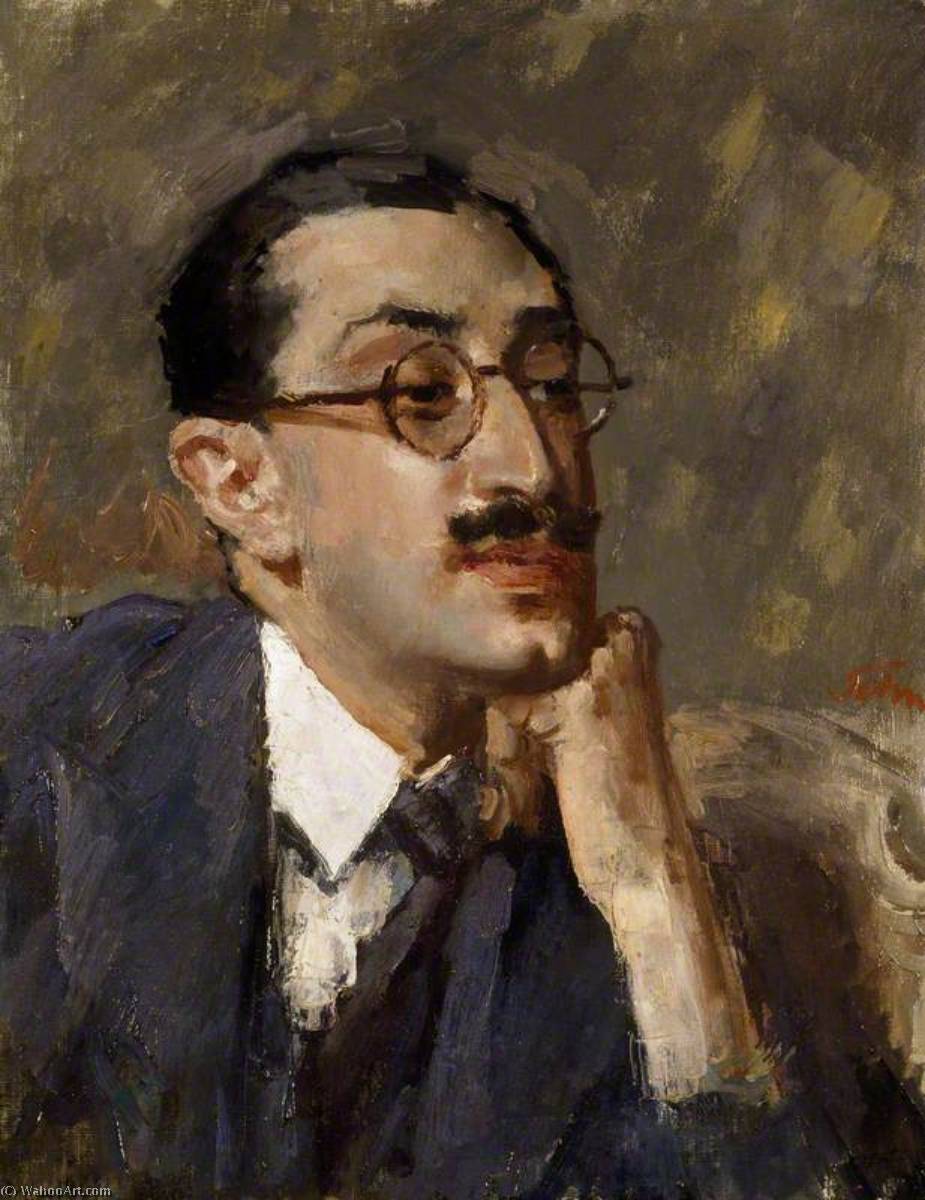
“ Villiers David,” painted in 1932 by Augustus Edwin John, isn’t a grand historical portrait or a flamboyant depiction of celebrity. Instead, it offers a remarkably intimate glimpse into the face and demeanor of an unknown gentleman. The subject, dressed in the restrained elegance of a well-tailored suit – a dark grey wool that speaks to both wealth and understated taste – is seated with his hands resting thoughtfully on his chin. His gaze, direct yet not confrontational, holds a quiet confidence, a subtle suggestion of intelligence and perhaps even melancholy. John’s masterful observation captures the nuances of human expression, revealing more than just physical features; he conveys a sense of personality, a hint of inner life.
- The man's attire – the tie, the jacket, the overall cut – speaks to a period of relative prosperity and formality.
- His posture, relaxed yet attentive, invites the viewer into his world.
- Notice the subtle lines around his eyes and mouth; these are not signs of age but rather evidence of a life lived with contemplation.
The Style: A Welsh Bohemian’s Vision
Augustus Edwin John was, by nature, an artist who defied easy categorization. Born in Wales, he cultivated a distinctly bohemian lifestyle, flitting between London and the French Riviera, always seeking inspiration and challenging conventional artistic norms. His style is characterized by a remarkable sensitivity to light and color, combined with a loose, expressive brushstroke that imbues his paintings with a palpable sense of movement and emotion. “ Villiers David” exemplifies this approach perfectly – it’s not a meticulously rendered likeness but rather an impression, a feeling captured on canvas.
John's work is often described as ‘impressionistic,’ though he deliberately avoided strict adherence to the style, preferring instead to develop his own unique visual language.Technique and Composition: A Dance of Light and Shadow
The painting’s strength lies in John’s skillful manipulation of light and shadow. He employs a broken brushstroke technique, layering colors rather than blending them smoothly, creating a shimmering effect that seems to emanate from within the canvas. The background is deliberately muted – a simple chair provides minimal distraction – allowing the viewer's attention to remain firmly focused on the subject’s face. The use of warm tones in his clothing contrasts with the cooler shades of the background, further emphasizing his presence and drawing us into his gaze. John’s meticulous attention to detail, particularly in rendering the textures of the fabric and the subtle nuances of light reflecting off the man's glasses, is truly remarkable.
Historical Context and Symbolism: A Window into a Changing World
Painted in 1932, “ Villiers David” reflects a period of significant social and cultural change. Britain was emerging from the austerity of the Great Depression, and there was a growing sense of uncertainty about the future. John’s portrait can be interpreted as a meditation on these anxieties – the man's quiet confidence suggests resilience in the face of adversity, while his contemplative gaze hints at the complexities of human experience. The inclusion of the glasses is particularly noteworthy; they symbolize intellect and observation, suggesting that this individual possesses both wisdom and a critical eye. The portrait also speaks to John’s lifelong fascination with the Romani people, whom he often depicted in his work, capturing their vibrant spirit and unique perspective.
Emotional Impact: A Moment of Quiet Reflection
Ultimately, “ Villiers David” is a profoundly moving painting. It's not merely a portrait; it’s an invitation to connect with another human being, to share in his thoughts and feelings. The man’s gaze holds a quiet dignity and a hint of melancholy, prompting us to consider our own place in the world. It’s a reminder that even in the midst of uncertainty, there is beauty and meaning to be found in simple moments of reflection. Reproductions of this piece offer a chance to bring this intimate portrait into your home, inviting contemplation and adding a touch of understated elegance to any space.
Artist Biography
A Welsh Bohemian: The Life and Art of Augustus Edwin John
Augustus Edwin John emerged as a pivotal figure in early 20th-century British art, a painter whose life was as vibrant and unconventional as the canvases he produced. Born in Tenby, Wales, on January 4, 1878, his artistic journey began under the nurturing influence of his mother, who instilled in him a love for drawing from a young age. This early encouragement led him to the Tenby School of Art at seventeen, where his natural aptitude quickly became apparent. However, it was his subsequent enrollment at the Slade School of Fine Art, University College London (1894-1898), that truly ignited his artistic development. There, under the tutelage of Henry Tonks, he honed his draughtsmanship to an exceptional degree, earning accolades and establishing himself as a prodigious talent even before graduation. A dramatic turning point arrived in 1897 with a head injury sustained during a diving accident in Tenby. This incident profoundly altered his personality, unleashing a newfound spontaneity and boldness that would characterize both his life and art.Influences and the Shaping of a Style
John’s artistic sensibilities were deeply rooted in the Old Masters, particularly Peter Paul Rubens, whose dynamic compositions and rich color palettes resonated with him. Simultaneously, he absorbed the innovations of French contemporaries like Matisse and Gauguin, embracing their expressive use of color and rejection of traditional academic constraints. The subtle tonal harmonies of Puvis de Chavannes also left an indelible mark on his aesthetic vision. These diverse influences coalesced into a distinctive style characterized by vibrant hues, fluid brushwork, and a compelling focus on capturing the essence of his subjects. He wasn’t merely interested in likeness; he sought to reveal the inner life, the fleeting emotions that defined each individual. This pursuit led him to excel in portraiture, where he possessed an uncanny ability to seize what he called an “instantaneous attitude” – a momentary glimpse into the soul of his sitter.Portraits and Gypsy Lore: A Life Lived Fully
Augustus Edwin John is perhaps best remembered for his striking portraits of prominent figures from the aristocratic and literary worlds. His canvases brought to life personalities such as David Lloyd George, James Joyce, and George Bernard Shaw, each rendered with a psychological depth that transcended mere representation. Notable works like *Caspar* (1909), a poignant depiction of youthful innocence, and portraits of Archibald Henry Macdonald Sinclair (1924) and Francis Henry Crittall (1919) exemplify his mastery of the genre. However, John’s artistic interests extended beyond the confines of conventional portraiture. A profound fascination with Romani culture led him to embrace a nomadic lifestyle, traveling in a caravan with his family for an extended period. This immersive experience profoundly influenced his art, infusing it with themes of freedom, wanderlust, and the beauty of the natural world. His deep connection to this community culminated in his presidency of the Gypsy Lore Society, solidifying his commitment to understanding and celebrating their unique way of life. *Air Mechanic Shaw* (1935), a portrait of T.E. Lawrence, stands as another testament to his ability to capture complex characters with remarkable sensitivity.A Complex Legacy: Recognition and Reassessment
Throughout his career, John experienced both widespread acclaim and periods of critical fluctuation. Initially celebrated for his innovative oil sketching techniques and figure drawings, some critics later found his work to be overly flamboyant or lacking in painterly finesse. His service as a war artist during World War I, attached to the Canadian forces, yielded memorable portraits of soldiers, but an unfortunate incident led to his recall to England. Despite these challenges, Augustus Edwin John remained a significant force in British art history. He was one of the few artists of his time to achieve widespread public recognition and played a crucial role in popularizing Post-Impressionism within the United Kingdom. Awarded the Order of Merit in 1942, he also documented his life and artistic philosophy in two volumes of autobiography: *Chiaroscuro* (1952) and *Finishing Touches* (published posthumously in 1964). While his reputation waned somewhat after World War II, there has been a renewed appreciation for his work in recent years, particularly for the vibrancy and originality of his early pieces. His legacy is further enriched by the artistic achievements of his sister, Gwen John, whose own unique vision contributed significantly to the modernist movement.- Born: January 4, 1878, Tenby, Wales
- Died: October 31, 1961, Fordingbridge, England

Augustus Edwin John
1878 - 1961 , United States of America
Quick Facts
- Artistic Movement Or Style: Post-Impressionism
- Artists Or Movements Influenced By This Artist: ['Modern British painting']
- Artists Who Influenced This Artist:
- Rubens
- Matisse
- Gauguin
- Date Of Birth: January 4, 1878
- Date Of Death: October 31, 1961
- Full Name: Augustus Edwin John
- Nationality: Welsh
- Notable Artworks:
- Caspar
- Air Mechanic Shaw
- David John
- Place Of Birth: Tenby, Wales

