Preview
 Send
Send Share
Share
 Details
 Guide
Guide

 Download
 Similars
 X-Ray
X-Ray Diaporama
 Stats
StatsNecklace and cross


 Read More
Giclée / Art Print
Museum-quality giclée or canvas print with fast production and flexible finish options. ( Buy Hand Made Painting Switch to Digital Image)




P118B $10

P118H $10

P118W $10

P438Z $10

P508JH $12

P508YH $12

P805H $10

P805Z $10

P919BZ $10

P919G $10

P919XJ $10

P959ZH $10

P968JZ $12

W106C $8

W218G $10

W218JH $8

W218Y $10

W307PJ $10

W316G $10

W316PJ $8

W316Y $10

W398PJ $8

W4111J $10

W500HY $15

W500JH $15

W692G $12

W849H $8

W940BG $15

W953PJ $8




Pick from our preset sizes that match the artwork's original proportions.

You may enter your own dimensions to fit a specific frame or space. If your selected size does not match the original image's proportions, we will either crop the artwork or extend the image with a mirrored or solid-fill edge. A digital mockup will be sent for your approval before production begins.
Please note that the on-screen preview does not reflect the actual cropping or extension. Only the mockup will accurately show the final composition.
While custom sizes are available, we recommend selecting a dimension from the predefined list to preserve the original proportions.
Worldwide Delivery () in 2 weeks instead of standard 4/5 weeks. (27 September)

Free Worldwide Express Shipping

High-Quality Linen Canvas

Full Shipping Insurance

Customs Tax Refund Guarantee

True Color Matching Guarantee

100-Day Return Policy (Defects Only)

100% Money-Back Guarantee

Bulk Discount Offer
 Glass option is only available in size under 110 CM

Necklace and cross
Giclée / Art Print
Reproduction Size
-


Total Price
$ 81
A Victorian Jewel: Unveiling Pugin’s ‘Necklace and Cross’
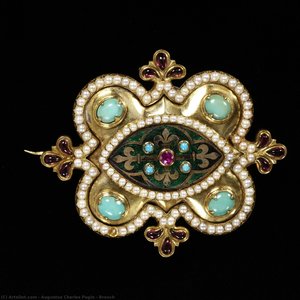
The image before us presents more than just a collection of gold, enamel, and gemstones; it's a window into the opulent aesthetic sensibilities of 19th-century Britain. Specifically, this exquisite necklace and pendant, crafted by Augustus Charles Pugin around 1843 for Louisa Burton – the second wife of the renowned architect A.W.N. Pugin – embodies the Victorian era’s fascination with Gothic Revival design, a movement that sought to recapture the perceived grandeur and spiritual depth of medieval architecture and art. The stark black background serves not as an absence of color, but rather as a dramatic stage highlighting the necklace's intricate details and vibrant hues, drawing the viewer into its meticulously constructed beauty.
Pugin’s design is deeply rooted in the principles of Gothic Revival, a style he essentially pioneered. The repeating quatrefoil motifs – stylized lozenge shapes – are not merely decorative; they echo the architectural elements found in medieval churches and cathedrals, creating a sense of continuity with the past. Each link of the chain, meticulously crafted from gold, is punctuated by small pearls, adding subtle points of light and texture. The pendant cross, with its own quatrefoil ends, further reinforces this connection to religious symbolism, reflecting Pugin’s devout Catholicism and his belief in the transformative power of art. The use of enamel—a technique involving fusing powdered glass into molten metal—allowed for a dazzling array of colors – deep reds from garnets, blues and greens subtly interwoven throughout the design – creating a richness and depth rarely achieved with purely metallic materials.
Materials, Technique, and Craftsmanship
The construction of this necklace is a testament to Victorian craftsmanship. Each quatrefoil was likely stamped out in two parts, then snapped together—a process that ensured precision and uniformity across the entire chain. The garnets, carefully set within the enamel, catch and reflect light with an almost jewel-like intensity, while the pearls contribute a delicate shimmer. The choice of materials – gold, precious stones, and enamel – speaks to the wealth and status associated with such a lavish piece, intended as a treasured possession for a prominent Victorian lady. The meticulous attention to detail, from the smooth surfaces of the gold to the precisely placed gemstones, demonstrates the skill and dedication of the artisans involved.
Symbolism and Context
Beyond its aesthetic beauty, this necklace is laden with symbolic meaning. The cross itself represents Christian faith and devotion, a central theme in Pugin’s life and work. The quatrefoils, frequently associated with the Virgin Mary, further emphasize this religious connection. Considering that Pugin was designing for Louisa Burton, who later became his third wife after a tumultuous marriage to Helen Lumsdaine, the necklace can be interpreted as a symbol of both personal affection and a deliberate attempt to create a harmonious domestic setting reflecting his artistic vision. The fact that it was intended for display at the Great Exhibition of 1851—an event celebrating British industry and innovation—underscores its significance as a showcase of Victorian artistry and design.
A Legacy of Gothic Revival
This necklace and cross is more than just a beautiful object; it’s a tangible representation of a pivotal moment in architectural history. Pugin's work profoundly influenced the design of numerous buildings, including the iconic Palace of Westminster (Houses of Parliament), where his distinctive Gothic style continues to inspire awe today. Reproductions of this piece offer a unique opportunity to bring a touch of Victorian elegance and spiritual depth into any setting, reminding us of the enduring power of art to evoke emotion, tell stories, and connect us to the past. It stands as a testament to Pugin’s genius—a master craftsman who not only designed buildings but also shaped an entire aesthetic movement.
Artist Biography
The Architect of Shadows: The Life and Legacy of Augustus Charles Pugin
In the grand tapestry of nineteenth-century design, few threads are as intricate or as influential as those woven by Augustus Charles Pugin. A figure whose work bridged the gap between meticulous scientific observation and the romanticized grandeur of the past, Pugin emerged as a pivotal force in the Gothic Revival movement. Though his name may not always command the immediate recognition of the great masters of oil painting, his impact on the very fabric of British architecture and decorative arts remains profound. Born into an era of rapid industrial transformation, he dedicated his life to capturing the soul of the Gothic style, ensuring that the elegance of medieval craftsmanship was not lost to the encroaching shadows of modernity.
Pugin’s journey was one defined by a deep, scholarly devotion to the structural and ornamental nuances of history. As a French-born British artist, draughtsman, and writer, he possessed a unique dual perspective—the precision of a continental trained eye paired with an intense passion for the English architectural heritage. His early mastery of the draughtsman’s craft allowed him to document the complexities of stone, wood, and glass with an accuracy that was both artistic and educational. Through his detailed illustrations, he did more than merely record buildings; he breathed life into their forgotten details, inviting a new generation to rediscover the spiritual and aesthetic power of the Gothic form.
A Visionary of the Gothic Revival
The true significance of Pugin’s contribution lies in his ability to translate historical motifs into a functional language for contemporary design. He was not merely a nostalgic observer but a visionary who understood that for an architectural style to survive, it must be documented, studied, and then re-applied to the living world. His seminal work, Specimens of Gothic Architecture, serves as a testament to this dedication. In these pages, his pen traced the delicate tracery of windows, the strength of pointed arches, and the intricate patterns of medieval ornamentation, providing a blueprint for the architects who would follow in his footsteps.
His influence extended far beyond the printed page, permeating the realms of:
- Architectural Illustration: Creating highly detailed records that served as essential references for the reconstruction and preservation of historic structures.
- Decorative Arts: Designing patterns and motifs that could be integrated into everything from furniture to metalwork, ensuring a cohesive Gothic aesthetic across various media.
- Design Theory: Promoting the idea that beauty in design is inextricably linked to structural honesty and historical continuity.
Through his tireless work as a designer and writer, Pugin helped shape the visual identity of an era. His ability to blend the technical rigor of a draughtsman with the poetic sensibility of an artist allowed him to influence not just the way buildings looked, but the way people perceived the relationship between history, art, and the built environment. He remains a cornerstone figure for anyone seeking to understand the resurgence of medievalism in the nineteenth century, leaving behind a legacy of intricate beauty that continues to inspire awe and reverence.

augustus charles pugin
1812 - 1852 , France
Quick Facts
- Artistic Movement Or Style: Literary nonsense; Illustration
- Artists Or Movements Influenced By This Artist:
- Lewis Carroll
- Victorian Illustration
- Artists Who Influenced This Artist:
- William Blake
- John Tenniel
- Date Of Birth: May 12, 1812
- Date Of Death: January 29, 1888
- Full Name: Edward Lear
- Nationality: English
- Notable Artworks:
- The Fortress of San George
- Limner's Book of Nonsense
- Place Of Birth: England
Related Articles
Gothic Art Guide for Hotel Designers: Leveraging Dramatic Shadows and Architectural Grandeur in Luxury Interiors
Elevate hospitality interiors with our expert guide to Gothic art. Discover how to leverage dramatic shadows, architectural grandeur, and high-end reproductions to create sophisticated, atmospheric hotel spaces that captivate guests.
Late Gothic Art: The Divine Transition from Medieval Symbolism to Renaissance Naturalism
Explore the profound transition of Late Gothic art from medieval symbolism to Renaissance naturalism. Discover the elegance of International Gothic, the legacy of Master Theodoric, and the evolution of European courtly masterpieces through an expert art-historical lens.

Gothic Vibes: From Dark Shadows to Bold Modern Edge | The Ultimate Trend Forecast
Explore the evolution of Gothic vibes, from historical shadows to bold modern edge. Discover how dark aesthetics, noir interiors, and contemporary subcultures are redefining modern design through a high-impact, trend-focused lens.
Shadows & Splendor: A Journey Through the Soul of Gothic Art and Architectural Grandeur
Embark on a profound journey through the spiritual intensity of Gothic art. Explore the architectural marvels, luminous stained glass, and sacred sculptures that define this era of grandeur and human devotion.

The Radiant Dusk of Medieval Vision: Exploring Late Gothic Art's Synthesis of Faith, Form & Emotionality (c. 1300-1500)
Explore the exquisite beauty & spiritual depth of Late Gothic art (c. 1300-1500). Discover key artists, symbolism, and its lasting influence on the Renaissance. Expert insights at OriginalUniqueArt.