- Home

- Oil Painting Reproduction
- Arshile Gorky
- The Liver is the Cock's Comb

 Buy print
 Send
Send Share
Share
 Details

 Download
 Similars
 X-Ray
X-Ray Diaporama
The Liver is the Cock's Comb
 Oil On Canvas
- WallArt
- Abstract Expressionism
 1944
1944- Modern
 186.0 x 249.0 cm
 Buffalo AKG Art Museum
 Read More
Hand Made Oil Reproduction
Hand-painted oil on canvas in your size and frame, made to order by our artists.




P118B $10

P118H $10

P118W $10

P438Z $10

P508JH $12

P508YH $12

P805H $10

P805Z $10

P919BZ $10

P919G $10

P919XJ $10

P959ZH $10

P968JZ $12

W106C $8

W218G $10

W218JH $8

W218Y $10

W307PJ $10

W316G $10

W316PJ $8

W316Y $10

W398PJ $8

W4111J $10

W500HY $15

W500JH $15

W692G $12

W849H $8

W940BG $15

W953PJ $8




Pick from our preset sizes that match the artwork's original proportions.

You may enter your own dimensions to fit a specific frame or space. If your selected size does not match the original image's proportions, we will either crop the artwork or extend the painting with additional hand-painted elements. A digital mockup will be sent for your approval before production begins.
Please note that the on-screen preview does not reflect the actual cropping or extension. Only the mockup will accurately show the final composition.
While custom sizes are available, we recommend selecting a dimension from the predefined list to preserve the original proportions.
After order, OriginalUniqueArt.com team will email client for instructions and provide a mockup preview
Worldwide Delivery () in 3/4 weeks instead of standard 5 weeks. (16 July). No compromise on quality.

Free Worldwide Express Shipping

High-Quality Linen Canvas

Full Shipping Insurance

Customs Tax Refund Guarantee

True Color Matching Guarantee

60-Day Return Policy (Defects Only)

100% Money-Back Guarantee

Bulk Discount Offer
 Glass option is only available in size under 110 CM

The Liver is the Cock's Comb
Reproduction Medium
Reproduction Size
-


Total Price
-
Artwork Description
A Landmark of Abstract Expressionism
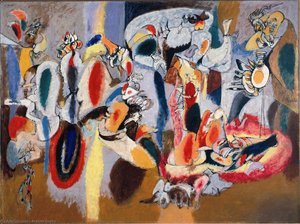
Painted in 1944, this monumental work by Arshile Gorky stands as a pivotal achievement within the burgeoning Abstract Expressionist movement. Moving beyond recognizable forms, Gorky crafts a vibrant and chaotic scene brimming with energy, hinting at figures engaged in a festive, yet unsettling, gathering. It’s not a depiction *of* something, but rather an evocation of feeling – a visual representation of collective experience filtered through personal trauma and artistic innovation.Deconstructing Form & Embracing Emotion
Gorky masterfully dismantles traditional representational techniques, opting instead for fragmented shapes, overlapping planes, and ambiguous spaces. Figures dissolve into swirling lines and dynamic poses, barely suggested rather than fully formed. This deliberate distortion isn’t arbitrary; it reflects the artist's exploration of subconscious imagery and his attempt to convey inner emotional states. The influence of both Cubism – in its fracturing of form – and Surrealism – in its embrace of the irrational – is readily apparent, yet Gorky transcends these influences to forge a uniquely personal style.A Palette of Passion & Psychological Depth
The canvas explodes with a bold and expressive color palette dominated by warm reds, oranges, and yellows, punctuated by cooler blues, purples, and whites. These colors aren’t blended smoothly but applied in broad, flat areas, creating visual tension and enhancing the painting's energetic quality. The strategic use of complementary colors further intensifies this vibrancy. While seemingly chaotic, a careful balance is maintained, preventing the composition from feeling overwhelming.Historical Context & Personal Narrative
Created during World War II, this artwork reflects the anxieties and uncertainties of the era. However, its roots run deeper, inextricably linked to Gorky’s personal history as a survivor of the Armenian genocide. The fragmentation and sense of displacement within the painting can be interpreted as symbolic representations of loss, trauma, and the search for identity. He reinvented his own narrative, adopting a new name and background, mirroring the deconstruction of form seen in his art.Symbolism & Emotional Resonance
The ambiguous subject matter – possibly a banquet or dance – invites multiple interpretations. Are we witnessing celebration, chaos, or both? The distorted figures might symbolize the breakdown of traditional societal structures or the alienation inherent in modern life. Despite its abstract nature, the painting evokes powerful emotions: joy, excitement, anxiety, and a subtle undercurrent of melancholy. It’s a work that demands engagement, prompting viewers to confront their own interpretations and emotional responses.A Statement Piece for Discerning Collectors
This artwork is more than just a visually striking composition; it's a testament to the power of artistic expression in the face of adversity. A reproduction of this piece will serve as a captivating focal point in any interior, adding depth, sophistication, and intellectual intrigue. Its bold colors and dynamic energy make it particularly well-suited for modern or contemporary spaces, while its historical significance appeals to collectors with an appreciation for art history’s pivotal moments.Artist Biography
early life and influences
arshile gorky, born vostanik manoug adoian, was a turkish-born armenian-american painter who left an indelible mark on the art world. born on april 15, 1904, in khorgom, van, ottoman empire (now turkey), gorky's life was marked by turmoil and displacement, which would later influence his artistic style.the formative years
gorky's family fled to russian-controlled territory during the armenian genocide in 1915. this pivotal event shaped his worldview and informed his future artistic expressions. in 1920, at the age of 16, gorky reunited with his father in america but struggled to form a close bond.artistic evolution
- landscape in the manner of cézanne (1927) and landscape, staten island (1927–1928) exemplify gorky's early experimentation with cubism and post-impressionism.
- his later works, such as nighttime, enigma, nostalgia (1930–1934), showcase a shift towards surrealism, characterized by complex, abstract forms.
notable works and collaborations
key artworks:- the artist and his mother (ca. 1926–1936), a poignant portrait inspired by a childhood photograph, showcases gorky's innovative style.
- portrait of master bill, initially believed to be a portrait of willem de kooning, is now recognized as a depiction of a swedish carpenter who worked for gorky.
- gorky's association with the works progress administration federal art project (1933) brought him alongside notable artists like alice neel, lee krasner, jackson pollock, and mark rothko.
- his work was also influenced by paul cézanne, as seen in his landscape series.
legacy and museum collections
gorky's impact on abstract expressionism is undeniable. his works can be found in various museums, including the national gallery of art, washington, d.c., and are a testament to his enduring influence.- explore gorky's artwork and other influential artists at OriginalUniqueArt.
- delve into the world of art history with OriginalUniqueArt's comprehensive timeline: wahoo art timeline.
conclusion
arshile gorky's life, marked by displacement and turmoil, translated into a body of work that would redefine the landscape of abstract expressionism. his legacy continues to inspire artists and art enthusiasts alike, a testament to the transformative power of art. view gorky's artworks on OriginalUniqueArt learn more about arshile gorky on wikipedia
Arshile Gorky
1904 - 1948 , Turkey
Quick Facts
- Artistic Movement Or Style: Abstract Expressionism
- Artists Or Movements Influenced By This Artist: ['Abstract Expressionism']
- Artists Who Influenced This Artist:
- Paul Cézanne
- Joan Miró
- Pablo Picasso
- Date Of Birth: April 15, 1904
- Date Of Death: July 21, 1948
- Full Name: Arshile Gorky
- Nationality: Armenian-American
- Notable Artworks:
- The Artist and His Mother
- Nighttime, Enigma, Nostalgia
- Portrait of Master Bill
- Waterfall
- Composition
- Place Of Birth: Khorgom, Turkey
Related Articles
Acrylic Canvas Masters: 10 Paintings That Redefined Modern Art |
Explore 10 legendary 'Acrylic On Canvas' masterpieces by artists like Rothko, Warhol & Frankenthaler. Discover the stories behind these iconic paintings and their impact on modern art. Find museum-quality reproductions at – elevate your home with timeless beauty.

R.B. Kitaj: Narrative Fragmentation & the Postmodern Condition in Figurative Painting
Explore the complex world of R.B. Kitaj's figurative paintings. Discover his postmodern techniques, Jewish identity themes, and lasting influence on contemporary art. A guide for discerning collectors.

Abstract Expressionism's 10 Defining Masterpieces |
Explore 10 defining Abstract Expressionism masterpieces by Pollock, Rothko & de Kooning. Discover the stories behind these iconic paintings and find museum-quality art reproductions to elevate your home decor on .
Beatrice Parsons: A Study in Abstract Expressionism & the Poetics of Color Field Painting
Explore the captivating world of Beatrice Parsons, a pioneering British abstract expressionist. Discover her journey from garden watercolors to evocative color field paintings and learn about her place within art history.

Georges Braque's Masterpieces: 25 Paintings That Defined Cubism & Modern Art | OriginalUniqueArt
Explore 25 iconic Georges Braque paintings that revolutionized Cubism & modern art. Discover the stories behind his masterpieces, from Fauvism to Analytical Cubism. Find museum-quality reproductions & elevate your home decor with OriginalUniqueArt.com.