Preview
 Send
Send Share
Share
 Details
 Guide
Guide

 Download
 Similars
 X-Ray
X-Ray Diaporama
 Stats
StatsMoscow
 Cubo-Futurism
 1913
1913 189.0 x 179.0 cm
 Read More
Hand Made Oil Reproduction
Hand-painted oil on canvas in your size and frame, made to order by our artists. ( Switch to Print Switch to Digital Image)




































Pick from our preset sizes that match the artwork's original proportions.

You may enter your own dimensions to fit a specific frame or space. If your selected size does not match the original image's proportions, we will either crop the artwork or extend the painting with additional hand-painted elements. A digital mockup will be sent for your approval before production begins.
Please note that the on-screen preview does not reflect the actual cropping or extension. Only the mockup will accurately show the final composition.
While custom sizes are available, we recommend selecting a dimension from the predefined list to preserve the original proportions.
After order, OriginalUniqueArt.com team will email client for instructions and provide a mockup preview
Worldwide Delivery () in 3/4 weeks instead of standard 5 weeks. (25 September). No compromise on quality.

Free Worldwide Express Shipping

High-Quality Linen Canvas

Full Shipping Insurance

Customs Tax Refund Guarantee

True Color Matching Guarantee

100-Day Return Policy (Defects Only)

100% Money-Back Guarantee

Bulk Discount Offer
 Glass option is only available in size under 110 CM

Moscow
Reproduction Medium
Reproduction Size
-


Total Price
$ 300
Background and Inspiration
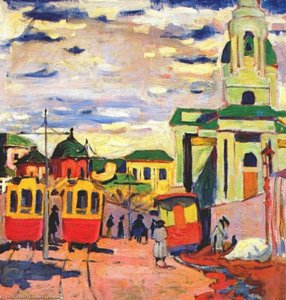
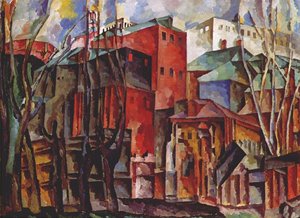
Aristarkh Vasilevich Lentulov was a Russian avant-garde artist who played a significant role in the development of Cubo-Futurism. He was influenced by the works of French artists such as Henri Le Fauconnier and Jean Metzinger, and his own style reflects a fusion of Cubist and Futurist elements. The painting Moscow is characterized by its bold, geometric shapes and a palette of bright, clashing colors.Composition and Style
The composition of Moscow is marked by a sense of movement and energy, with fragmented forms and overlapping planes creating a dynamic, three-dimensional effect. The artist's use of color is equally striking, with bold brushstrokes and vibrant hues that seem to pulse with life. This style is reminiscent of other Cubo-Futurist works, such as those by Wassily Kandinsky and Kazimir Malevich, who were also experimenting with new forms and techniques during this period.- View more artworks by Aristarkh Vasilevich Lentulov on OriginalUniqueArt.com
- Learn more about Cubo-Futurism and its key artists, including Wassily Kandinsky and Kazimir Malevich, on WikiArt.org
- Discover the Moscow painting in detail, including its size, medium, and style, on OriginalUniqueArt.com
The Moscow painting is a testament to the innovative spirit of Cubo-Futurism, and its enduring appeal lies in its bold, dynamic, and deeply expressive qualities. As a masterpiece of early 20th-century art, it remains an essential work for anyone interested in the development of modern art.
Artist Biography
Aristarkh Lentulov: A Pioneer of Russian Modernism
Aristarkh Vasilyevich Lentulov, born in 1882 in a small village near Penza, Russia, was not merely a painter; he was a vital architect of the Russian avant-garde. His life’s work represents a fascinating confluence of influences – from traditional folk art and religious iconography to the radical experimentation of Cubism and Futurism – resulting in a uniquely vibrant and emotionally charged style that continues to captivate viewers today. Lentulov's journey, marked by both artistic breakthroughs and periods of political alignment, offers a compelling glimpse into the turbulent era of early 20th-century Russia.
Early influences shaped Lentulov’s formative years. Initially drawn to realism, he honed his skills at various art schools in Penza, Kiev, and St. Petersburg, absorbing techniques from masters like Ilya Repin and Dmitry Kardovsky. However, it was his encounter with the Parisian avant-garde in 1911 that proved transformative. Immersed in the circles of Cubists such as Robert Delaunay, he embraced fragmentation, geometric abstraction, and a bold use of color – elements that would become cornerstones of his distinctive style. This period wasn’t simply an imitation of Western trends; Lentulov skillfully integrated these influences with his own deeply rooted Russian sensibility.
The Jack of Diamonds and the Rise of Cubo-Futurism
Lentulov's artistic trajectory gained momentum through his involvement in the “Jack of Diamonds” group, a notoriously rebellious collective that emerged in Moscow during 1910. This association was far more than just a social circle; it represented a deliberate challenge to established artistic norms and a fervent embrace of innovation. The Jack of Diamonds, known for their provocative exhibitions and outspoken critiques, sought to shock the public and force a re-evaluation of art’s role in society. Lentulov's participation solidified his position within this dynamic movement, pushing him towards increasingly experimental forms.
His work during this period – exemplified by paintings like “Moscow” (1916) and “Church. New Jerusalem” (1917) – is characterized by a remarkable dynamism. Planes are fractured and reassembled, colors clash and harmonize in unexpected ways, and the familiar world is rendered with an almost hallucinatory intensity. Lentulov’s use of color wasn't merely decorative; it conveyed emotion, energy, and a sense of underlying chaos. He drew inspiration from Russian folklore, incorporating elements of traditional patterns and imagery into his abstract compositions, creating a visual language that was both modern and deeply rooted in the nation’s cultural heritage.
From Cubo-Futurism to Social Realism
Following the 1917 Revolution, Lentulov navigated the shifting political landscape of Soviet Russia. While initially aligned with the avant-garde, he gradually adapted his style to align with the prevailing artistic directives. He continued to work as a stage designer for prominent theaters, contributing significantly to the visual identity of numerous productions. This period saw a shift towards more tonal and representational works, often depicting landscapes and portraits imbued with a sense of warmth and vitality.
Despite these changes, Lentulov never abandoned his core artistic principles. His paintings from the 1920s and 30s – such as “Dawn at Volga” (1928) and “Sun over the Roofs. Sunrise” (1928) – retain a remarkable energy and emotional depth. He continued to experiment with color and composition, exploring themes of everyday life and the beauty of the Russian countryside. His later work, particularly his stage designs for productions like "Spanish Priest" (1934), demonstrated his enduring creativity and versatility.
Legacy and Significance
Aristarkh Lentulov’s legacy extends far beyond his individual works. He was a pivotal figure in the development of Russian modernism, bridging the gap between European avant-garde movements and the unique cultural traditions of Russia. His innovative use of color, fragmented forms, and symbolic imagery profoundly influenced generations of artists. Lentulov's art serves as a testament to the power of artistic experimentation and the enduring spirit of creativity in the face of political and social upheaval. He remains an important voice in Russian art history, celebrated for his bold vision and unwavering commitment to pushing the boundaries of artistic expression.

aristarkh vasilevich lentulov
1882 - 1943
Quick Facts
- Artistic Movement Or Style:
- Cubism
- Cubo-Futurism
- Orphism
- Fauvism
- Artists Or Movements Influenced By This Artist:
- Wassily Kandinsky
- Kazimir Malevich
- Artists Who Influenced This Artist:
- Robert Delaunay
- Henri Le Fauconnier
- J. Metzenge
- Dmitry Kardovsky
- Date Of Birth: January 16, 1882
- Date Of Death: April 15, 1943
- Full Name: Aristarkh Vasilyevich Lentulov
- Nationality: Russian
- Notable Artworks:
- Moscow
- Portrait of N. Svendonskaya
- Street, Moscow
- Churches, New Jerusalem
- Place Of Birth: Penza Oblast, Russia