Send
Send Share
Share
 Details

 Download
 Similars
 Diaporama
 Stats
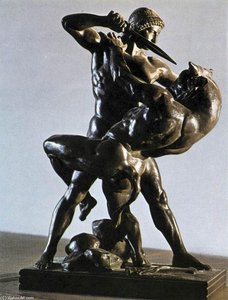
StatsPanther Seizing a Stag


 Read More
Giclée / Art Print
Museum-quality giclée or canvas print with fast production and flexible finish options. ( Buy Hand Made Painting Switch to Digital Image)




































Pick from our preset sizes that match the artwork's original proportions.

You may enter your own dimensions to fit a specific frame or space. If your selected size does not match the original image's proportions, we will either crop the artwork or extend the image with a mirrored or solid-fill edge. A digital mockup will be sent for your approval before production begins.
Please note that the on-screen preview does not reflect the actual cropping or extension. Only the mockup will accurately show the final composition.
While custom sizes are available, we recommend selecting a dimension from the predefined list to preserve the original proportions.
Worldwide Delivery () in 2 weeks instead of standard 4/5 weeks. (17 September)

Free Worldwide Express Shipping

High-Quality Linen Canvas

Full Shipping Insurance

Customs Tax Refund Guarantee

True Color Matching Guarantee

100-Day Return Policy (Defects Only)

100% Money-Back Guarantee

Bulk Discount Offer
 Glass option is only available in size under 110 CM

Panther Seizing a Stag
Giclée / Art Print
Reproduction Size
-


Total Price
$ 81
A Primal Symphony in Bronze
In the quiet halls of art history, few movements capture the raw, unbridled pulse of nature as effectively as the animalier genre, and few works embody its ferocious heart quite like Antoine-Louis Barye’s Panther Seizing a Stag. Created around 1833, this bronze masterpiece is far more than a mere depiction of predation; it is a theatrical explosion of Romanticism captured in metal. As the viewer approaches, they are immediately thrust into a moment of breathless tension, where the boundary between life and death dissolves into a swirling composition of muscular exertion and instinctual violence. The sculpture does not merely sit upon its base; it vibrates with a kinetic energy that seems to defy the stillness of the bronze, pulling the observer into the very center of a desperate struggle for survival.
Barye, a master who transitioned from the meticulous precision of a goldsmith to the sweeping drama of fine sculpture, utilizes every ounce of his technical prowess to render this scene. The composition is a masterclass in dynamic movement, employing sharp diagonal lines that guide the eye through the interlocking forms of the panther and its prey. One can almost feel the weight of the predator pressing down upon the stag, the tension in the sinews, and the frantic struggle of the elk as it attempts to break free. The texture of the bronze is worked with such incredible detail that the roughness of fur, the hardness of bone, and the sleekness of powerful limbs are all palpably present, offering a tactile richness that makes the sculpture feel alive.
The Intersection of Anatomy and Emotion
What elevates this work from a scientific study to a high art form is Barye’s ability to infuse anatomical accuracy with profound emotional depth. While his training allowed him to capture the precise musculature and skeletal structure of the animals—likely informed by his studies at the Jardin des Plantes—his true genius lies in the Romantic spirit he breathes into the bronze. This is not a sanitized or idealized version of nature; it is a celebration of the sublime, where beauty is found in the terrifying and the untamed. The panther’s ferocity and the stag's vulnerability serve as powerful symbols of the eternal cycle of life, death, and the relentless drive of the natural world.
For the discerning collector or interior designer, a high-quality reproduction of this piece offers an unparalleled opportunity to introduce a sense of drama and historical weight into a space. The deep, chocolatey tones of the bronze and the intricate play of light across its textured surfaces provide a sophisticated focal point that complements both classical and contemporary settings. Whether placed in a sunlit library or a moody, modern study, Panther Seizing a Stag acts as an anchor of storytelling, inviting conversation and evoking a sense of wonder at the primal forces that continue to fascinate the human imagination centuries after its creation.
Artist Biography
A Pioneer of Animal Sculpture: The Life and Legacy of Antoine-Louis Barye
Antoine-Louis Barye, born in Paris on September 24, 1795, emerged as a pivotal figure in the world of 19th-century sculpture. He wasn’t merely depicting animals; he was imbuing them with a dramatic intensity and anatomical accuracy previously unseen, effectively launching the *animalier* genre – a dedicated focus on animal forms – into the realm of fine art. Barye's journey began not in the studio of a sculptor, but as an apprentice goldsmith following in his father’s footsteps. This early training instilled within him a meticulous attention to detail and a mastery of technique that would prove invaluable throughout his career. He honed these skills further under sculptors like François-Joseph Bosio and Baron Antoine-Jean Gros, absorbing classical principles while simultaneously developing a uniquely Romantic sensibility. His formal education at the École des Beaux-Arts provided a solid foundation, but it was an encounter with the living world – specifically, the animals housed within the Jardin des Plantes in Paris around 1823 – that truly ignited his artistic vision.From Goldsmith to Animalier: The Development of a Unique Style
Barye’s dedication to observing animals was obsessive. He didn't simply glance; he studied, sketched, and meticulously analyzed their anatomy, movements, and behaviors. This commitment to realism wasn’t cold or clinical, however. It was infused with the emotional fervor characteristic of the Romantic movement. Early works like “Milo of Crotana Devoured by a Lion” (1819) and “Hercules with the Erymanthean Boar” (c. 1820), created while still a student, hinted at his emerging talent for dynamic composition and dramatic narrative. But it was with sculptures such as "Tiger Devouring a Gavial Crocodile" (1831) – a monumental plaster that caused a sensation at the Salon – and “Lion Crushing a Serpent” (1832), cast in bronze, that Barye truly established his signature style. These weren’t static representations; they were moments of raw power frozen in time, capturing the brutal beauty of nature's struggle for survival. He moved beyond mere imitation to convey the very essence of animal life – their strength, agility, and untamed spirit. His work resonated with a growing public fascination with the exotic and the wild, reflecting a Romantic yearning for experiences beyond the confines of civilized society.Major Works and Monumental Commissions
Throughout his career, Barye produced an astonishing array of sculptures, each demonstrating his unparalleled skill in capturing animal form and movement. Beyond the iconic “Tiger Devouring a Gavial Crocodile” and “Lion Crushing a Serpent,” masterpieces like "Theseus and the Minotaur" (1843), “Roger and Angelica on the Hippogriff” (1846), “Lapitha and Centaur” (1848) and “Jaguar Devouring a Hare” (1850) showcased his versatility and imaginative power. He wasn’t limited to depictions of predatory encounters; he also explored mythological scenes, imbuing them with the same dynamic energy and anatomical precision that defined his animal studies. His talent extended beyond smaller-scale bronzes as well. Barye received prestigious commissions for monumental works, including the “Lion of the Column of July,” a powerful symbol of French resilience, and sculptures adorning the Tuileries Garden in Paris. These large-scale projects demonstrated his ability to translate his artistic vision into public art, solidifying his reputation as one of France’s leading sculptors.Influences, Struggles, and Lasting Significance
Barye's work was a synthesis of diverse influences. The Romantic emphasis on emotion and individualism is palpable in the dramatic tension of his sculptures. Simultaneously, he drew inspiration from classical art, evident in his attention to anatomical accuracy and idealized forms. However, what truly set him apart was his scientific approach to observation – a direct result of his countless hours spent studying animals at the Jardin des Plantes. Despite achieving critical acclaim, Barye’s life wasn't without hardship. He struggled with financial difficulties throughout much of his career, largely due to poor business acumen. A bankruptcy in 1848 forced him to sell his models and molds, leading to a period where inferior copies flooded the market, damaging his reputation. He found some stability as Professor of Drawings at the Museum of Natural History in 1854, but it was only posthumously that his genius received its full due. Today, Antoine-Louis Barye is recognized as the father of modern animal sculpture. His influence on subsequent generations of artists is undeniable, and his works are celebrated for their power, realism, and enduring beauty. He elevated the *animalier* genre from a niche pursuit to a respected form of artistic expression, leaving an indelible mark on the history of sculpture. His legacy continues to inspire awe and admiration in collectors and museums worldwide.
Antoine-Louis Barye
1796 - 1875 , France
Quick Facts
- Artistic Movement Or Style: Romanticism
- Artists Or Movements Influenced By This Artist: ['Animal sculptors']
- Artists Who Influenced This Artist:
- Francois-Joseph Bosio
- Baron Antoine-Jean Gros
- Date Of Birth: September 24, 1795
- Date Of Death: June 25, 1875
- Full Name: Antoine-Louis Barye
- Nationality: French
- Notable Artworks:
- Tiger Devouring a Gavial
- Lion Crushing a Serpent
- Theseus and the Minotaur
- Roger & Angelica
- Lapitha and Centaur
- Jaguar Devouring Hare
- Place Of Birth: Paris, France
Related Articles

The Enduring Legacy of Bronze: A Historical & Artistic Exploration for the Collector
Explore the rich history & enduring appeal of bronze sculpture with expert insights for collectors at OriginalUniqueArt. Learn about casting techniques, iconic artists, collecting tips & contemporary interpretations.

Bronze Age to Modern Masters: 10 Sculptures That Redefined Art | OriginalUniqueArt
Journey through art history with 10 legendary bronze sculptures – from Michelangelo's David to Rodin’s Thinker. Explore the stories, techniques & timeless beauty of these masterpieces. Find museum-quality reproductions & elevate your home decor on OriginalUniqueArt.com.
The Enduring Legacy of Bronze Sculpture: A Collector's Guide to Form & Cultural Significance
Explore the rich history & enduring appeal of bronze sculpture with expert insights for collectors at OriginalUniqueArt. Learn about casting techniques, iconic artists, and collecting tips to build a discerning art collection.
The Enduring Legacy of Bronze: History, Technique & Artistic Expression for the Collector
Explore the rich history & enduring appeal of bronze sculpture with expert insights for collectors at OriginalUniqueArt. Learn about casting techniques, iconic artists, and collecting tips.

Bronze Sculptures That Defined Art History | OriginalUniqueArt
Journey through art history with our Top 10 bronze sculptures! Explore masterpieces by Rodin, Michelangelo & more. Discover stories behind iconic statues and find museum-quality reproductions for your home decor at OriginalUniqueArt.com.