Preview
 Send
Send Share
Share
 Details
 Guide
Guide

 Download
 Similars
 X-Ray
X-Ray Diaporama
 Stats
StatsMorgenthau Plan
 2012
2012 330.0 x 570.0 cm
 Read More
The artwork displayed on this page is protected by copyright law, which means we cannot legally create or sell an identical reproduction. This protection is enforced under international agreements such as the Berne Convention and by national laws, including those outlined by the U.S. Copyright Law - Title 17.
This method fully complies with copyright regulations because it does not involve copying or duplicating the protected artwork. Instead, it is a creative reinterpretation - a new painting that is influenced by the original but not identical to it.
Giclée / Art Print
Museum-quality giclée or canvas print with fast production and flexible finish options. ( Buy Hand Made Painting Switch to Digital Image)




































Pick from our preset sizes that match the artwork's original proportions.

You may enter your own dimensions to fit a specific frame or space. If your selected size does not match the original image's proportions, we will either crop the artwork or extend the image with a mirrored or solid-fill edge. A digital mockup will be sent for your approval before production begins.
Please note that the on-screen preview does not reflect the actual cropping or extension. Only the mockup will accurately show the final composition.
While custom sizes are available, we recommend selecting a dimension from the predefined list to preserve the original proportions.
Worldwide Delivery () in 2 weeks instead of standard 4/5 weeks. (11 October)

Free Worldwide Express Shipping

High-Quality Linen Canvas

Full Shipping Insurance

Customs Tax Refund Guarantee

True Color Matching Guarantee

100-Day Return Policy (Defects Only)

100% Money-Back Guarantee

Bulk Discount Offer
 Glass option is only available in size under 110 CM

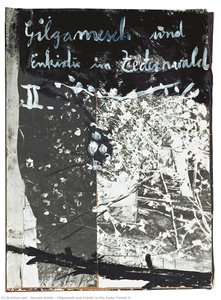
Morgenthau Plan
Giclée / Art Print
Reproduction Size
-


Total Price
$ 81
Questions & Answers
Who created "Morgenthau Plan"?
The artist behind "Morgenthau Plan" is Anselm Kiefer. The work is catalogued under Anselm Kiefer's name.
At what age did Anselm Kiefer make "Morgenthau Plan"?
Anselm Kiefer was 67 years old when creating "Morgenthau Plan" in 2012. The age is computed from the artist's birth year, 1945.
What color saturation does "Morgenthau Plan" by Anselm Kiefer have?
The palette of "Morgenthau Plan" is muted in saturation.
When was "Morgenthau Plan" made?
"Morgenthau Plan" by Anselm Kiefer was created in 2012.
Do the colors of "Morgenthau Plan" appear strong or soft?
The color intensity of "Morgenthau Plan" is monochromatic. Intensity describes how strong the colors appear.
Can the image of "Morgenthau Plan" by Anselm Kiefer be freely reproduced?
"Morgenthau Plan" by Anselm Kiefer is still protected by copyright. This status governs how the image of the work may be reproduced.
Can I use augmented reality to see "Morgenthau Plan" by Anselm Kiefer in my room?
"Morgenthau Plan" has an augmented reality preview: the artwork's AR Preview page shows it in your own space on a compatible device.
Artist Biography
The Weight of Memory: The Art of Anselm Kiefer
Anselm Kiefer stands as one of the most profound and distinctive voices within Neo-Expressionism, an artistic movement that emerged in the late 1970s and early 1980s as a powerful reaction against the austerity of Minimalism and Conceptual Art. Born in Donaueschingen, Germany, in 1945, Kiefer’s very existence is inextricably linked to the aftermath of World War II. His oeuvre transcends mere representation; it is an immersive, visceral exploration of German history—particularly its profound trauma—expressed through monumental canvases and sculptures that demand a physical confrontation from the viewer. His artistic journey began with rigorous studies under Peter Dreher and Horst Antes at the Hochschule für Gestaltung Weinheim-Basel, where he established a foundation for his famously experimental approach to artmaking.
The soul of Kiefer’s work is deeply rooted in the literary shadows of the past, most notably through the haunting poetry of Paul Celan. The fragmented language and preoccupation with loss found in Celan's verse profoundly impacted Kiefer’s thematic concerns, specifically regarding the Holocaust and its lingering, often silent, effects on German collective memory. Through his art, Kiefer seeks to give form to this silence, exploring themes of absence, destruction, and the heavy burden of historical legacy. His work does not merely depict history; it attempts to excavate it from the layers of time and debris.
Materiality and the Alchemy of Destruction
What truly distinguishes Kiefer from his contemporaries is his deliberate and masterful use of materials that carry immense symbolic weight. He treats the canvas not as a flat surface, but as a site of geological and historical transformation. By incorporating unconventional elements such as ash, straw, clay, lead, and shellac, he creates works that feel less like paintings and much more like artifacts recovered from a scorched earth. Each material serves a narrative purpose:
- Ash: Derived from burned forests, ash acts as a poignant reminder of ecological devastation and the literal and metaphorical destruction wrought by war.
- Straw: This element introduces a sense of fragility, representing the vulnerability of human life against the overwhelming forces of nature and history.
- Lead: A heavy, somber medium that provides a sense of permanence and the crushing weight of the past.
Kiefer’s technique is characterized by an intense, thick impasto layering. He applies paint in multiple, dense coats to create textured surfaces that resemble scorched earth or ancient geological formations. This tactile approach is not merely decorative; it actively engages the viewer, forcing them to confront the sheer physicality of his process. The scale of his canvases often mirrors the monumental scale of the historical events he addresses, creating an environment where the viewer is swallowed by the texture and gravity of the work.
Legacy and Historical Significance
As his career progressed, Kiefer’s international recognition grew through works that challenged the boundaries between painting, sculpture, and installation. His ability to weave together myth, alchemy, and historical catastrophe has secured his place as a titan of contemporary art. Whether he is depicting the brooding shadows of Roman emperors or the desolate landscapes of post-war Europe, his work remains a continuous dialogue with the concept of time itself. Through his mastery of texture and symbolism, Anselm Kiefer has created a visual language capable of articulating the most difficult aspects of human history, ensuring that the scars of the past are never truly erased, but rather transformed into profound works of enduring significance.

Anselm Kiefer
1945 - , Germany
Quick Facts
- Full Name: Anselm Kiefer
- Nationality: German
- Date Of Birth: 1945
- Place Of Birth: Donaueschingen, Germany
- Notable Artworks:
- Nero paints
- Böhmen liegt am Meer
- Gilgamesh and Enkidu in the Cedar Forest II
- Artistic Movement Or Style: Neo-Expressionism
- Artists Who Influenced This Artist:
- Paul Celan
- Peter Dreher
- Horst Antes
- Artists Or Movements Influenced By This Artist: ['Kabbalah']