Read More


 For artworks or reproductions larger than 105 cm (approximately 41 inches) on any side, the frame will be shipped as a kit, disassembled. This method ensures safe delivery and prevents damage during transport.


More about this painting
Text size

() ·
A print made for you, with care
Giclée / Art Print
Museum-quality giclée or canvas print with fast production and flexible finish options. ( Buy Hand Made Painting Switch to Digital Image)
Artist Biography
Explore the Baroque art of Andrea Camassei (1602-1649), an Italian painter known for dramatic religious scenes & mythological narratives like 'The Massacre of the Niobids.' Discover his legacy!
from ·
Chapter 1
On which medium should it be printed?
Canvas is printed with giclée inks and can be stretched or framed like a painting; paper comes flat, or framed behind glass.
Chapter 2
How large should it be?
Slide to change the size; the picture on the left shows the frame at its real width. The proportions of the original are kept.
Standard
custom
CM
INCH
Pick from our preset sizes that match the artwork's original proportions.
Loading sizes...

width
height
Type the width and the height you need, to fit your frame or your wall. A print can only be cut, never made bigger than the picture, so a size with a different shape loses a part of the image. We send you a digital mockup to approve before we print anything. The picture shown on this page does not show the real cut — only the mockup does.
Chapter 3
How should it arrive?
Choose the edges of the stretched canvas
Choose your frame

White $1

Blurside $1

Extended $1

P118B $10

P118H $10

P118W $10

P438Z $10

P508JH $12

P508YH $12

P805H $10

P805Z $10

P919BZ $10

P919G $10

P919XJ $10

P959ZH $10

P968JZ $12

W106C $8

W218G $10

W218JH $8

W218Y $10

W307PJ $10

W316G $10

W316PJ $8

W316Y $10

W398PJ $8

W4111J $10

W500HY $15

W500JH $15

W692G $12

W849H $8

W940BG $15

W953PJ $8

H24-GOLD $30

H24-SILVER $30

H36-GOLD $45

H36-SILVER $45
Framed
Moulding: . Overall size with the frame: .
Chapter 4
Worldwide Delivery () in 2 weeks instead of standard 4/5 weeks. (21 November)
The finishing touches
A nameplate, as in a museum?
Engraved Bronze Plaque Details
This elegant plaque features the artist's name and the title of the artwork, finely engraved for a timeless presentation.
It is made from bronze with a refined, elegant finish. The text is precisely laser-engraved for a sharp and permanent result. Measuring 9x2 cm, the plaque is compact yet easy to read. It's built to be durable and scratch-resistant, offering a professional, museum-quality look. Mounting is simple thanks to the included adhesive backing.
Transparent Acrylic Plaque Details
The plaque includes essential engraved details such as the artist's name, the title of the artwork, the date it was created, the type of media used-like oil on canvas or watercolor-a brief description of the piece, and a QR code that links to the complete artwork information.
It is crafted from clear acrylic, offering a sleek, modern appearance. The text is UV-engraved in black to ensure strong visual contrast. With a size of 10x15 cm, it ensures optimal readability. It comes equipped with two metal hooks for secure wall mounting. The plaque is designed to be weather-resistant, making it suitable for various environments, and it includes interactive features that work seamlessly with smartphone scanning.
Black Acrylic Plaque Details
This elegant plaque includes engraved information such as the artist's name, the title of the artwork, the date it was created, the type of media used (like oil on canvas or watercolor), a short description of the artwork, and a QR code for quick access to more information.
The plaque itself is made from refined black acrylic with a premium finish. The text is laser-engraved in white for high contrast and readability. Its size is 10x15 cm, designed to be easy to read. It comes with two metal hooks for professional mounting. The design is sleek and fits any interior style. It is also weather-resistant and durable, with built-in digital integration for mobile compatibility.
A protective varnish?
When do you need it?
Chapter 5
Your print, as you ordered it
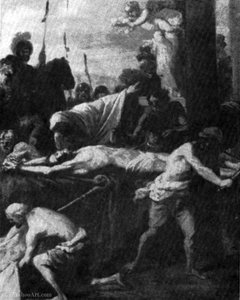
Lupercalia feasts
Reproduction Medium
Reproduction Size
-
Reproduction Frame
-
-
For artworks or reproductions larger than 105 cm (approximately 41 inches) on any side, the frame will be shipped as a kit, disassembled. This method ensures safe delivery and prevents damage during transport.
Professional assembly required - this is not a DIY product.
The kit must be assembled and the canvas stretched by an experienced professional framer, using wood glue (not supplied), a canvas stretching plier and clamps to hold the bars square while the glue dries. Incorrect assembly or uneven canvas tension can permanently damage the artwork and is not covered by our warranty.
All solid wood bars are included, precisely cut to size.
Assembled with the screws provided, plus wood glue for the corner joints, which is not supplied and must be sourced by your framer.
Professional tools are required and not included: a canvas stretching plier (tensioner) and clamps to hold the bars square while the glue dries.
Important:
The corner joints require wood glue, the bars must be held with clamps until the glue is fully dry, and tightening the canvas on the assembled frame requires a canvas stretching plier. None of these are included in the kit. Please arrange an experienced professional framer before ordering this size.
Nameplate
-
-
Protective Varnish
Glossy Varnish (enhances colors, protects against light/moisture)
-
Urgent
Worldwide Delivery () in 2 weeks instead of standard 4/5 weeks. (21 November)
-
Express Shipping
Worldwide Delivery () in 4/5 weeks. (28 November).
Included
Total Price
$ 81
Glass option is only available in size under 110 CM
Included with every order
- Free Worldwide Express Shipping
- High-Quality Linen Canvas
- Full Shipping Insurance
- Customs Tax Refund Guarantee
- True Color Matching Guarantee
- 100-Day Return Policy (Defects Only)
- 100% Money-Back Guarantee
- Bulk Discount Offer
 Preview

 Send
 Share
 Details
 Guide


 Download
 Similars
 X-Ray
 Diaporama
 Q&A
 Stats
In numbers
- 29frames to choose from
- standard sizes, in its own proportions
- 5weeks to paint and deliver it
About the original


Andrea Camassei
1602 - 1649, Italy
Quick facts about Andrea Camassei
- Full Name: Andrea Camassei
- Nationality: Italian
- Date Of Birth: 1602
- Date Of Death: 1649
- Place Of Birth: Bevagna, Italy
- Notable Artworks:
- Massacre of the Niobids
- Hunt of Diana
- Artistic Movement Or Style: Baroque Painting
- Artists Who Influenced This Artist: ['Domenichino']
- Artists Or Movements Influenced By This Artist: ['Raphael']
Artist Biography
Andrea Camassei: A Baroque Master of Light and Shadow
Born in the Umbrian town of Bevagna in 1602, Andrea Camassei’s life was a testament to both artistic talent and a tragically curtailed career. His early years were steeped in the traditions of Italian painting, yet he possessed an individual vision that quickly distinguished him within the vibrant, competitive environment of Rome during the mid-17th century. While often overshadowed by his more celebrated contemporaries – Domenichino, Guido Reni, and Pietro da Cortona – Camassei’s work reveals a profound understanding of light, color, and dramatic composition, securing him a place as a significant, if somewhat elusive, figure in Baroque art.
Camassei's formal training remains somewhat shrouded in mystery. He apprenticed under Domenichino, a master known for his meticulous realism and ability to capture the nuances of human expression. This early influence is evident in Camassei’s initial works, characterized by a careful attention to detail and a restrained palette. However, he quickly developed a distinctive style, marked by an increased use of chiaroscuro – the dramatic contrast between light and dark – that would become his signature. His first documented commission came in 1627, decorating the chapel of St Philip Neri in Bevagna with scenes from the life of the saint, providing him with invaluable experience and establishing a foundation for his future endeavors.
The Barberini Patronage and Early Rome
By 1628, Camassei had relocated to Rome, entering the orbit of the powerful Barberini family. This patronage proved crucial to his early career, providing him with commissions for elaborate decorations within the Palazzo Barberini – a complex undertaking that involved collaborating with established artists like Guido Reni, Andrea Sacchi, and Pietro da Cortona. These projects demanded not only technical skill but also an understanding of architectural design and the integration of painting into broader spatial arrangements. The frescoes he contributed to Santa Maria della Concezione, depicting scenes from the life of St Peter, showcased his burgeoning talent for creating dynamic compositions filled with movement and emotion.
A pivotal moment in Camassei’s career came in 1631 when he was entrusted with decorating a ceiling in the Palazzo Barberini. This commission – “Apollo and the Muses on Mt Parnassus” – demonstrated his ability to handle large-scale projects, but also highlighted a potential limitation: his reluctance to embrace overly complex or decorative schemes. He famously declined a subsequent, even more ambitious assignment – the decoration of the Gran Salone – recognizing that it exceeded his capabilities. This decision, while perhaps strategically prudent, ultimately contributed to a period of relative obscurity.
Dramatic Narratives and Religious Iconography
Camassei’s most enduring legacy lies in his dramatic depictions of religious narratives and mythological scenes. His paintings are characterized by an intense emotionality, conveyed through expressive gestures, dynamic poses, and a masterful manipulation of light and shadow. The “Massacre of the Niobids” (circa 1645-48), arguably his most famous work, exemplifies this approach. The painting’s chaotic composition, featuring a brutal slaughter of innocent women by zealous priests, is rendered with visceral intensity, capturing both the horror of the event and the underlying moral ambiguity. Other notable works include “St. Erasmus Martyrdom” and “Alexander and Hephaestion,” each demonstrating his ability to infuse historical or mythological subjects with profound psychological depth.
His style was influenced by Poussin’s use of light, color, and composition, as well as the more restrained realism of Domenichino. However, Camassei possessed a unique sensibility, evident in his preference for pastel colors and his ability to create a sense of atmospheric depth. His works are not merely illustrations of biblical or mythological tales; they are carefully constructed narratives designed to evoke contemplation and elicit an emotional response from the viewer.
A Tragic End and Lasting Influence
Andrea Camassei’s career was tragically cut short in 1649, at the age of forty-six. The political turmoil surrounding the deposition of Pope Urban VIII and the exile of his successors severely impacted the patronage system that supported many artists. Despite his talent and potential, Camassei struggled to secure consistent commissions during this period. He spent his final years working for the Palazzo Pamphilj in Rome, producing decorative frescoes depicting scenes from the story of Bacchus and Ariadne.
Although largely forgotten for centuries, Andrea Camassei’s work has experienced a resurgence of interest in recent decades. His paintings are now recognized as significant examples of Baroque art, admired for their dramatic intensity, masterful use of light and shadow, and profound psychological insights. His legacy endures through his captivating depictions of religious narratives and mythological scenes – works that continue to resonate with viewers today.
Related Articles
Paolo Veronese: A Renaissance Master of Color, Composition, and Venetian Splendor
Explore the vibrant world of Paolo Veronese, a Renaissance master renowned for his opulent compositions, masterful use of color, and dramatic Venetian scenes. Discover key artworks & legacy.

Master of Antiquity: The 25 Greatest Artworks by Andrea Mantegna
Explore 25 iconic Andrea Mantegna masterpieces of the Renaissance. Discover museum-quality art on OriginalUniqueArt.com.

The Fête Galante & Beyond: Exploring the Artistic World of Jean-Antoine Watteau
Discover the captivating world of Jean-Antoine Watteau, master of the Fête Galante! Explore his iconic paintings, symbolism, and lasting influence on Rococo art. A deep dive for classic art enthusiasts.

Masterpieces of Grandeur: The Top 25 Artworks by Paolo Veronese
Step into the opulence of the Venetian Renaissance with our curated guide to the top 25 Paolo Veronese masterpieces. From grand feasts to luminous colors, explore the stories behind these timeless icons and find museum-quality reproductions. Discover all masterpieces on OriginalUniqueArt.com.
Explore artworks organized by themes, styles, and characteristics.