 Preview
 Send
Send Share
Share
 Details
 Guide
Guide

 Download
 Similars
 X-Ray
X-Ray Diaporama
 Q&A
Q&A Stats
StatsMontserrat

- 47.0 x 63.0 cm


 Read More
The artwork displayed on this page is protected by copyright law, which means we cannot legally create or sell an identical reproduction. This protection is enforced under international agreements such as the Berne Convention and by national laws, including those outlined by the U.S. Copyright Law - Title 17.
This method fully complies with copyright regulations because it does not involve copying or duplicating the protected artwork. Instead, it is a creative reinterpretation - a new painting that is influenced by the original but not identical to it.
Giclée / Art Print
Museum-quality giclée or canvas print with fast production and flexible finish options. ( Buy Hand Made Painting Switch to Digital Image)




P118B $10

P118H $10

P118W $10

P438Z $10

P508JH $12

P508YH $12

P805H $10

P805Z $10

P919BZ $10

P919G $10

P919XJ $10

P959ZH $10

P968JZ $12

W106C $8

W218G $10

W218JH $8

W218Y $10

W307PJ $10

W316G $10

W316PJ $8

W316Y $10

W398PJ $8

W4111J $10

W500HY $15

W500JH $15

W692G $12

W849H $8

W940BG $15

W953PJ $8




Pick from our preset sizes that match the artwork's original proportions.

Type the width and the height you need, to fit your frame or your wall. A print can only be cut, never made bigger than the picture, so a size with a different shape loses a part of the image. We send you a digital mockup to approve before we print anything. The picture shown on this page does not show the real cut — only the mockup does.
Worldwide Delivery () in 2 weeks instead of standard 4/5 weeks. (15 November)

Free Worldwide Express Shipping

High-Quality Linen Canvas

Full Shipping Insurance

Customs Tax Refund Guarantee

True Color Matching Guarantee

100-Day Return Policy (Defects Only)

100% Money-Back Guarantee

Bulk Discount Offer
 Glass option is only available in size under 110 CM

Montserrat
Giclée / Art Print
Reproduction Size
-


Total Price
$ 81
André Masson’s “Montserrat”: A Journey Into the Subconscious
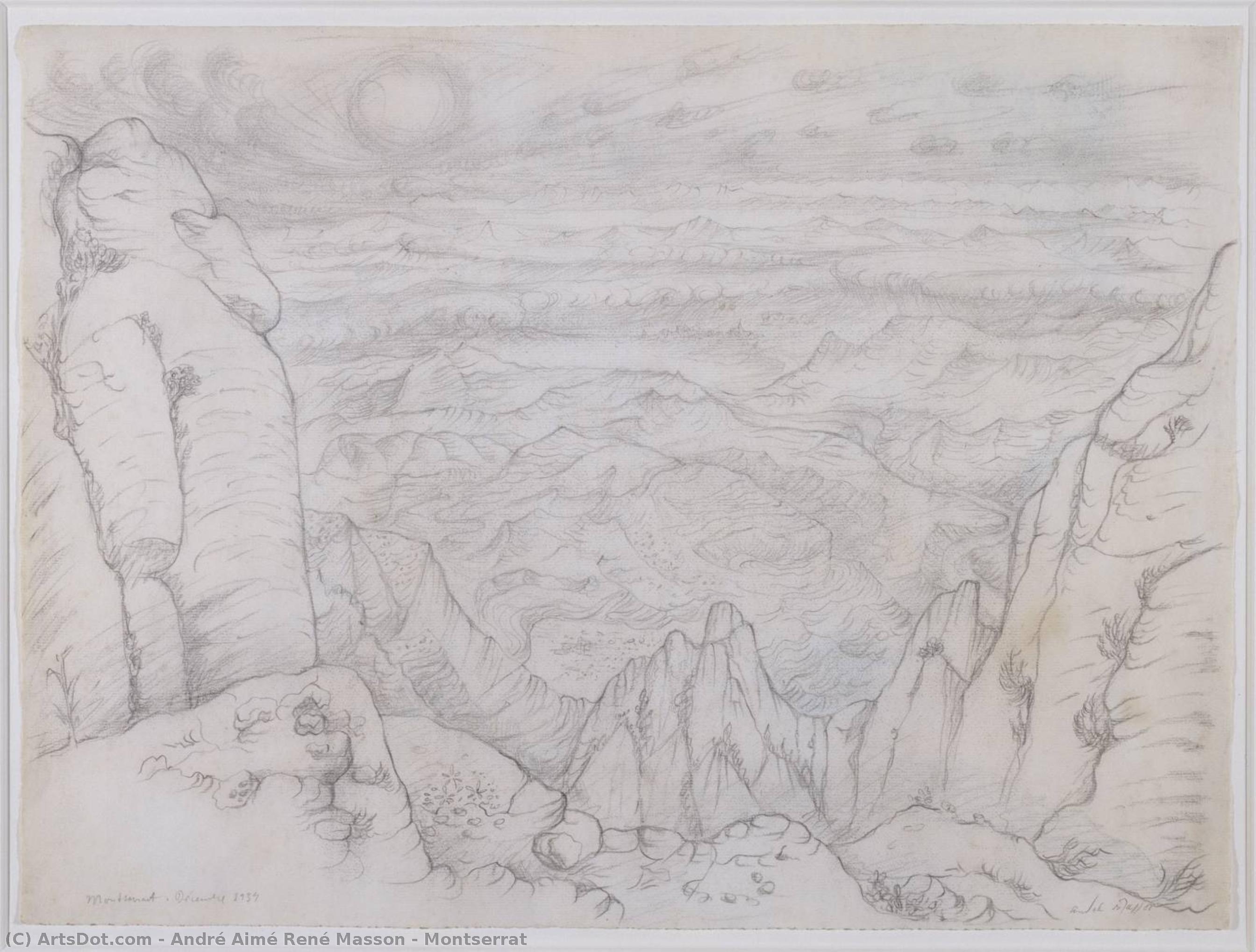
André Masson's "Montserrat," painted in 1934, isn’t merely a landscape; it’s an invitation into the heart of the Surrealist mind. This graphite and chalk drawing on paper captures a rugged, almost violently sculpted mountain range under a dramatic, circular sun – a scene that feels both familiar and profoundly unsettling. Masson, a key figure in the Surrealist movement, employed his signature technique of automatic drawing to create an image brimming with raw emotion and symbolic depth, reflecting a fascination with the subconscious and primal forces.
The genesis of “Montserrat” lies within Masson’s exploration of automatism – a method he embraced wholeheartedly, believing it bypassed conscious control and allowed the unconscious to dictate the artistic process. He often began by throwing sand and glue onto a canvas, then meticulously building upon the resulting shapes, allowing them to organically inform the composition. This technique is vividly apparent in “Montserrat,” where jagged peaks emerge from seemingly random lines, suggesting a landscape born not of observation but of internal feeling. The drawing’s loose, expressive lines eschew traditional perspective, instead prioritizing the immediate impact and emotional resonance of the scene.
Deconstructing the Landscape: Form, Color, and Technique
The color palette is deliberately restrained – primarily shades of grey, white, and beige against a creamy background. This monochromatic approach amplifies the drawing’s textural qualities, emphasizing the rough surfaces of the mountains and the dynamic interplay between light and shadow. Masson masterfully utilizes hatching and cross-hatching to build up volume and create a sense of depth, mimicking the appearance of rock formations and atmospheric conditions. The composition itself is asymmetrical, with peaks arranged in a way that feels both precarious and powerful – mirroring perhaps the inherent instability of the subconscious mind.
Notice the deliberate lack of detail; Masson isn’t striving for photographic realism. Instead, he focuses on capturing the *essence* of the mountain range, reducing it to its most fundamental forms. The lines are not precise but rather suggestive, creating a dreamlike quality that aligns perfectly with the Surrealist aesthetic. The circular sun, dominating the upper center, acts as a potent symbol – representing enlightenment, clarity, or perhaps even the overwhelming force of the unconscious itself.
Symbolism and Emotional Resonance
“Montserrat” is rich in symbolic potential. The jagged peaks can be interpreted as challenges, obstacles, or even the fragmented nature of memory. The vastness of the landscape evokes feelings of solitude and isolation, while the dramatic lighting creates a sense of drama and tension. Considering Masson’s interest in primal expression, one might also read the drawing as an attempt to tap into something deeper – a connection with the earth, with instinct, or even with the darker aspects of human experience.
The painting's emotional impact is undeniably powerful. It doesn’t simply depict a mountain range; it invites us to contemplate our own internal landscapes, to confront the uncertainties and anxieties that lie beneath the surface of consciousness. “Montserrat” stands as a testament to Masson’s ability to translate complex psychological states into a visually arresting and deeply evocative work of art – a timeless exploration of the human spirit.
André Masson: Context and Legacy
Born in Balagny-sur-Thérain, France, in 1896, André Masson’s artistic journey was shaped by early exposure to Cubism and a later embrace of Surrealism. He collaborated extensively with other prominent figures of the movement, including Antonin Artaud and Joan Miró, fostering a vibrant artistic community centered around automatic drawing. His work has been exhibited widely throughout Europe and America, influencing generations of artists. Masson’s legacy extends beyond his own paintings; he played a crucial role in shaping the direction of Surrealist art, leaving an indelible mark on 20th-century visual culture.
Questions & Answers
Can the image of "Montserrat" by André Masson be freely reproduced?
Regarding copyright, "Montserrat" is still protected by copyright.
Can I order an oil reproduction of "Montserrat"?
"Montserrat" is available as a hand-painted oil reproduction on linen canvas. The order can be placed on its Hand-Painted Reproduction page, with a choice of sizes.
How strong are the colors of "Montserrat"?
"Montserrat" by André Masson is recorded with a muted saturation and a monochromatic intensity.
Artist Biography
André Masson: A Life in Art
- Born: Balagny-sur-Thérain, France (January 4, 1896)
- Died: 1987
Early Life and Artistic Training
- Masson began his artistic journey at the age of eleven, studying at the Académie Royale des Beaux-Arts in Brussels under Constant Montald. This early training provided a foundation for his later experimentation with various styles.
- His initial work showed an interest in Cubism, demonstrating an early engagement with modern art movements.
The Surrealist Period and Automatic Drawing
- Masson became a key figure within the Surrealist movement, enthusiastically embracing automatic drawing as a technique. This involved creating artwork without conscious control, allowing the subconscious to guide the hand.
- He collaborated with other prominent figures of the era like Antonin Artaud, Michel Leiris, Joan Miró, Georges Bataille, Jean Dubuffet, and Georges Malkine, fostering a vibrant artistic community.
- Notable Techniques:
- Automatic Drawings: Numerous pen-and-ink works showcasing his innovative approach to art.
- Sand and Glue on Canvas: Experimentation with throwing sand and glue onto canvas, creating unique oil paintings based on the resulting shapes.
- His work during this period often explored violent or erotic themes, reflecting a departure from traditional artistic conventions.
Evolution and Later Works
- By the late 1920s, Masson moved away from Surrealism, developing a more structured style influenced by artists like André Derain. This is evident in his landscape paintings.
- During World War II, his work was condemned as "degenerate" by the Nazis. He escaped to the United States with assistance from Varian Fry, significantly impacting American Abstract Expressionists like Jackson Pollock.
- After returning to France, Masson settled in Aix-en-Provence and focused on landscape painting, demonstrating a shift towards more naturalistic subjects.
Legacy and Influence
- André Masson's pioneering work in Surrealism and automatic drawing left an enduring legacy on the art world.
- His influence can be seen across various artistic movements, from Cubism to Abstract Expressionism, solidifying his position as a pivotal figure in modern art history.
- Masson’s exploration of subconscious imagery and innovative techniques continue to inspire artists today.

André Masson
1896 - 1987 , France
Quick Facts
- Full Name: André Aimé René Masson
- Nationality: French
- Date Of Birth: 1896
- Date Of Death: 1987
- Place Of Birth: Balagny-sur-Thérain, France
- Notable Artworks:
- Beyond
- Landscape with Rocks
- The metamorphosis of the lovers
- Pygmalion
- Artistic Movement Or Style:
- Surrealism
- Cubism
- Artists Who Influenced This Artist: ['André Derain']
- Artists Or Movements Influenced By This Artist:
- Jackson Pollock
- Abstract Expressionism
Related Articles
André Masson: Automatism, Surrealism & Primal Expression in 20th-Century Art
Explore the revolutionary art of André Masson – pioneer of automatism & Surrealist expression. Discover his powerful imagery, innovative techniques, and lasting influence on modern art. Learn more at OriginalUniqueArt.
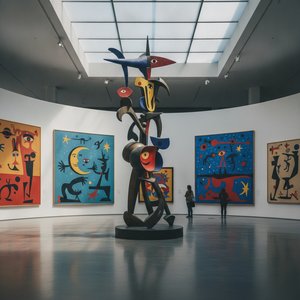
25 Masterpieces by Joan Miró: A Journey Through Surrealist Magic
Step into the surreal world of Joan Miró. Explore 25 iconic masterpieces, from biomorphic shapes to vibrant colors. Discover the stories behind these timeless Surrealist works and find museum-quality art reproductions for your space. Explore the full collection on OriginalUniqueArt.com.

Impressionistic Landscapes: 10 Masterpieces That Changed Art & Decor
Journey into the heart of Impressionism! Explore 10 masterpieces by Monet, Renoir & Degas that revolutionized landscape art. Discover their stories, techniques & find museum-quality reproductions to elevate your home decor on OriginalUniqueArt.com.

The Eternal Horizon: A Curated Journey Through the World's Most Iconic Landscape Masterpieces
Embark on a visual journey through history's most iconic landscapes. Discover the mastery of Impressionism and the sublime power of nature through our expert guide to classical landscape art, curated for the discerning collector and fine art enthusiast.

The Language of Light and Form: Emotional Resonance in Abstract Landscapes
Explore the emotional depth of abstract landscapes through Kandinsky and Gauguin. Discover the power of color and form today.