Preview
 Send
Send Share
Share
 Details
 Guide
Guide

 Download
 Similars
 X-Ray
X-Ray Diaporama
 Stats
StatsTwo Friends
 Oil On Canvas
- WallArt
- Cubist Vision
 1927
1927- Modern
 149.0 x 116.0 cm
 Musée des Beaux-Arts de Bordeaux
 Read More
The artwork displayed on this page is protected by copyright law, which means we cannot legally create or sell an identical reproduction. This protection is enforced under international agreements such as the Berne Convention and by national laws, including those outlined by the U.S. Copyright Law - Title 17.
This method fully complies with copyright regulations because it does not involve copying or duplicating the protected artwork. Instead, it is a creative reinterpretation - a new painting that is influenced by the original but not identical to it.
Giclée / Art Print
Museum-quality giclée or canvas print with fast production and flexible finish options. ( Buy Hand Made Painting Switch to Digital Image)




P118B $10

P118H $10

P118W $10

P438Z $10

P508JH $12

P508YH $12

P805H $10

P805Z $10

P919BZ $10

P919G $10

P919XJ $10

P959ZH $10

P968JZ $12

W106C $8

W218G $10

W218JH $8

W218Y $10

W307PJ $10

W316G $10

W316PJ $8

W316Y $10

W398PJ $8

W4111J $10

W500HY $15

W500JH $15

W692G $12

W849H $8

W940BG $15

W953PJ $8




Pick from our preset sizes that match the artwork's original proportions.

Type the width and the height you need, to fit your frame or your wall. A print can only be cut, never made bigger than the picture, so a size with a different shape loses a part of the image. We send you a digital mockup to approve before we print anything. The picture shown on this page does not show the real cut — only the mockup does.
Worldwide Delivery () in 2 weeks instead of standard 4/5 weeks. (28 October)

Free Worldwide Express Shipping

High-Quality Linen Canvas

Full Shipping Insurance

Customs Tax Refund Guarantee

True Color Matching Guarantee

100-Day Return Policy (Defects Only)

100% Money-Back Guarantee

Bulk Discount Offer
 Glass option is only available in size under 110 CM

Two Friends
Giclée / Art Print
Reproduction Size
-


Total Price
$ 81
A Symphony of Geometry and Grace
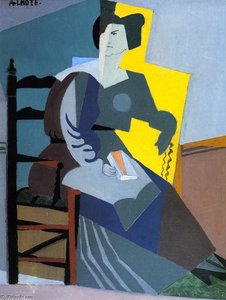
In the quiet intimacy of a shared moment, André Lhote’s 1927 masterpiece, “Two Friends,” invites the viewer into a world where the boundaries between human emotion and structural precision dissolve. This captivating oil on canvas is far more than a mere portrait; it is a profound exploration of connection, rendered through the sophisticated lens of Cubist innovation. As one gazes upon the two women, there is an immediate sense of warmth that defies the analytical nature of the movement. Lhote, a master of blending the radical with the relatable, manages to capture a tender dialogue between figures, making the painting feel less like a static museum piece and more like a living, breathing memory preserved in pigment.
The composition is a brilliant study in contrast and balance. One figure, draped in a striking, vibrant red dress, sits in conversation with her companion, who is elegantly attired in white. This bold color dichotomy serves as the painting's heartbeat, creating a visual rhythm that guides the eye across the fractured planes of the scene. Lhote utilizes the principles of Cubism—not to obscure reality, but to deepen it—by presenting multiple perspectives through overlapping geometric shapes. The influence of Cézanne is palpable here, seen in the way the artist dissects form into rhythmic facets, yet there remains a soft, Fauvist-inspired luminosity that prevents the work from feeling cold or purely academic.
Spatial Poetry and Symbolic Depth
The setting of “Two Friends” acts as a silent third character in this intimate drama. Lhote meticulously constructs a domestic interior where the furniture—a simple chair and a plush couch—is subtly warped to enhance the illusion of depth and movement. The diagonal line of the chair provides a sharp, architectural counterpoint to the horizontal repose of the couch, creating a dynamic tension that mirrors the subtle psychological interplay between the two women. Every element within this room, from the way light hits the fabric to the deliberate placement of objects, contributes to an atmosphere of sophisticated tranquility.
Beyond the immediate visual impact, the painting is rich with subtle details that reward the contemplative observer. A delicate necklace catches the light, adding a touch of refined elegance, while the presence of a book suggests a shared intellectual life or a moment of quiet reflection interrupted by companionship. These small, symbolic touches ground the avant-garde technique in a recognizable human reality. For the collector or interior designer, this piece offers a rare duality: it possesses the intellectual weight and historical significance of the Cubist era, yet its harmonious color palette and inviting subject matter make it an exquisite centerpiece for a modern, curated space.
To possess a reproduction of “Two Friends” is to bring a piece of art history’s most transformative era into one's own surroundings. It is an invitation to appreciate the beauty found in structure and the profound warmth found in friendship. Whether placed in a sunlit gallery or a contemporary living room, Lhote’s vision continues to resonate, offering a timeless testament to the enduring power of human connection through the lens of modern mastery.
Questions & Answers
Is "Two Friends" available as a fine art print?
"Two Friends" is available as a fine art print on cotton canvas or archival canvas paper. Orders are placed on its Fine Art Print page, in the size of your choice.
Where in the home does a reproduction of "Two Friends" fit well?
A reproduction of "Two Friends" fits well in a living room.
How do I discover artworks close to "Two Friends" by André Lhote?
Artworks similar to "Two Friends" by André Lhote are gathered on the artwork's Similars page.
Artist Biography
André Lhote: A Pioneer of Cubist Vision
André Lhote, born in Bordeaux in 1885 and passing away in Paris in 1962, stands as a pivotal figure in the evolution of French Cubism. More than simply a painter, he was a theorist, critic, and influential educator whose work profoundly shaped the course of modern art. His journey began not within the hallowed halls of an academy, but amidst the practical skills of a woodcarver’s workshop – a grounding that would later inform his unique approach to depicting reality through fragmented forms and intersecting planes. This early exposure to craftsmanship instilled in him a meticulousness and attention to detail that became hallmarks of his mature style. Lhote's artistic development unfolded during a period of immense change and experimentation within the art world. Initially influenced by the vibrant colors and expressive distortions of Paul Gauguin, he quickly moved towards the radical innovations of Cézanne, absorbing the artist’s emphasis on geometric structure and the reduction of natural forms to their essential elements. This shift culminated in his embrace of Cubism, a movement he joined with considerable enthusiasm in 1912, aligning himself with luminaries like Fernand Léger, Albert Gleizes, and Jean Metzinger within the Section d'Or group. This association proved crucial, exposing him to the core tenets of Cubist theory – the simultaneous representation of multiple viewpoints, the fragmentation of objects into geometric components, and the exploration of spatial relationships through overlapping planes. His early works, such as *Port of Bordeaux* (1911), demonstrate this initial foray into Cubism, showcasing a bold departure from traditional perspective and a nascent interest in dissecting forms to reveal their underlying structure.Early Life and Artistic Foundations
Lhote’s formative years were deeply rooted in the traditions of his native Bordeaux. His father apprenticed him to a furniture maker at the age of twelve, providing an invaluable education in wood carving and sculpture – skills that would later inform his meticulous approach to painting. This early training instilled within him a deep appreciation for craftsmanship and a keen eye for detail, qualities he carried with him throughout his career. He enrolled at the École des Beaux-Arts in Bordeaux in 1898, studying decorative sculpture until 1904, where he honed his technical skills and began to experiment with different artistic styles. Crucially, it was during this period that he developed a passion for painting, pursuing it largely independently of formal instruction. This self-directed learning, combined with the influence of Gauguin and Cézanne, laid the groundwork for his distinctive Cubist vision. Leaving Bordeaux in 1905, Lhote moved to Paris, determined to establish himself as an artist. He initially worked in a Fauvist style, characterized by bold colors and expressive brushstrokes, but quickly recognized the limitations of this approach. He sought a more rigorous and intellectually stimulating path, leading him towards the revolutionary ideas of Cubism. His first solo exhibition at Galerie Druet in 1910 marked a significant milestone, establishing his presence within the Parisian art scene and signaling his commitment to exploring new artistic possibilities.The Rise of Section d'Or and Theoretical Contributions
Lhote’s arrival in Paris coincided with the emergence of the Section d'Or group, a collective of avant-garde artists who championed Cubism and sought to challenge established artistic conventions. Joining this influential circle in 1912 provided Lhote with invaluable exposure and intellectual stimulation. The Salon de la Section d'Or, held at Galerie La Boëtie in 1912, showcased the group’s radical approach to representation, featuring works by figures such as Pablo Picasso, Georges Braque, and Juan Gris. Lhote’s *Port of Bordeaux* was a key piece within this exhibition, demonstrating his ability to translate complex spatial relationships into a dynamic and visually arresting composition. Beyond his artistic practice, Lhote made significant contributions to the theoretical discourse surrounding Cubism. He became a regular contributor to *La Nouvelle Revue Française*, a journal founded in 1909 that championed modern art and challenged traditional aesthetic values. Through his articles and essays, he articulated the core principles of Cubist theory – emphasizing the importance of analyzing objects from multiple viewpoints, reducing forms to their essential geometric components, and exploring spatial relationships through overlapping planes. His writings were instrumental in shaping the understanding and acceptance of Cubism within the art world.Teaching, Legacy, and Lasting Influence
Lhote’s influence extended far beyond his own artistic creations. He recognized the importance of educating future generations of artists and established his own school, the Académie André Lhote, in Montparnasse in 1922. This institution became a breeding ground for talent, attracting a diverse cohort of students – including Henri Cartier-Bresson, Conrad O’Brien-ffrench, Elena Mumm Thornton Wilson, and many other prominent figures who would go on to make significant contributions to the art world. His teaching philosophy emphasized rigorous observation, analytical thinking, and a deep understanding of artistic principles. Following World War I, Lhote continued to lecture extensively throughout Europe and beyond, sharing his insights and promoting the ideas of Cubism. He remained actively involved in the art scene until his death in Paris in 1962, leaving behind a rich legacy as a painter, theorist, critic, and educator. André Lhote’s work continues to be studied and admired for its innovative approach to representation, its intellectual rigor, and its enduring influence on the development of modern art. His commitment to both artistic creation and theoretical exploration cemented his place as a truly exceptional figure in the history of 20th-century art.
André Lhote
1885 - 1962 , France
Quick Facts
- Full Name: André Lhote
- Nationality: French
- Date Of Birth: 1885
- Date Of Death: 1962
- Place Of Birth: Bordeaux, France
- Notable Artworks:
- Port of Bordeaux
- Rugby
- Bacchante
- Artistic Movement Or Style: Cubism, Section d'Or
- Artists Who Influenced This Artist:
- Gauguin
- Cézanne
- Artists Or Movements Influenced By This Artist:
- Léonce Rosenberg
- Cubism
Related Articles

The Gilded Age Reimagined: Exploring the Aesthetic Principles & Enduring Legacy of Art Deco
Explore the captivating world of Art Deco! Discover its origins, defining features, cultural impact & enduring legacy. Expert insights for collectors and design enthusiasts. Shop handmade reproductions at OriginalUniqueArt.

Charles-André van Loo: A Study in Rococo Portraiture & the French Court's Artistic Dynamics
Explore the elegant world of Charles-André van Loo, a master of Rococo portraiture at the French court. Discover his life, techniques, and enduring influence on 18th-century art. Hand-painted reproductions available.

The Enduring Muse: Women as Subject & Symbol in Art History
Explore the rich history of women in art – from iconic muses to groundbreaking artists. Discover feminist movements, global perspectives & reclaim female narratives with OriginalUniqueArt.

Jean Dominique Antony Metzinger: Pioneering Cubism & the Evolution of Abstract Form
Explore the life & work of Jean Metzinger, a pivotal Cubist painter and theorist. Discover his innovations in proto-Cubism, 'Du Cubisme,' and Crystal Cubism – a journey through modern art's evolution.

Crimson Threads of Narrative: Exploring Symbolism & Representation in Artworks Featuring the Red Dress
Explore the rich symbolism of the red dress in art history! From ancient power displays to iconic portraits like Cézanne’s 'Madame Cezanne', discover the cultural and artistic significance behind this captivating color. Expert analysis & insights.