Preview
 Send
Send Share
Share
 Details
 Guide
Guide

 Download
 Similars
 X-Ray
X-Ray Diaporama
 Stats
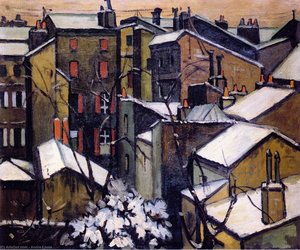
StatsTrees at Avignon
 Oil On Canvas
- WallArt
- Cubism
 1914
1914- Modern
 61.0 x 38.0 cm
 Musee Malraux
 Read More
The artwork displayed on this page is protected by copyright law, which means we cannot legally create or sell an identical reproduction. This protection is enforced under international agreements such as the Berne Convention and by national laws, including those outlined by the U.S. Copyright Law - Title 17.
As a respectful and legal alternative, we offer custom, hand-painted artworks inspired by the original. Our skilled and professional artists carefully study the original's style, mood, and artistic essence to create a new, unique piece that evokes the same feeling - while remaining an original creation in its own right.
This method fully complies with copyright regulations because it does not involve copying or duplicating the protected artwork. Instead, it is a creative reinterpretation - a new painting that is influenced by the original but not identical to it.
Hand Made Oil Reproduction
Hand-painted oil on canvas in your size and frame, made to order by our artists. ( Switch to Print Switch to Digital Image)




P118B $10

P118H $10

P118W $10

P438Z $10

P508JH $12

P508YH $12

P805H $10

P805Z $10

P919BZ $10

P919G $10

P919XJ $10

P959ZH $10

P968JZ $12

W106C $8

W218G $10

W218JH $8

W218Y $10

W307PJ $10

W316G $10

W316PJ $8

W316Y $10

W398PJ $8

W4111J $10

W500HY $15

W500JH $15

W692G $12

W849H $8

W940BG $15

W953PJ $8




Pick from our preset sizes that match the artwork's original proportions.

Type the width and the height you need, to fit your frame or your wall. This is hand-painted, so for a size with a different shape the artist can paint a bit more around the picture, or cut a bit — you choose. We send you a digital mockup to approve before the painting starts. The picture shown on this page does not show the real result — only the mockup does.
After order, OriginalUniqueArt.com team will email client for instructions and provide a mockup preview
Worldwide Delivery () in 3/4 weeks instead of standard 5 weeks. (27 October). No compromise on quality.

Free Worldwide Express Shipping

High-Quality Linen Canvas

Full Shipping Insurance

Customs Tax Refund Guarantee

True Color Matching Guarantee

100-Day Return Policy (Defects Only)

100% Money-Back Guarantee

Bulk Discount Offer
 Glass option is only available in size under 110 CM

Trees at Avignon
Reproduction Medium
Reproduction Size
-


Total Price
$ 300
A Woodland Reverie: Exploring André Lhote's "Trees at Avignon"
To gaze upon André Lhote’s Trees at Avignon is to step through a veil and into a sun-dappled moment suspended in time. This painting captures the profound, almost palpable atmosphere of a dense woodland, rendered with a warmth that seems to emanate from the canvas itself. The subject matter—a cluster of trees bathed in a yellowish, golden light—is deceptively simple. Yet, Lhote elevates this natural scene into something deeply resonant, inviting the viewer not merely to look, but to breathe in the quietude of the woods.
The composition is masterfully balanced; while the forest foliage dominates the foreground, suggesting an immersive depth, the subtle inclusion of a house nestled in the background provides crucial context. It anchors the wildness of nature with the gentle presence of human habitation, creating a dialogue between the untamed and the domestic.
The Echoes of Cubism in Nature
André Lhote’s artistic journey is inextricably linked to the revolutionary currents of early 20th-century art. A pioneer whose vision helped shape French Cubism, his technique here showcases a fascinating evolution from pure fragmentation toward something more lyrical. While his training and theoretical understanding were rooted in dissecting form into intersecting planes, in this piece, that intellectual rigor serves a softer purpose. The trees are not merely depicted; they are analyzed through light and structure. One can sense the influence of Cézanne’s structural approach—the reduction of organic forms to underlying geometric principles—but filtered through Lhote's unique lens, resulting in a vision that feels both modernly constructed and deeply natural.
The yellowish hue permeating the scene is key. It bathes every trunk and leaf in an almost nostalgic glow, suggesting either the magic hour of late afternoon or the warm memory of a perfect summer day. This careful handling of color prevents the dense grouping of trees from becoming claustrophobic; instead, it feels enveloping.
Symbolism and Emotional Resonance
The forest itself has always been a potent symbol in art—a place of mystery, transition, and introspection. In Trees at Avignon, the density of the woods speaks to moments of deep thought or quiet solitude. The juxtaposition with the distant house suggests that even within our most wild, internal landscapes, there remains a sense of belonging or return. For the collector or decorator, this painting offers an immediate emotional anchor; it is a visual balm for the hurried modern life.
To bring this piece into a room is to invite a pocket of pastoral calm. It suggests moments stolen from the rush—a pause before entering the threshold of home, or a quiet contemplation while standing at the edge of an ancient wood.
Crafting Your Sanctuary with Art
For those seeking to replicate this masterful ambiance in your own space, acquiring a high-quality reproduction allows you to bring Lhote’s sophisticated vision into your daily life. The texture and depth captured in these reproductions aim to mimic the richness of his original oil application, allowing the interplay between light and shadow—the very essence of the scene—to remain vibrant. Whether placed above a console table or serving as a focal point in a gallery setting, Trees at Avignon promises not just decoration, but an experience; a window into a luminous, enduring moment.
Questions & Answers
How do the colors of "Trees at Avignon" relate to each other?
"Trees at Avignon" by André Lhote displays a strong color unity color harmony.
Can I examine "Trees at Avignon" in more detail?
"Trees at Avignon" can be examined layer by layer on the artwork's X-Ray page, a viewer inspired by a conservator's light bench with eleven optical readings of the image.
Where does "Trees at Avignon" by André Lhote sit in art history?
The art-historical classification of "Trees at Avignon" by André Lhote is Cubism, in the Modern period.
Artist Biography
André Lhote: A Pioneer of Cubist Vision
André Lhote, born in Bordeaux in 1885 and passing away in Paris in 1962, stands as a pivotal figure in the evolution of French Cubism. More than simply a painter, he was a theorist, critic, and influential educator whose work profoundly shaped the course of modern art. His journey began not within the hallowed halls of an academy, but amidst the practical skills of a woodcarver’s workshop – a grounding that would later inform his unique approach to depicting reality through fragmented forms and intersecting planes. This early exposure to craftsmanship instilled in him a meticulousness and attention to detail that became hallmarks of his mature style. Lhote's artistic development unfolded during a period of immense change and experimentation within the art world. Initially influenced by the vibrant colors and expressive distortions of Paul Gauguin, he quickly moved towards the radical innovations of Cézanne, absorbing the artist’s emphasis on geometric structure and the reduction of natural forms to their essential elements. This shift culminated in his embrace of Cubism, a movement he joined with considerable enthusiasm in 1912, aligning himself with luminaries like Fernand Léger, Albert Gleizes, and Jean Metzinger within the Section d'Or group. This association proved crucial, exposing him to the core tenets of Cubist theory – the simultaneous representation of multiple viewpoints, the fragmentation of objects into geometric components, and the exploration of spatial relationships through overlapping planes. His early works, such as *Port of Bordeaux* (1911), demonstrate this initial foray into Cubism, showcasing a bold departure from traditional perspective and a nascent interest in dissecting forms to reveal their underlying structure.Early Life and Artistic Foundations
Lhote’s formative years were deeply rooted in the traditions of his native Bordeaux. His father apprenticed him to a furniture maker at the age of twelve, providing an invaluable education in wood carving and sculpture – skills that would later inform his meticulous approach to painting. This early training instilled within him a deep appreciation for craftsmanship and a keen eye for detail, qualities he carried with him throughout his career. He enrolled at the École des Beaux-Arts in Bordeaux in 1898, studying decorative sculpture until 1904, where he honed his technical skills and began to experiment with different artistic styles. Crucially, it was during this period that he developed a passion for painting, pursuing it largely independently of formal instruction. This self-directed learning, combined with the influence of Gauguin and Cézanne, laid the groundwork for his distinctive Cubist vision. Leaving Bordeaux in 1905, Lhote moved to Paris, determined to establish himself as an artist. He initially worked in a Fauvist style, characterized by bold colors and expressive brushstrokes, but quickly recognized the limitations of this approach. He sought a more rigorous and intellectually stimulating path, leading him towards the revolutionary ideas of Cubism. His first solo exhibition at Galerie Druet in 1910 marked a significant milestone, establishing his presence within the Parisian art scene and signaling his commitment to exploring new artistic possibilities.The Rise of Section d'Or and Theoretical Contributions
Lhote’s arrival in Paris coincided with the emergence of the Section d'Or group, a collective of avant-garde artists who championed Cubism and sought to challenge established artistic conventions. Joining this influential circle in 1912 provided Lhote with invaluable exposure and intellectual stimulation. The Salon de la Section d'Or, held at Galerie La Boëtie in 1912, showcased the group’s radical approach to representation, featuring works by figures such as Pablo Picasso, Georges Braque, and Juan Gris. Lhote’s *Port of Bordeaux* was a key piece within this exhibition, demonstrating his ability to translate complex spatial relationships into a dynamic and visually arresting composition. Beyond his artistic practice, Lhote made significant contributions to the theoretical discourse surrounding Cubism. He became a regular contributor to *La Nouvelle Revue Française*, a journal founded in 1909 that championed modern art and challenged traditional aesthetic values. Through his articles and essays, he articulated the core principles of Cubist theory – emphasizing the importance of analyzing objects from multiple viewpoints, reducing forms to their essential geometric components, and exploring spatial relationships through overlapping planes. His writings were instrumental in shaping the understanding and acceptance of Cubism within the art world.Teaching, Legacy, and Lasting Influence
Lhote’s influence extended far beyond his own artistic creations. He recognized the importance of educating future generations of artists and established his own school, the Académie André Lhote, in Montparnasse in 1922. This institution became a breeding ground for talent, attracting a diverse cohort of students – including Henri Cartier-Bresson, Conrad O’Brien-ffrench, Elena Mumm Thornton Wilson, and many other prominent figures who would go on to make significant contributions to the art world. His teaching philosophy emphasized rigorous observation, analytical thinking, and a deep understanding of artistic principles. Following World War I, Lhote continued to lecture extensively throughout Europe and beyond, sharing his insights and promoting the ideas of Cubism. He remained actively involved in the art scene until his death in Paris in 1962, leaving behind a rich legacy as a painter, theorist, critic, and educator. André Lhote’s work continues to be studied and admired for its innovative approach to representation, its intellectual rigor, and its enduring influence on the development of modern art. His commitment to both artistic creation and theoretical exploration cemented his place as a truly exceptional figure in the history of 20th-century art.
André Lhote
1885 - 1962 , France
Quick Facts
- Full Name: André Lhote
- Nationality: French
- Date Of Birth: 1885
- Date Of Death: 1962
- Place Of Birth: Bordeaux, France
- Notable Artworks:
- Port of Bordeaux
- Rugby
- Bacchante
- Artistic Movement Or Style: Cubism, Section d'Or
- Artists Who Influenced This Artist:
- Gauguin
- Cézanne
- Artists Or Movements Influenced By This Artist:
- Léonce Rosenberg
- Cubism
Related Articles

Romantic Landscapes: 10 Masterpieces for Your Home | OriginalUniqueArt
Journey through 10 Romantic landscape masterpieces by Friedrich, Turner & Cole. Explore emotional art, sublime nature scenes & iconic 19th-century paintings. Find museum-quality reproductions for your home at OriginalUniqueArt.com – discover the full collection online!

Impressionistic Landscapes: 10 Masterpieces That Changed Art & Decor
Journey into the heart of Impressionism! Explore 10 masterpieces by Monet, Renoir & Degas that revolutionized landscape art. Discover their stories, techniques & find museum-quality reproductions to elevate your home decor on OriginalUniqueArt.com.

Evocations of Place: A Historical Journey Through Landscape Art
Explore the rich history of landscape art with OriginalUniqueArt. Discover renowned artists, movements like Impressionism & Romanticism, and expert guidance for collecting timeless pieces. Find your perfect serene escape today!

Nature’s Sanctuary: Curating Enchanting Forest Artworks to Transform Your Home into a Serene Woodland Retreat
Transform your home into a serene woodland retreat with enchanting forest artworks. Discover museum-quality oil reproductions and custom landscape commissions designed to bring the peaceful beauty of nature indoors.

John Constable's Masterpieces: Explore 25 Iconic Landscapes for Your Home
Journey through John Constable's 25 most celebrated landscapes. Explore Romanticism, Dedham Vale & his masterful use of light in iconic paintings like 'Hay Wain'. Find museum-quality art reproductions and elevate your home decor on OriginalUniqueArt.com.