Preview
 Send
Send Share
Share
 Details
 Guide
Guide

 Download
 Similars
 X-Ray
X-Ray Diaporama
 Stats
StatsSalome litho
 Lithograph
- Art Nouveau
 1897
1897- 19th Century
 41.0 x 31.0 cm
 Read More
Giclée / Art Print
Museum-quality giclée or canvas print with fast production and flexible finish options. ( Buy Hand Made Painting Switch to Digital Image)




P118B $10

P118H $10

P118W $10

P438Z $10

P508JH $12

P508YH $12

P805H $10

P805Z $10

P919BZ $10

P919G $10

P919XJ $10

P959ZH $10

P968JZ $12

W106C $8

W218G $10

W218JH $8

W218Y $10

W307PJ $10

W316G $10

W316PJ $8

W316Y $10

W398PJ $8

W4111J $10

W500HY $15

W500JH $15

W692G $12

W849H $8

W940BG $15

W953PJ $8




Pick from our preset sizes that match the artwork's original proportions.

Type the width and the height you need, to fit your frame or your wall. A print can only be cut, never made bigger than the picture, so a size with a different shape loses a part of the image. We send you a digital mockup to approve before we print anything. The picture shown on this page does not show the real cut — only the mockup does.
Worldwide Delivery () in 2 weeks instead of standard 4/5 weeks. (22 October)

Free Worldwide Express Shipping

High-Quality Linen Canvas

Full Shipping Insurance

Customs Tax Refund Guarantee

True Color Matching Guarantee

100-Day Return Policy (Defects Only)

100% Money-Back Guarantee

Bulk Discount Offer
 Glass option is only available in size under 110 CM

Salome litho
Giclée / Art Print
Reproduction Size
-


Total Price
$ 81
The Enigmatic Allure of Art Nouveau
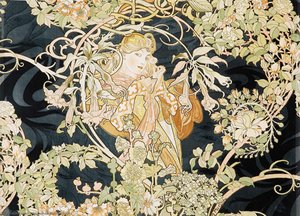
To gaze upon Alphonse Maria Mucha's Salome litho is to step directly into the opulent dreamscape of the late nineteenth century. This piece is not merely an illustration; it is a visual poem rendered in ink and pigment, encapsulating the very spirit of Art Nouveau. The style itself—with its sinuous, whiplash curves and organic embrace of form—was a deliberate rebellion against the rigid structures of academic art. Mucha masterfully channeled this movement's ethos, creating an aesthetic that celebrates nature’s fluidity and the exquisite curve of the human figure. Every flowing strand of hair, every drape of fabric, seems to move with an internal, rhythmic life, drawing the viewer into its mesmerizing current.
Composition and Mystique
At the heart of the composition stands the central figure, Salome, whose presence is both captivating and deeply enigmatic. She is depicted in a state of poised concentration, her upward gaze suggesting communion with something unseen or divine. Her flowing gown seems less like woven material and more like liquid silk caught mid-swirl. The inclusion of the large wheel or spinning top adds an intriguing layer of symbolism—a suggestion of cyclical time, fate, or perhaps the turning nature of earthly desires. Flanking her, the two background figures complete a tableau vivant, grounding the central mystery within a richly populated narrative space. It is this careful orchestration of forms and gazes that gives the artwork its profound sense of mystique.
Historical Echoes and Symbolism
The choice of Salome, a figure steeped in biblical lore, speaks volumes about the cultural currents of Mucha's time. The late nineteenth century saw an intense fascination with mythology, the exotic, and narratives that touched upon profound spiritual or dramatic themes. Mucha did not simply illustrate a story; he imbued it with universal symbolism. The interplay between the earthly beauty of the woman and the weight of her narrative suggests a contemplation on desire, devotion, and the passage from mortal life to mythic legend. For the modern collector, this piece offers a tangible connection to an era when art was deeply intertwined with storytelling and decorative splendor.
Bringing Salon Grandeur Home
The reproduction of this 1897 lithograph allows contemporary interiors to absorb the grandeur of a bygone artistic epoch. The delicate detail inherent in Mucha's technique—the way light seems to catch on jewelry, or how the background elements blend into the main subject—demands appreciation up close. Whether placed above a mantelpiece or incorporated into a gallery setting, this artwork acts as an immediate focal point, lending an air of sophisticated, bohemian elegance. It is a piece that whispers tales of Parisian salons and Bohemian artistry, transforming any space it graces with enduring beauty and artistic depth.
Questions & Answers
Can I see an X-ray view of "Salome litho" by Alphonse Mucha?
The X-Ray page of "Salome litho" by Alphonse Mucha is an interactive viewer that lets you slide through eleven optical layers of the artwork's image, including an X-ray style view.
What is the dominant hue of "Salome litho" by Alphonse Mucha?
"Salome litho" leans toward a golden yellow range tone.
Which artist is "Salome litho" attributed to?
"Salome litho" was created by Alphonse Mucha. The information on this page describes Alphonse Mucha's original work.
Artist Biography
Early Life and Education
- Born: July 15, 1860, in Ivanačice, Moravia (now part of the Czech Republic)
- Showed artistic talent from a young age.
- Studied at the Academy of Fine Arts in Prague but became disillusioned with traditional approaches.
- Moved to Paris in 1887 to pursue his own style.
Artistic Style and Notable Works
- Known for distinctive Art Nouveau style characterized by flowing lines, organic forms, and a sense of movement.
- Influenced by artists like Pierre-Auguste Renoir and Gustave Moreau.
- Notable Works:
- The Slavonic Uprising - Showcases blending traditional Czech motifs with modern Art Nouveau elements.
- Salon des Cent
- Paintings inspired by works like The Daughters of Tespio by Gustave Moreau, and La Ribambelle des Gobelins by Piero Dorazio.
- Illustrations based on Young Farmers Breaking Flax by Sir Hubert von Herkomer.
- Frequently featured idealized women in flowing robes surrounded by lush flowers.
Career Highlights and Major Commissions
- Sarah Bernhardt Collaboration: Created posters and designs for the actress Sarah Bernhardt, starting with the poster for Gismonda (1894), which launched his career.
- Universal Exhibition in Paris (1900): His Art Nouveau style gained international recognition at this exhibition. He decorated the Bosnia and Herzegovina Pavilion and collaborated on the Austrian Pavilion.
- Charles Richard Crane Patronage: Received support from Charles Richard Crane, which enabled him to create the monumental series The Slav Epic (1912-30).
- Post-Independence Czechoslovakia: Designed postage stamps, banknotes, and government documents for newly independent Czechoslovakia.
Influences and Legacy
- Influenced by Czech artistic traditions and modern European art movements.
- His unique style paved the way for future generations of artists in Art Nouveau and Secessionism.
- Inspired other artists like Eva Prokopcová.
- Legacy extends beyond his artwork to influence design and aesthetics.
Later Life and Death
- Married Maruska (Marie/Maria) Chytilová in 1906.
- Visited the United States from 1906-1910, where their daughter Jaroslava was born.
- Died on July 14, 1939, in Prague, Czechoslovakia.

Alphonse Mucha
1860 - 1939 , Czech Republic
Quick Facts
- Full Name: Alphonse Maria Mucha
- Nationality: Czech
- Date Of Birth: 1860
- Date Of Death: 1939
- Place Of Birth: Brno, Czech Republic
- Notable Artworks:
- Slavic Uprising
- Salon des Cent
- The Daughters of Tespio
- La Ribambelle des Gobelins
- Young Farmers Breaking Flax
- Artistic Movement Or Style: Art Nouveau
- Artists Who Influenced This Artist:
- Pierre-Auguste Renoir
- Gustave Moreau
- Dante Gabriel Rossetti
- Artists Or Movements Influenced By This Artist: ['Eva Prokopcová']
Related Articles
Alphonse Mucha: A Comprehensive Exploration of Art Nouveau's Master of Decorative Symbolism
Explore the life & art of Alphonse Mucha, master of Art Nouveau! Discover his iconic posters, stunning illustrations, and the monumental Slav Epic. A comprehensive guide for collectors & enthusiasts.

Giclée Prints: Archival Quality & Aesthetic Nuances for the Discerning Collector
Explore the world of giclée prints with OriginalUniqueArt. Learn about archival quality, aesthetic nuances & investment potential. Expert guidance for discerning art collectors seeking museum-quality reproductions and lasting value.
Top 10 Lithographs That Revolutionized Art | OriginalUniqueArt
Explore 10 legendary lithographs by Toulouse-Lautrec, Munch & Picasso that redefined art! Discover the stories behind these iconic prints and find museum-quality reproductions for your home decor at OriginalUniqueArt.com. Explore the full collection online.
Art Nouveau's Golden Age: 10 Masterpieces for Your Home |
Journey into Art Nouveau's golden age! Explore 10 masterpieces by Klimt, Mucha & more. Discover captivating stories behind iconic paintings, floral motifs & flowing lines. Find museum-quality art reproductions for your home at .

The Enduring Legacy of Fine Art Prints: Technique, History & Aesthetic Impact
Explore the rich history & techniques of fine art prints. Discover investment potential, assess authenticity, and learn how to preserve your collection with expert guidance. Trusted insights for discerning collectors.