Preview
 Send
Send Share
Share
 Details
 Guide
Guide

 Download
 Similars
 X-Ray
X-Ray Diaporama
 Stats
StatsCoffee

 Read More
Hand Made Oil Reproduction
Hand-painted oil on canvas in your size and frame, made to order by our artists. ( Switch to Print Switch to Digital Image)




































Pick from our preset sizes that match the artwork's original proportions.

Type the width and the height you need, to fit your frame or your wall. This is hand-painted, so for a size with a different shape the artist can paint a bit more around the picture, or cut a bit — you choose. We send you a digital mockup to approve before the painting starts. The picture shown on this page does not show the real result — only the mockup does.
After order, OriginalUniqueArt.com team will email client for instructions and provide a mockup preview
Worldwide Delivery () in 3/4 weeks instead of standard 5 weeks. (22 October). No compromise on quality.

Free Worldwide Express Shipping

High-Quality Linen Canvas

Full Shipping Insurance

Customs Tax Refund Guarantee

True Color Matching Guarantee

100-Day Return Policy (Defects Only)

100% Money-Back Guarantee

Bulk Discount Offer
 Glass option is only available in size under 110 CM

Coffee
Reproduction Medium
Reproduction Size
-


Total Price
$ 300
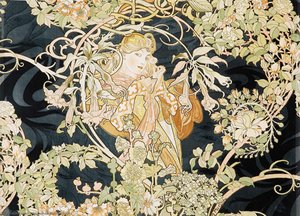
A Moment of Refined Leisure: Alphonse Mucha's "Coffee"
Step into a world of Art Nouveau elegance with Alphonse Mucha’s captivating “Coffee.” This stunning work exemplifies Mucha’s signature style, transporting viewers to the turn-of-the-century era of Parisian cafes and refined leisure. The artwork depicts a young woman gracefully seated, seemingly lost in the simple pleasure of enjoying a cup of coffee – a scene that embodies the spirit of the Belle Époque. More than just a portrait, "Coffee" is an embodiment of beauty, tranquility, and artistic embellishment, reflecting Mucha's mastery of decorative art.Art Nouveau Aesthetics & Technique
Mucha’s distinctive Art Nouveau style shines through every detail of “Coffee.” The composition is characterized by flowing, curvilinear lines that define the woman’s form, the folds of her dress, and the surrounding stylized foliage. Notice how these lines create a sense of movement and fluidity, drawing the eye across the canvas. The color palette—warm yellows, oranges, and creams contrasted with cooler blues and greens—further enhances the artwork's visual appeal. The technique likely involves watercolors or gouache on paper, allowing for delicate layering and subtle gradations in tone. The soft, diffused lighting contributes to a gentle glow around the woman, emphasizing her features and adding to the overall sense of elegance. The perspective is intentionally flattened, a hallmark of Mucha’s style, which prioritizes decorative impact over realistic depth.Symbolism & Emotional Resonance
Beyond its aesthetic beauty, "Coffee" carries symbolic weight. The act of enjoying coffee itself represents leisure and indulgence – hallmarks of the era. The woman's direct gaze establishes a connection with the viewer, inviting contemplation and creating a sense of intimacy. The stylized decorative elements—the swirling leaves and branches—are not merely ornamental; they contribute to an idealized vision of beauty and artistic embellishment. The overall emotional impact is one of tranquility, grace, and perhaps a touch of nostalgia for a bygone era of refined elegance. It evokes a feeling of peaceful contemplation and appreciation for the simple pleasures in life.Historical Context & Mucha's Legacy
Created during the height of the Art Nouveau movement (roughly 1890-1910), "Coffee" reflects the era’s fascination with organic forms, decorative detail, and idealized beauty. Alphonse Mucha was a pivotal figure in this movement, his posters and decorative panels adorning Parisian streets and homes. His work significantly influenced graphic design, illustration, and fine art, leaving an enduring legacy that continues to inspire artists and designers today. Owning a reproduction of "Coffee" is not just acquiring a beautiful piece of art; it's owning a tangible connection to a pivotal moment in artistic history and the captivating world of Art Nouveau.Questions & Answers
Do the colors of "Coffee" appear strong or soft?
"Coffee" by Alphonse Mucha shows a vivid color intensity.
What color leads the composition of "Coffee" by Alphonse Mucha?
The color that stands out most in "Coffee" is espresso (#4b2d1f). The dominant color is useful when matching an artwork to an interior.
How much light do the colors of "Coffee" appear to reflect?
The luminance recorded for "Coffee" by Alphonse Mucha is gentle luminance.
Artist Biography
Early Life and Education
- Born: July 15, 1860, in Ivanačice, Moravia (now part of the Czech Republic)
- Showed artistic talent from a young age.
- Studied at the Academy of Fine Arts in Prague but became disillusioned with traditional approaches.
- Moved to Paris in 1887 to pursue his own style.
Artistic Style and Notable Works
- Known for distinctive Art Nouveau style characterized by flowing lines, organic forms, and a sense of movement.
- Influenced by artists like Pierre-Auguste Renoir and Gustave Moreau.
- Notable Works:
- The Slavonic Uprising - Showcases blending traditional Czech motifs with modern Art Nouveau elements.
- Salon des Cent
- Paintings inspired by works like The Daughters of Tespio by Gustave Moreau, and La Ribambelle des Gobelins by Piero Dorazio.
- Illustrations based on Young Farmers Breaking Flax by Sir Hubert von Herkomer.
- Frequently featured idealized women in flowing robes surrounded by lush flowers.
Career Highlights and Major Commissions
- Sarah Bernhardt Collaboration: Created posters and designs for the actress Sarah Bernhardt, starting with the poster for Gismonda (1894), which launched his career.
- Universal Exhibition in Paris (1900): His Art Nouveau style gained international recognition at this exhibition. He decorated the Bosnia and Herzegovina Pavilion and collaborated on the Austrian Pavilion.
- Charles Richard Crane Patronage: Received support from Charles Richard Crane, which enabled him to create the monumental series The Slav Epic (1912-30).
- Post-Independence Czechoslovakia: Designed postage stamps, banknotes, and government documents for newly independent Czechoslovakia.
Influences and Legacy
- Influenced by Czech artistic traditions and modern European art movements.
- His unique style paved the way for future generations of artists in Art Nouveau and Secessionism.
- Inspired other artists like Eva Prokopcová.
- Legacy extends beyond his artwork to influence design and aesthetics.
Later Life and Death
- Married Maruska (Marie/Maria) Chytilová in 1906.
- Visited the United States from 1906-1910, where their daughter Jaroslava was born.
- Died on July 14, 1939, in Prague, Czechoslovakia.

Alphonse Mucha
1860 - 1939 , Czech Republic
Quick Facts
- Full Name: Alphonse Maria Mucha
- Nationality: Czech
- Date Of Birth: 1860
- Date Of Death: 1939
- Place Of Birth: Brno, Czech Republic
- Notable Artworks:
- Slavic Uprising
- Salon des Cent
- The Daughters of Tespio
- La Ribambelle des Gobelins
- Young Farmers Breaking Flax
- Artistic Movement Or Style: Art Nouveau
- Artists Who Influenced This Artist:
- Pierre-Auguste Renoir
- Gustave Moreau
- Dante Gabriel Rossetti
- Artists Or Movements Influenced By This Artist: ['Eva Prokopcová']
Related Articles
OriginalUniqueArt.com F.A.Q.: Premium Art Poster Prints – Vivid Colors & Versatile Sizing
Discover OriginalUniqueArt.com's premium art poster prints. Featuring 12-color archival pigments for vivid color fidelity and versatile sizing for bespoke decor. Expertly crafted museum-quality reproductions designed for discerning collectors and professional decorators.