
 Preview
 Send
Send Share
Share
 Details

 Download
 Similars
 X-Ray
X-Ray Diaporama
 Stats
StatsLittle Island
 Oil
Oil- WallArt
- Canadian Realism
 1965
1965- Modern
 75.0 x 88.0 cm
 McMichael Canadian Art Collection
 Read More
Giclée / Art Print
Museum-quality giclée or canvas print with fast production and flexible finish options. ( Buy Hand Made Painting Switch to Digital Image)




P118B $10

P118H $10

P118W $10

P438Z $10

P508JH $12

P508YH $12

P805H $10

P805Z $10

P919BZ $10

P919G $10

P919XJ $10

P959ZH $10

P968JZ $12

W106C $8

W218G $10

W218JH $8

W218Y $10

W307PJ $10

W316G $10

W316PJ $8

W316Y $10

W398PJ $8

W4111J $10

W500HY $15

W500JH $15

W692G $12

W849H $8

W940BG $15

W953PJ $8




Pick from our preset sizes that match the artwork's original proportions.

You may enter your own dimensions to fit a specific frame or space. If your selected size does not match the original image's proportions, we will either crop the artwork or extend the image with a mirrored or solid-fill edge. A digital mockup will be sent for your approval before production begins.
Please note that the on-screen preview does not reflect the actual cropping or extension. Only the mockup will accurately show the final composition.
While custom sizes are available, we recommend selecting a dimension from the predefined list to preserve the original proportions.
Worldwide Delivery () in 2 weeks instead of standard 4/5 weeks. (8 September)

Free Worldwide Express Shipping

High-Quality Linen Canvas

Full Shipping Insurance

Customs Tax Refund Guarantee

True Color Matching Guarantee

100-Day Return Policy (Defects Only)

100% Money-Back Guarantee

Bulk Discount Offer
 Glass option is only available in size under 110 CM

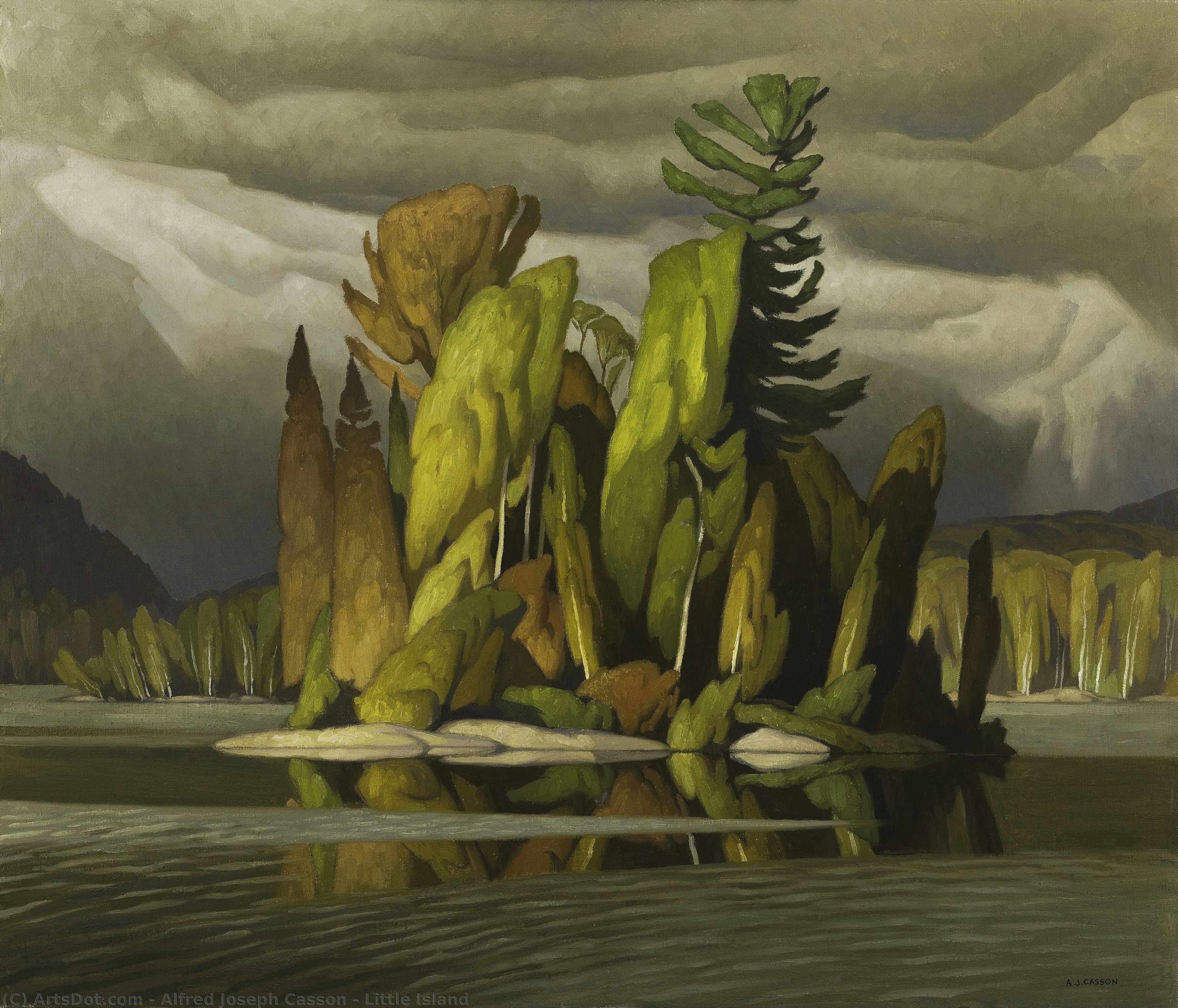
Little Island
Giclée / Art Print
Reproduction Size
-


Total Price
$ 81
A Serene Encounter with the Canadian Wild
In the quietude of Little Island, created in 1965 by the esteemed Canadian master Alfred Joseph Casson, we find ourselves transported to a moment of profound stillness. The painting serves as a window into a secluded world, where a solitary patch of earth rests peacefully amidst the gentle ripples of a lake or river. This is not merely a depiction of geography, but an invitation to pause and breathe alongside the natural rhythm of the landscape. Through Casson’s expert hand, the viewer is drawn into a composition that balances the weight of the lush, verdant trees with the airy, reflective expanse of the water, creating a sense of equilibrium that is both visually captivating and spiritually grounding.
The scene is masterfully layered, guiding the eye from the immediate presence of the foreground foliage toward the soft, hazy silhouettes of distant islands. A small boat, adrift and motionless near the center of the frame, acts as a poignant symbol of human presence—or perhaps, more accurately, human absence. It suggests a narrative of quiet contemplation, where the traveler has stepped away to merge with the scenery, leaving only a trace of life upon the water. This subtle touch of humanity enhances the painting's emotional depth, transforming a landscape study into a meditative experience that resonates deeply with anyone seeking solace from the frantic pace of modern existence.
The Mastery of Light and Canadian Heritage
As a prominent member of the Group of Seven lineage, Casson brought a unique perspective to the Canadian landscape, blending a meticulous attention to detail learned during his early lithography apprenticeship with a soulful appreciation for light. In Little Island, his technique shines through the delicate interplay of color and texture. The artist utilizes a palette that celebrates the organic tones of the wilderness—deep forest greens, earthy browns, and the shimmering, translucent blues of the water. Each brushstroke feels intentional, contributing to a surface that captures the way light filters through canopy leaves and dances upon the liquid surface.
For the discerning collector or interior designer, this piece offers more than just aesthetic beauty; it provides an atmospheric anchor for any space. The painting’s ability to evoke a sense of tranquility makes it an ideal centerpiece for rooms designed for relaxation, such as a study, a library, or a master suite. A high-quality reproduction of this work allows the timeless charm of Southern Ontario's natural beauty to inhabit contemporary homes, bringing with it the prestige of Canadian art history and the enduring, peaceful spirit of Casson’s vision.
Artist Biography
A Life Rooted in the Canadian Landscape
Alfred Joseph Casson, a name synonymous with Canada’s artistic identity, was born in Toronto on May 17, 1898. His journey began not within the hallowed halls of an art academy, but amidst the practical demands of apprenticeship at a Hamilton lithography company following early studies at Hamilton Technical School. This formative period instilled in him a meticulous attention to detail and a deep understanding of visual processes – skills that would later prove invaluable as he translated his vision of the Canadian landscape onto canvas. Even these early experiences were nurtured by formal instruction; private lessons with Harry Britton introduced young Casson to both oil and watercolour techniques, igniting a lifelong passion for capturing the nuances of light and colour. A move back to Toronto in 1916 allowed him to further hone his skills at Central Technical School and the Ontario College of Art, setting the stage for a career that would profoundly shape Canadian art.Joining the Chorus: The Group of Seven
The year 1926 marked a pivotal moment in Casson’s artistic trajectory. He received an invitation from Franklin Carmichael to join the esteemed Group of Seven, stepping into the role previously held by Frank Johnston. This wasn't merely acceptance into a collective; it was an embrace by a group actively forging a distinctly Canadian visual language. The Group of Seven sought to move beyond European conventions and depict the raw beauty and untamed spirit of their homeland. Casson’s contribution lay in his unique perspective, often focusing on the more settled regions of southern Ontario – picturesque villages, rolling farmlands, and tranquil forests. While others explored the dramatic grandeur of northern landscapes, Casson found poetry in the everyday scenes of rural life, imbuing them with a quiet dignity and subtle emotional resonance. His style, characterized by clear colours and carefully constructed compositions, offered a counterpoint to the bolder, more expressive brushwork of some of his colleagues, yet remained undeniably part of the Group’s unified vision.Beyond the Seven: Expanding Artistic Horizons
Casson's commitment to fostering Canadian art extended beyond his involvement with the Group of Seven. In 1933, he co-founded the Canadian Group of Painters, an organization intended to provide a broader platform for artists working in various styles and mediums. This demonstrated a desire not only to promote his own work but also to nurture a thriving artistic community across the nation. Throughout his career, Casson balanced commercial work – notably as Art Director at Sampson-Matthews Ltd. for nearly two decades – with his personal artistic pursuits. He skillfully navigated these dual roles, using his position in the commercial world to support and promote Canadian art while simultaneously dedicating himself to painting full-time after his retirement in 1957. This dedication allowed him to fully immerse himself in capturing the landscapes that had captivated him since childhood.A Lasting Legacy: Recognition and Influence
Alfred Joseph Casson’s impact on Canadian art is undeniable. His paintings, celebrated for their serene beauty and evocative depictions of Ontario's countryside, are held in prominent collections such as the McMichael Canadian Art Collection. He received numerous accolades throughout his life, including full membership in the Royal Canadian Academy of Arts, the Order of Canada, and honorary degrees from universities recognizing his significant contributions to the nation’s cultural heritage. The record-breaking sale of “Street in Glen Williams” for $542,800 in 2010 stands as a testament to the enduring appeal and increasing value of his work. Casson's legacy isn’t simply about the paintings he created; it’s about his role in defining what Canadian art could be – bold, independent, and deeply rooted in the unique character of the land. He passed away on February 20, 1992, leaving behind a body of work that continues to inspire artists and captivate audiences with its timeless beauty.
Alfred Joseph Casson
1898 - 1992 , Canada
Quick Facts
- Artistic Movement Or Style: Group of Seven
- Artists Who Influenced This Artist: ['Franklin Carmichael']
- Date Of Birth: May 17, 1898
- Date Of Death: 1992
- Full Name: Alfred Joseph Casson
- Nationality: Canadian
- Notable Artworks:
- Mill at Cobaconk - Adaptation
- Hillside near Nashville
- In the village of Markham
- Place Of Birth: Toronto, Canada
Related Articles
Tranquil Masterpieces: 10 Artworks for Serene Decor & Emotional Well-being |
Find serenity with our Top 10 tranquil artworks! Explore masterpieces by Monet, Van Gogh & more. Discover the stories behind calming Impressionist landscapes and peaceful Japanese art. Museum-quality reproductions at .
Monet's Masterpieces: 25 Iconic Artworks to Transform Your Home
Journey through 25 iconic Claude Monet masterpieces! Explore Impressionism’s beauty, from Water Lilies to Rouen Cathedral. Discover stunning art reproductions & curated decor ideas – explore the full collection online at OriginalUniqueArt.com.

Boats on Canvas: 10 Masterpieces of Maritime Art for Your Home Decor
Sail away with 10 iconic boat paintings! Explore masterpieces by Monet, Van Gogh & Turner. Discover the stories behind these timeless seascapes and find museum-quality art reproductions for your home decor at OriginalUniqueArt.com.

Renoir's Masterpieces: Explore 25 Iconic Paintings & Bring Art Home | OriginalUniqueArt
Explore 25 iconic Pierre-Auguste Renoir paintings! Discover the stories behind Impressionist masterpieces like 'Dance at Le Moulin de la Galette' & 'Luncheon of the Boating Party'. Find museum-quality art reproductions and elevate your home decor with OriginalUniqueArt.com.
Serene Masterpieces: 10 Artworks That Define Tranquility | OriginalUniqueArt
Find peace with 10 iconic artworks embodying tranquility! Explore Monet's water lilies, Van Gogh’s starry night & more. Discover the stories behind these serene masterpieces and bring calming art into your home with museum-quality reproductions from OriginalUniqueArt.com.


