Preview
 Send
Send Share
Share
 Details
 Guide
Guide

 Download
 Similars
 X-Ray
X-Ray Diaporama
 Stats
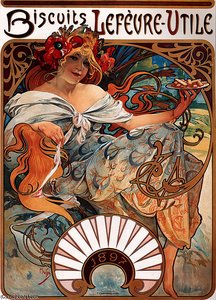
StatsBiscuits Lefevre-Utile litho
 Art Nouveau
 1896
1896 44.0 x 62.0 cm
 Read More
Giclée / Art Print
Museum-quality giclée or canvas print with fast production and flexible finish options. ( Buy Hand Made Painting Switch to Digital Image)




































Pick from our preset sizes that match the artwork's original proportions.

You may enter your own dimensions to fit a specific frame or space. If your selected size does not match the original image's proportions, we will either crop the artwork or extend the image with a mirrored or solid-fill edge. A digital mockup will be sent for your approval before production begins.
Please note that the on-screen preview does not reflect the actual cropping or extension. Only the mockup will accurately show the final composition.
While custom sizes are available, we recommend selecting a dimension from the predefined list to preserve the original proportions.
Worldwide Delivery () in 2 weeks instead of standard 4/5 weeks. (6 October)

Free Worldwide Express Shipping

High-Quality Linen Canvas

Full Shipping Insurance

Customs Tax Refund Guarantee

True Color Matching Guarantee

100-Day Return Policy (Defects Only)

100% Money-Back Guarantee

Bulk Discount Offer
 Glass option is only available in size under 110 CM

Biscuits Lefevre-Utile litho
Giclée / Art Print
Reproduction Size
-


Total Price
$ 81
Artistic Style and Influences
Alfons Maria Mucha's work is deeply rooted in the Art Nouveau movement, which emerged in the late 19th century. This style is marked by its emphasis on natural forms, flowing lines, and a sense of elegance and sophistication. Biscuits Lefevre-Utile litho embodies these characteristics, featuring a beautiful woman with flowing hair and a decorative backdrop. Key Features of the painting include:- The use of sinuous lines and curves to create a sense of movement and fluidity
- The incorporation of natural forms, such as flowers and leaves, into the design
- The emphasis on elegance and sophistication, reflected in the woman's pose and attire
Artistic Significance and Legacy
Biscuits Lefevre-Utile litho is not only a beautiful work of art but also an important example of Alfons Maria Mucha's contribution to the Art Nouveau movement. The painting has been widely admired and influential, with many artists drawing inspiration from its unique style and composition. For those interested in learning more about Alfons Maria Mucha and his work, visit the OriginalUniqueArt.com website, which offers a range of resources and information on the artist. Additionally, the Wikipedia page on Alphonse Mucha provides a comprehensive overview of his life and career.The Musée National Picasso in Paris also features an extensive collection of Art Nouveau works, including pieces by Alfons Maria Mucha. Visit the OriginalUniqueArt.com page on the Musée National Picasso to learn more about this world-renowned museum and its collection.
Questions & Answers
Is "Biscuits Lefevre-Utile litho" by Alfons Maria Mucha in the public domain, and why?
The copyright status of "Biscuits Lefevre-Utile litho" - in the public domain - its copyright has expired - follows from the artist's death in 1939.
How much light do the colors of "Biscuits Lefevre-Utile litho" appear to reflect?
The colors of "Biscuits Lefevre-Utile litho" show a gentle luminance luminance.
How old was Alfons Maria Mucha when creating "Biscuits Lefevre-Utile litho" in 1896?
When "Biscuits Lefevre-Utile litho" was created in 1896, Alfons Maria Mucha - born in 1860 - was 36 years old.
What is the creation date of "Biscuits Lefevre-Utile litho" by Alfons Maria Mucha?
"Biscuits Lefevre-Utile litho" by Alfons Maria Mucha was created in 1896.
Is "Biscuits Lefevre-Utile litho" by Alfons Maria Mucha a light or a dark artwork?
"Biscuits Lefevre-Utile litho" is balanced overall, and its luminance is gentle luminance.
How can I view "Biscuits Lefevre-Utile litho" by Alfons Maria Mucha as a slideshow?
The diaporama of "Biscuits Lefevre-Utile litho" can be watched on the artwork's Diaporama page.
Which artist is "Biscuits Lefevre-Utile litho" attributed to?
The artist behind "Biscuits Lefevre-Utile litho" is Alfons Maria Mucha. The work is catalogued under Alfons Maria Mucha's name.
Artist Biography
Alphonse Mucha: The Enchanting Visionary of Art Nouveau
Alphonse Maria Mucha, born in Ivančice, Czech Republic, on July 24, 1860, and tragically passing away in Prague on July 14, 1939, remains one of the most recognizable figures of the Art Nouveau movement. More than just a painter and illustrator, Mucha was a master of visual storytelling, crafting images that seamlessly blended decorative elegance with profound symbolism. His work, particularly his iconic posters and monumental murals like “The Slav Epic,” continues to captivate audiences today, embodying a romantic vision of beauty, nature, and national identity.
Mucha’s early life was marked by both artistic talent and personal hardship. Growing up in a modest family, he displayed an exceptional aptitude for drawing from a young age, receiving encouragement from a local merchant who provided him with essential supplies. Despite his ambition to pursue formal art training, financial constraints prevented him from attending prestigious academies. This led him through various apprenticeships – first in theatre scene painting in Vienna and later in Paris – where he honed his skills and began to develop the distinctive style that would soon define his career. These early experiences instilled a deep appreciation for craftsmanship and a desire to create art accessible to a wide audience, a principle that would inform much of his later work.
The Rise to Fame: Posters and Sarah Bernhardt
Mucha’s breakthrough came in 1894 with the commission to design posters for the celebrated actress Sarah Bernhardt. The resulting poster for *Gismonda* was a sensation, instantly establishing Mucha's signature style – characterized by elongated figures, flowing lines, and an opulent use of color. This marked the birth of what became known as “The Mucha Style,” a highly sought-after aesthetic that quickly permeated advertising, fashion, and decorative arts. He created a series of posters for Bernhardt over the next decade, each one further solidifying his reputation as a leading designer. These weren’t merely advertisements; they were carefully constructed visual narratives, imbued with a sense of mystery, sensuality, and timeless beauty.
Beyond posters, Mucha expanded his creative output to include illustrations for magazines like *La Jugend*, *Le Style*, and *Harper's Bazaar*. His work frequently featured women as idealized figures – the “femme nouvelle,” embodying both innocence and allure. This fascination with female beauty was deeply intertwined with a broader interest in symbolism and mythology, often drawing inspiration from pre-Raphaelite art and Japanese woodblock prints. He skillfully blended these influences to create a unique visual language that resonated powerfully with his audience.
The Slav Epic: A Nationalistic Masterpiece
In 1912, Mucha embarked on one of the most ambitious projects of his career – “The Slav Epic,” a series of twenty monumental murals depicting the history and mythology of Slavic peoples. This undertaking was deeply personal for Mucha, fueled by a fervent patriotism and a desire to celebrate Czech cultural heritage following the country’s independence from Austria-Hungary. He collaborated with fellow artist František Sekyra, and together they created a vast panorama of scenes – from ancient legends to historical battles – rendered in a rich, symbolic style.
The Slav Epic represents a significant shift in Mucha's artistic focus, moving beyond commercial commissions to engage with grand narratives of national identity. The murals are not simply historical accounts; they’re imbued with a potent blend of romanticism, symbolism, and nationalist fervor. They were presented to the Czech nation in 1928 on the tenth anniversary of Czechoslovakia’s declaration of independence, cementing Mucha's legacy as a key figure in shaping the country’s cultural identity.
Legacy and Influence
Alphonse Mucha’s impact on art and design is undeniable. His distinctive style—characterized by flowing lines, decorative patterns, and idealized female figures—influenced generations of artists and designers. The “Mucha Style” became synonymous with Art Nouveau, shaping the aesthetics of posters, jewelry, furniture, and interior decoration throughout Europe and beyond. Even today, his work continues to inspire contemporary artists and designers, demonstrating the enduring power of his vision.
Beyond his artistic achievements, Mucha’s story is one of resilience, creativity, and unwavering dedication to his craft. Despite facing financial challenges and personal hardships, he persevered in pursuing his artistic ambitions, leaving behind a remarkable body of work that continues to enchant and inspire audiences worldwide. His legacy as a master of Art Nouveau and a champion of Czech cultural identity remains firmly established.

Alfons Maria Mucha
1860 - 1939 , Czech Republic
Quick Facts
- Full Name: Alphonse Maria Mucha
- Nationality: Czech
- Date Of Birth: 1860
- Date Of Death: 1939
- Place Of Birth: Ivančice, Czech Republic
- Notable Artworks:
- Spring panel
- Biscuits Lefevre-Utile litho
- Mistletoe Portrait of Mme. Mucha
- The Slav Epic
- Gismonda poster
- Artistic Movement Or Style: Art Nouveau
- Artists Who Influenced This Artist:
- Gustave Moreau
- James Abbott McNeill Whistler
- Artists Or Movements Influenced By This Artist:
- Aubusson Tapestries
- Pre-Raphaelites