

 Preview
 Send
Send Share
Share
 Details

 Download
 Similars
 X-Ray
X-Ray Diaporama
Drouth Stricken Area
 Oil On Canvas
- WallArt
- Contemporary Realism
 1934
1934- 19th Century
 107.0 x 76.0 cm
 Dallas Museum of Art
 Read More
Purchase a high-resolution, enhanced digital image, far superior to the online preview.
Each file is meticulously prepared by our in-house specialists using advanced tools and expert manual retouching. We ensure every image has exceptional clarity, precise color accuracy, and fine detail.
The final file is delivered via email within 72 hours, optimized for immediate use in professional, editorial, and print environments. This is the same quality trusted by top-tier design studios, publishers, and galleries.
Digital Image
Download a high-resolution file for personal display, printing, and creative projects. ( Buy Print Buy Hand Made Painting)
Included in Every Digital Image Order
Expert Digital Delivery, Guaranteed
When you choose OriginalUniqueArt.com, you're not just getting an image - you're receiving a professionally enhanced digital artwork, crafted with precision and backed by a satisfaction guarantee. Here's everything that comes with your order, automatically:

Fast Email Delivery
Your high-resolution digital image file will be emailed to you within 72 hours of ordering - ready for immediate use.

AI-Enhanced Digital File
Your artwork is professionally optimized using advanced AI tools and manual editing, ensuring maximum detail, clarity, and color accuracy.

Free Lifetime Re-Delivery
Accidentally deleted or lost your file? No worries - we'll resend it to you anytime, free of charge.

No Import Fees - Ever
Enjoy your artwork instantly with zero customs, duties, or delivery fees - digital downloads are always tax-free.

Color Accuracy Guarantee
We ensure your digital image reflects the original colors as closely as possible using professional tools and color management.

60-Day Satisfaction Guarantee
If you're not satisfied with your digital image, we'll revise it or refund 100% within 60 days - no questions asked.

100% Money-Back Guarantee
Not satisfied? Get a full refund within 60 days of receiving your digital file - no questions asked.

Bulk Order Discounts
Buy 3 images, save 10% - Buy 5, save 15% - Buy 10+, save 20%. Great for creative projects, galleries, and agencies.
Alexandre Hogue’s “Drouth Stricken Area”: A Testament to Resilience in the American Dust Bowl
Alexandre Hogue's "Drouth Stricken Area," painted in 1934, is more than just a depiction of a desolate landscape; it’s a poignant and deeply affecting record of an era – the harrowing years of the Dust Bowl. Measuring 107 x 76 cm, this oil on canvas offers a starkly beautiful portrayal of survival against overwhelming odds, solidifying Hogue's place as a visionary chronicler of American realism.
A Landscape Forged by Despair and Determination
The painting immediately commands attention with its central figure: a weathered windmill, standing tall yet vulnerable amidst the vast expanse of a barren field. This iconic image speaks directly to the plight of farmers struggling against relentless dust storms that choked the land and shattered livelihoods. The color palette – dominated by ochres, browns, and grays – perfectly captures the oppressive atmosphere of drought and decay. Scattered throughout this desolate scene are essential elements of rural life: two birds perched on a fence post, symbolizing fragile hope; cows and horses, representing the livestock upon which many families depended; and figures of people, adding a human element to the overwhelming natural forces.
Technique and Style – The Realist Vision of Alexandre Hogue
Hogue’s artistic style is firmly rooted in American realism. His meticulous brushwork and attention to detail are evident in the rendering of the rough textures of the soil, the weathered wood of the windmill, and the individual features of the animals. The composition itself is carefully constructed, drawing the viewer's eye towards the central subject while simultaneously conveying a sense of scale and isolation. His training at Minneapolis College of Art and Design, combined with his early work as an illustrator for the Dallas Morning News, honed his skills in capturing light and shadow, contributing to the painting’s powerful emotional impact. The use of impasto – thick layers of paint – adds further texture and depth, enhancing the sense of physicality within the scene.
Symbolism and Historical Context: Echoes of the Dust Bowl
"Drouth Stricken Area" is inextricably linked to the historical context of the 1930s Dust Bowl. This period, marked by severe drought, unsustainable farming practices, and devastating dust storms, profoundly impacted the American Midwest. Hogue’s painting serves as a visual testament to this hardship, reflecting the economic and psychological toll it took on families who lost their farms and livelihoods. The lone figures within the scene represent the resilience of the human spirit in the face of unimaginable adversity – a quiet dignity amidst devastation. The artist's mother's influence, emphasizing a connection with nature and respect for the earth, is subtly reflected in the painting’s core message.
Emotional Impact and Artistic Legacy
Ultimately, “Drouth Stricken Area” transcends its historical context to offer a timeless meditation on humanity's relationship with the environment. It evokes feelings of melancholy, empathy, and awe at the power of nature. This painting is a significant work in Hogue’s oeuvre and a powerful example of American realist art. A hand-painted reproduction offers an opportunity to own a piece of this important historical narrative and appreciate Hogue's masterful skill and profound vision.
Artist Biography
Alexandre Hogue: A Visionary of the Dust Bowl Landscape
Alexandre Hogue (1898-1994) stands as a pivotal figure in American realist painting, particularly renowned for his unflinching depictions of the devastation wrought by the Dust Bowl era. Born in Memphis, Missouri, he possessed an innate connection to the natural world instilled by his mother—a woman who profoundly shaped his artistic worldview with the simple yet powerful mantra: “...conjured up visions of a great female figure under the ground everywhere- so i would tread easy on the ground.” This formative influence permeated his oeuvre, informing his exploration of themes like environmental responsibility and the human condition’s relationship to the forces of nature. Hogue's artistic journey began with formal training at Minneapolis College of Art and Design before relocating to Dallas in 1925 where he established himself as an illustrator for the Dallas Morning News. Recognizing the transformative potential of European art education, he embarked on a formative trip to New York City in 1921, immersing himself in museums and honing his skills alongside prominent calligraphy artists. His artistic sensibilities were further refined through collaborations with advertising firms and continued observation of the Southwest landscape. The Dallas Nine—a collective of influential Southwestern painters—recognized Hogue’s talent early on, cementing his place within a movement dedicated to capturing the stark realities of rural America during the Great Depression. He achieved particular acclaim for his monumental canvases portraying desolate Dust Bowl landscapes—images imbued with palpable emotion and conveying both the grandeur and fragility of the American frontier. Notable works include “Dust Bowl” and “Drouth Stricken Area,” which exemplify Hogue’s masterful technique – characterized by meticulous detail, subdued color palettes, and a deliberate emphasis on textural qualities that mirrored the ravaged earth itself. Throughout his prolific career spanning from 1931 to 1963, Hogue served as Head of Art Department at Texas State College for Women and subsequently at Hockaday Junior College, nurturing generations of aspiring artists. His legacy extended beyond teaching; he founded the Alexandre Hogue Gallery in Tulsa, Oklahoma—a testament to his enduring influence on the artistic landscape of the region. He remained a resident of Tulsa until his passing in 1994, leaving behind an impressive body of work that continues to inspire contemplation and appreciation for the beauty found amidst hardship. His artistic output reflects not only technical prowess but also a deep philosophical engagement with the environment—a conviction rooted in his mother’s guiding principle. Hogue's paintings serve as poignant reminders of humanity's vulnerability before the forces of nature, urging viewers to consider our responsibilities toward preserving the planet's delicate ecosystems. Alexandre Hogue remains an important artist for understanding the visual representation of the Dust Bowl era and its lasting impact on American art history.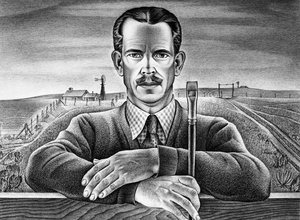
Alexandre Hogue
1898 - 1994 , United States of America
Quick Facts
- Artistic Movement Or Style: Dallas Nine; Realist
- Artists Or Movements Influenced By This Artist: ['Regionalism art']
- Artists Who Influenced This Artist: ['Charles Franklin Reaugh']
- Date Of Birth: February 22, 1898
- Date Of Death: July 22, 1994
- Full Name: Alexandre Hogue
- Nationality: American
- Notable Artworks:
- Young Girl in Purple
- Dust Bowl
- Drouth Stricken Area
- Place Of Birth: Memphis, United States

