Modernisme
Untitled (660) (Alexandre de Riquer)
Alexandre de Riquer (1856–1920) made Untitled (660). It belongs to the Modernisme movement.

 Preview

 Hand Made Oil Painting
 Send
 Share
 Fact sheet


 Download
 Similars
 X-Ray
 Diaporama
 Q&A

 Stats
Untitled (660), in brief
- Title
- Untitled (660)
- Artist
- Alexandre de Riquer (1856–1920)
- Artist born in
- Catalonia, Spain
- Movement
- Modernisme
- Subject
- vintage portrait, floral arrangement, reading woman art, catalan painting, antique illustration, pensive mood
High-resolution images of Untitled (660)
Alexandre de Riquer, Untitled (660). Public domain.
Questions on Untitled (660), answered
What does "Untitled (660)" by Alexandre de Riquer depict?
The subjects of "Untitled (660)" are vintage portrait, floral arrangement, reading woman art, catalan painting, antique illustration, pensive mood, book and flowers.
Is "Untitled (660)" free of copyright?
Regarding copyright, "Untitled (660)" is in the public domain - its copyright has expired.
Who created "Untitled (660)"?
The artist behind "Untitled (660)" is Alexandre de Riquer. The work is catalogued under Alexandre de Riquer's name.
What style does "Untitled (660)" belong to?
"Untitled (660)" is a work of Modernisme. The movement indicates the artistic tradition the work is part of.
Which period of Alexandre de Riquer's career does "Untitled (660)" belong to?
"Untitled (660)" represents the Late Medieval of Alexandre de Riquer.
Why is the copyright status of "Untitled (660)" what it is?
"Untitled (660)" by Alexandre de Riquer is in the public domain - its copyright has expired. Copyright duration runs from the artist's death, which occurred in 1920.
What does "Untitled (660)" share with the rest of Alexandre de Riquer's output?
Within Alexandre de Riquer's output, "Untitled (660)" sits in the Modernisme style, alongside the themes of catalan modernisme, art nouveau echoes, religious contemplation, moral reflection, personal pensive mood, female inner world, classic portraiture, symbolic narrative.
Where does "Untitled (660)" stand among Alexandre de Riquer's recurring subjects?
Alexandre de Riquer's recurring themes include catalan modernisme, art nouveau echoes, religious contemplation, moral reflection, personal pensive mood, female inner world, classic portraiture, symbolic narrative; "Untitled (660)" focuses on vintage portrait, floral arrangement, reading woman art, catalan painting, antique illustration, pensive mood, book and flowers.
About the artist, Alexandre de Riquer

1856–1920, Spain
Alexandre de Riquer
A Life Woven in Art and Intellect Alexandre de Riquer i Ynglada, 7th Count of Casa Dávalos, was more than just an artist; he embodied a confluence of aristocratic lineage, intellectual curiosity, and artistic innovation that defined the Catalan Modernisme movement. Born in Calaf, Catalonia, in 1856, his life unfolded against a backdrop of political tension – his father, Martí de Riquer, being a prominent Carlist leader – yet was simultaneously nurtured by a mother, Elisea Ynglada, who fostered a deep appreciation for art and literature within the family. This duality shaped Riquer’s path, imbuing him with both a sense of tradition and a restless desire to forge new artistic expressions. His early education in France, first in Béziers and later at the School of Fine Arts in Toulouse, provided a foundational grounding in French artistic traditions, but it was his return to Barcelona and studies at La Llotja that truly ignited his creative spirit under the mentorship of figures like Tomas Padro, Claudi Lorenzale, and particularly Antoni Caba.
About Alexandre de Riquer Notable works by Alexandre de Riquer
Also by Alexandre de Riquer
 Composition with Winged Nymph Blowing Amongst Reeds1887
 Composition with winged nymph at sunrise1887
Essays around Untitled (660)
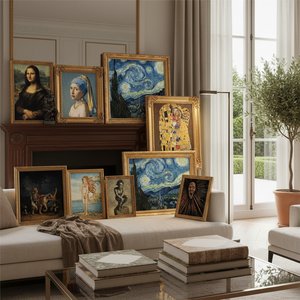 Timeless Masterpieces: 10 Classic Artworks for Elegant Homes |Explore 10 timeless masterpieces – from Van Gogh to Rembrandt – that define classic art & evoke enduring moods. Discover art history, techn…
 25 Masterpieces by Jean-Antoine Watteau: The Essence of Rococo EleganceExplore 25 iconic Rococo masterpieces by Jean-Antoine Watteau. Discover the full collection online at OriginalUniqueArt.com.
 25 Iconic Masterpieces by Henri de Toulouse-Lautrec: Capturing the Spirit of MontmartreStep into the vibrant nightlife of Montmartre with our curated guide to the top 25 Henri de Toulouse-Lautrec masterpieces. Explore the soul…