 Buy Painting
 Send
Send Share
Share
 Details

 Download
 Similars
 X-Ray
X-Ray Diaporama
Casa
 Acrylic On Canvas
- WallArt
- Figurative Surrealism
 2001
2001- Renaissance
 33.0 x 24.0 cm
 Pinacoteca do Estado de São Paulo
 Read More
Giclée / Art Print
Museum-quality giclée or canvas print with fast production and flexible finish options.




P118B $10

P118H $10

P118W $10

P438Z $10

P508JH $12

P508YH $12

P805H $10

P805Z $10

P919BZ $10

P919G $10

P919XJ $10

P959ZH $10

P968JZ $12

W106C $8

W218G $10

W218JH $8

W218Y $10

W307PJ $10

W316G $10

W316PJ $8

W316Y $10

W398PJ $8

W4111J $10

W500HY $15

W500JH $15

W692G $12

W849H $8

W940BG $15

W953PJ $8




Pick from our preset sizes that match the artwork's original proportions.

You may enter your own dimensions to fit a specific frame or space. If your selected size does not match the original image's proportions, we will either crop the artwork or extend the image with a mirrored or solid-fill edge. A digital mockup will be sent for your approval before production begins.
Please note that the on-screen preview does not reflect the actual cropping or extension. Only the mockup will accurately show the final composition.
While custom sizes are available, we recommend selecting a dimension from the predefined list to preserve the original proportions.
Worldwide Delivery () in 2 weeks instead of standard 4/5 weeks. (23 July)

Free Worldwide Express Shipping

High-Quality Linen Canvas

Full Shipping Insurance

Customs Tax Refund Guarantee

True Color Matching Guarantee

60-Day Return Policy (Defects Only)

100% Money-Back Guarantee

Bulk Discount Offer
 Glass option is only available in size under 110 CM

Casa
Giclée / Art Print
Reproduction Size
-


Total Price
-
Collectible Description
Alexandre Cerveny’s “Casa”: A Symphony of Tools and Myth
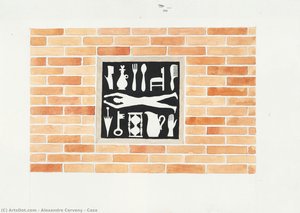
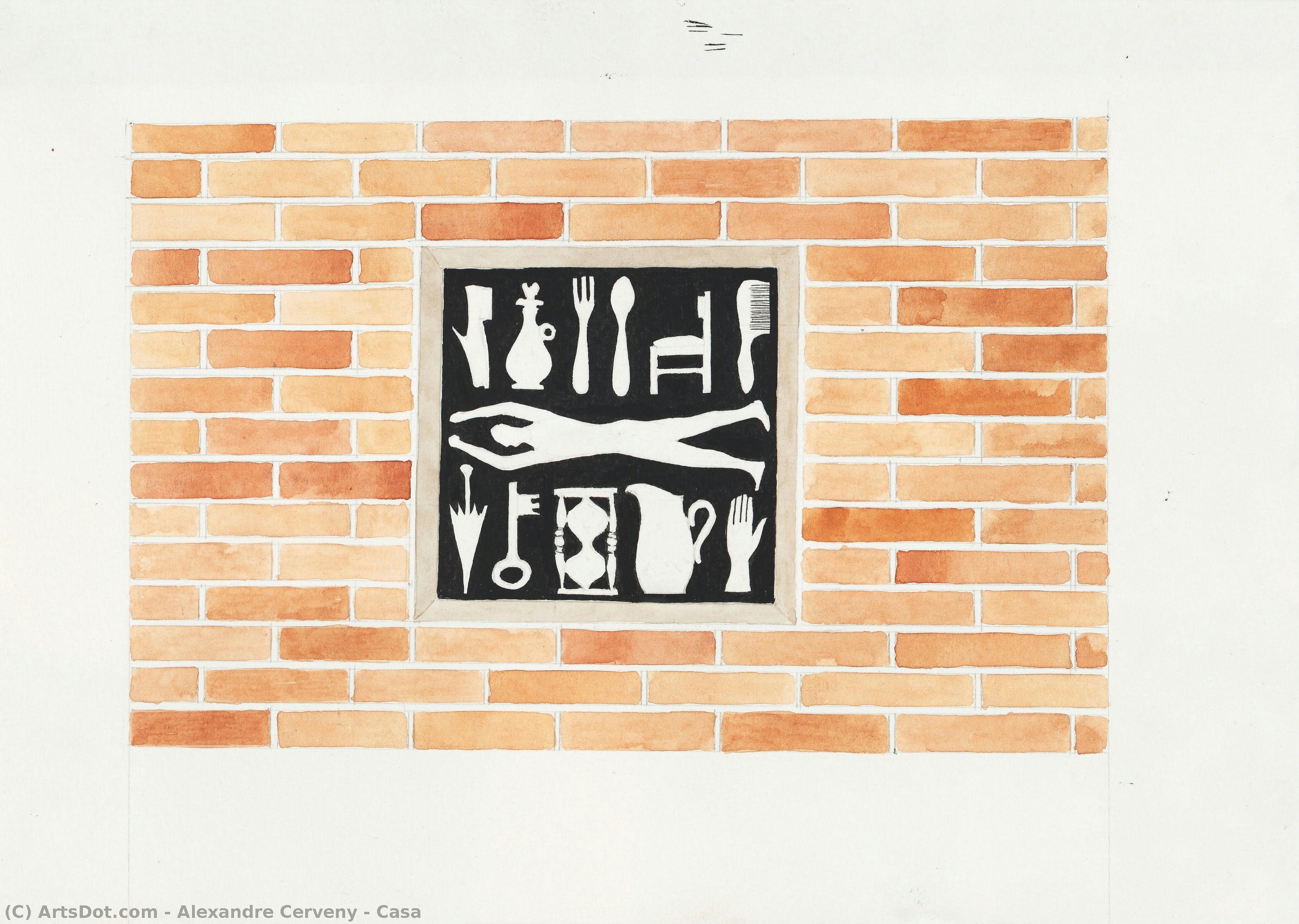
“Casa,” a captivating work by Brazilian artist Alexandre Cerveny from 2001, presents a meticulously rendered tableau that transcends the simple depiction of a brick wall. Measuring 33 x 24 cm, this painting is more than just an image; it’s an invitation into a world where everyday objects – spoons, knives, and forks – intertwine with mythological narratives and historical references, creating a visually arresting and intellectually stimulating experience. Cerveny's artistic lineage is deeply rooted in Brazilian tradition, yet his work consistently pushes boundaries, reflecting a profound engagement with themes of representation, human experience, and the inherent tension between order and chaos.
- The Composition: The central focus is undeniably the brick wall itself, a sturdy foundation for an extraordinary arrangement. A window pierces through the structure, offering a glimpse beyond – a subtle suggestion of escape or perhaps a portal to another realm.
- A Menagerie of Utensils: The painting’s power lies in its carefully orchestrated collection of tools and utensils. Their placement isn't random; they seem deliberately positioned as if part of a larger, unspoken story. The abundance of spoons, knives, and forks evokes a sense of domesticity, but also hints at ritualistic or symbolic significance.
- Cerveny’s Influences: Cerveny’s artistic journey is marked by the influence of masters like Valdir Sarubbi and Selma Daffré, whose teachings shaped his approach to drawing and engraving. His background in theatre and circus further informs his work, adding a layer of theatricality and narrative complexity.
Technique and Style: A Masterful Blend
Cerveny’s technique is characterized by an exceptional level of detail and precision. The application of color is bold and deliberate, contributing significantly to the painting's dramatic impact. The artist employs a meticulous approach to rendering textures – the rough surface of the brick, the polished metal of the utensils – creating a palpable sense of realism that belies the underlying surrealism of the composition. The sharp lines and defined forms suggest a classical influence, while the vibrant color palette speaks to Cerveny’s distinctly Brazilian sensibility. The painting showcases a mastery of both figurative representation and decorative elements, resulting in a work that is simultaneously beautiful and thought-provoking.
Symbolic Layers: Myth, Utility, and Representation
“Casa” operates on multiple symbolic levels. The tools themselves – traditionally associated with sustenance and labor – take on a more profound significance within the context of the painting. They can be interpreted as symbols of creation, destruction, or perhaps even the instruments of fate. The inclusion of mythological references (implied through the arrangement) adds another layer of complexity, inviting viewers to contemplate timeless narratives about human nature and our relationship with the world around us. Cerveny’s work consistently challenges conventional notions of representation, prompting us to question how we perceive and interpret visual imagery.
Historical Context and Artistic Legacy
Created in 2001, “Casa” reflects a pivotal moment in Cerveny's artistic development. It builds upon his established style while demonstrating an increasing willingness to experiment with form and narrative. The painting’s meticulous detail and evocative imagery align it with the broader trends of Brazilian art at the turn of the millennium – a period marked by both a renewed interest in tradition and a bold embrace of contemporary ideas. This piece stands as a testament to Cerveny's enduring talent and his ability to create works that resonate deeply with viewers across time and cultures.
Artist Biography
Alexandre Cerveny: A Brazilian Visionary of Color and Form
Born in São Paulo, Brazil, in 1963, Alexandre Cerveny is a multifaceted artist whose work—spanning painting, sculpture, engraving, and illustration—is characterized by a vibrant energy and a compelling dialogue between construction and deconstruction. His artistic journey has been shaped by rigorous training alongside influential figures like Valdir Sarubbi and Selma D’Affre, grounding him in the traditions of Brazilian art while simultaneously pushing him toward a uniquely personal vision. Cerveny's work isn't merely decorative; it’s an exploration of complex themes—nature, human experience, and the very nature of representation—presented through bold colors, dynamic compositions, and often, a touch of surrealism.
Early Influences and Artistic Foundations
Cerveny's artistic development began with formal training in drawing and painting under Valdir Sarubbi, a renowned Brazilian artist known for his expressive figurative work. This early exposure instilled in him an appreciation for the power of line and form. Subsequently, he honed his technical skills in metal engraving and printing techniques with Selma D’Affre, gaining expertise in traditional printmaking methods. A pivotal experience occurred during his enrollment in the lithography course at FAAP (Fundação Armando Álvares de Andrade), further expanding his artistic repertoire. Notably, a period spent studying contortionism within the Piolin Circus Arts Academy and Picadeiro Circus School profoundly impacted his oeuvre, imbuing it with a sense of fluidity, movement, and an understanding of the human body’s capacity for transformation – a recurring motif in his work.
A Dualistic Approach: Construction and Deconstruction
Cerveny's artistic practice is fundamentally rooted in a tension between opposing forces. He navigates the interplay between construction and deconstruction, form and function, creating works that are simultaneously structured and fragmented. This duality manifests itself through layered imagery, unexpected juxtapositions, and a deliberate blurring of boundaries. His paintings frequently feature bold color palettes—often saturated hues—that seem to vibrate with energy. These colors aren’t simply decorative; they serve as vehicles for conveying emotion, atmosphere, and symbolic meaning. Recurring themes include depictions of nature, particularly the human figure, rendered in abstracted forms that invite interpretation rather than offering straightforward representation.
Notable Works and Recognition
Several of Cerveny’s works stand out as testaments to his unique artistic vision. “Alexandre Cerveny: O Artico Não Existe” (The Arctic Doesn't Exist) is a particularly captivating piece, prompting viewers to decipher its layered meanings and engage in active interpretation. His work has been exhibited extensively throughout Brazil and internationally, including at the Museu Civico Giovanni Fattori and the Frederic Remington Art Museum. He’s received significant recognition for his talent, culminating in the Prêmio Marcantonio Vilaça from the National Arts Foundation (FUNARTE) in 2012 and the Proac Book Artist Award in 2016. His pieces are held within prestigious collections such as the Musée Baron Gérard and the Pinacoteca do Estado de São Paulo, solidifying his place within the contemporary art landscape.
Contemporary Presence and Continued Exploration
Alexandre Cerveny’s work continues to evolve, reflecting a deep engagement with both Brazilian identity and broader global concerns. His recent exhibitions at institutions like the Cartier Foundation and the Ibero-American Art Museum (Museo de Arte Iberoamericana) demonstrate his continued relevance within contemporary art discourse. Furthermore, his participation in projects such as *rīvus* – a Biennale of Sydney initiative – highlights his willingness to experiment with new mediums and explore complex themes related to environmental sustainability and cultural heritage. His ongoing collaborations and exhibitions ensure that Cerveny remains a vital voice in the Brazilian art scene and beyond. You can find more information about his work on platforms like OriginalUniqueArt, Wikipedia, and OriginalUniqueArt.

alexandre cerveny
1963 - , Brazil
Quick Facts
- Artistic Movement Or Style: Bold colors & forms
- Artists Or Movements Influenced By This Artist:
- Contemporary art
- Metal engraving
- Artists Who Influenced This Artist:
- Valdir Sarubbi
- Selma d'Affre
- Date Of Birth: 1963
- Full Name: Alexandre Cerveny
- Nationality: Brazilian
- Notable Artworks:
- Televisão
- Sem título
- Astros 3
- O Artico não existe
- Place Of Birth: São Paulo, Brazil
Related Articles
Monet's Masterpieces: 25 Iconic Artworks to Transform Your Home
Journey through 25 iconic Claude Monet masterpieces! Explore Impressionism’s beauty, from Water Lilies to Rouen Cathedral. Discover stunning art reproductions & curated decor ideas – explore the full collection online at OriginalUniqueArt.com.

Georges Braque's Masterpieces: 25 Paintings That Defined Cubism & Modern Art | OriginalUniqueArt
Explore 25 iconic Georges Braque paintings that revolutionized Cubism & modern art. Discover the stories behind his masterpieces, from Fauvism to Analytical Cubism. Find museum-quality reproductions & elevate your home decor with OriginalUniqueArt.com.
Marianne North's Masterpieces: 25 Botanical Paintings That Bloom With Adventure | OriginalUniqueArt
Journey through the vibrant world of Marianne North’s botanical paintings! Explore 25 iconic artworks from this Victorian artist, celebrating exotic flora & travel. Find museum-quality reproductions and curated decor ideas at OriginalUniqueArt.com.
National Gallery London's Masterpieces: 25 Iconic Paintings for Your Home Decor
Journey through the National Gallery London's 25 most iconic paintings! Explore Van Gogh, Monet, Rembrandt & more. Discover art history, techniques & find museum-quality reproductions for your home decor on OriginalUniqueArt.com.
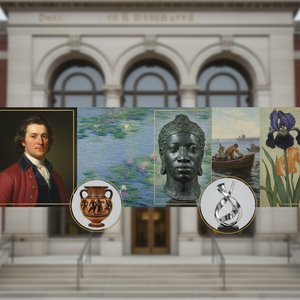
Masterpieces of Boston: Explore 25 Iconic Artworks | OriginalUniqueArt
Journey through 25 iconic artworks at Boston's MFA! Explore masterpieces by Monet, Sargent, Van Gogh & more. Discover art history, techniques & find museum-quality reproductions for your home on OriginalUniqueArt.com.