Preview
 Send
Send Share
Share
 Details
 Guide
Guide

 Download
 Similars
 X-Ray
X-Ray Diaporama
 Stats
StatsBlossoms
 Oil On Canvas
- WallArt
- Pre-Raphaelite
 1881
1881 46.0 x 147.0 cm
 Tate Britain
 Read More
Giclée / Art Print
Museum-quality giclée or canvas print with fast production and flexible finish options. ( Buy Hand Made Painting Switch to Digital Image)




P118B $10

P118H $10

P118W $10

P438Z $10

P508JH $12

P508YH $12

P805H $10

P805Z $10

P919BZ $10

P919G $10

P919XJ $10

P959ZH $10

P968JZ $12

W106C $8

W218G $10

W218JH $8

W218Y $10

W307PJ $10

W316G $10

W316PJ $8

W316Y $10

W398PJ $8

W4111J $10

W500HY $15

W500JH $15

W692G $12

W849H $8

W940BG $15

W953PJ $8




Pick from our preset sizes that match the artwork's original proportions.

Type the width and the height you need, to fit your frame or your wall. A print can only be cut, never made bigger than the picture, so a size with a different shape loses a part of the image. We send you a digital mockup to approve before we print anything. The picture shown on this page does not show the real cut — only the mockup does.
Worldwide Delivery () in 2 weeks instead of standard 4/5 weeks. (23 October)

Free Worldwide Express Shipping

High-Quality Linen Canvas

Full Shipping Insurance

Customs Tax Refund Guarantee

True Color Matching Guarantee

100-Day Return Policy (Defects Only)

100% Money-Back Guarantee

Bulk Discount Offer
 Glass option is only available in size under 110 CM

Blossoms
Giclée / Art Print
Reproduction Size
-


Total Price
$ 81
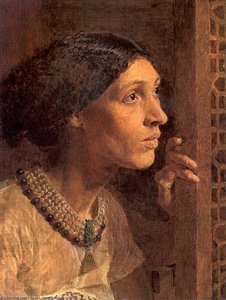
A Moment Frozen in Time: Exploring Albert Moore’s ‘Blossoms’
Albert Joseph Moore's “Blossoms,” completed in 1881, stands as a quintessential example of Pre-Raphaelite Romanticism—a testament to meticulous observation and an unwavering devotion to beauty. More than just a depiction of flowers, it embodies a profound meditation on femininity, stillness, and the delicate interplay between nature and artifice. This captivating oil painting resides within the Tate Gallery’s collection, offering viewers a glimpse into the artistic sensibilities of Victorian England.The Composition: A Symphony of Lines and Shapes
Moore skillfully employs geometric principles to orchestrate his scene. The vertical format dominates the canvas, emphasizing height and conveying a sense of grandeur—a deliberate echo of classical sculpture. Within this framework, a woman occupies the central position, draped in flowing pink robes that cascade downwards like petals themselves. Her posture exudes serenity, mirroring the tranquil beauty of the surrounding blossoms. Lines are smooth and curving, particularly evident in the drapery and flower stems, creating an organic flow that guides the eye across the composition. Shapes are predominantly curvilinear—the woman’s form, the floral arrangement, and the folds of fabric—reflecting the influence of Japanese prints, a burgeoning trend during Moore's time which championed subtle coloration and decorative patterns.Technique: Impasto and Detail – Capturing Essence
Moore’s technique is characterized by impasto—thickly applied paint—which lends textural richness to the artwork. This deliberate layering builds depth and simulates the tactile qualities of real blossoms, inviting viewers to imagine the velvety softness of petals and the delicate fragrance of flowers. The artist's meticulous brushwork captures every nuance of light and shadow, enhancing the sense of realism while simultaneously elevating the painting beyond mere representation. Careful attention is paid to detail—the intricate folds of fabric, the subtle variations in color within the blossoms—demonstrating Moore’s unwavering commitment to capturing the essence of his subject matter.Symbolism: White Flowers and Crimson Curtain – Layers of Meaning
The choice of white flowers as a backdrop speaks volumes about purity and remembrance—themes frequently explored by Pre-Raphaelite artists. They symbolize innocence, virtue, and spiritual contemplation, aligning perfectly with Moore’s artistic vision. Conversely, the crimson curtain introduces an element of drama and passion, hinting at hidden emotions or perhaps suggesting a secret rendezvous. This juxtaposition reinforces the painting's contemplative mood while simultaneously stimulating intellectual curiosity. The artist’s use of color is restrained yet purposeful—primarily pinks and reds—creating a harmonious palette that complements the floral motif and enhances its visual impact.Historical Context: Japonisme and Victorian Aestheticism
“Blossoms” emerged during the height of Japonisme—the fascination with Japanese art and culture among Western European artists—a movement fueled by Commodore Perry’s opening of Japan to trade in 1853. Moore embraced these aesthetic principles, prioritizing decorative design and subtle coloration over literal realism. This aligns seamlessly with Victorian Aestheticism, which championed beauty for its own sake and rejected didactic narratives. The painting exemplifies the Pre-Raphaelites' desire to recapture the spirit of medieval art—characterized by idealized forms and luminous colors—a reaction against the prevailing academic conventions of the era. Moore’s masterpiece continues to inspire admiration for its exquisite craftsmanship and profound artistic vision, securing its place as a cornerstone of Victorian Romanticism.Questions & Answers
How do I discover artworks close to "Blossoms" by Albert Joseph Moore?
Artworks similar to "Blossoms" by Albert Joseph Moore are gathered on the artwork's Similars page.
How much light do the colors of "Blossoms" appear to reflect?
The luminance recorded for "Blossoms" by Albert Joseph Moore is gentle luminance.
Where can I find a guide to "Blossoms"?
A Guide page is available for "Blossoms" by Albert Joseph Moore: a printable factsheet about the artwork, designed for students and classroom use.
Artist Biography
early life and education
albert joseph moore, a renowned english painter, was born on september 4, 1841, in york, united kingdom. he was the thirteenth son and fourteenth child of well-known portrait-painter william moore and his second wife, sarah collingham. several of his numerous brothers were educated as artists, including henry moore, r.a., a notable sea painter. albert moore received education at archbishop holgate's school and st. peter's school in york, where he also received instruction in drawing and painting from his father.artistic career
moore's early works show the influence of ruskin, and by 1857, he had already exhibited at the royal academy, showcasing a goldfinch and a woodcock. his artistic style evolved over time, with a marked neo-classical character emerging in the 1860s. this period saw moore designing tiles, wallpaper, and stained glass for morris, marshall, faulkner and co., as well as working as an ecclesiastic and domestic mural painter.notable works and style
moore's paintings typically feature single female figures with formalized proportions, neo-classical drapery, and floral accessories, establishing a major strand of the aesthetic movement. some of his notable works include:- the marble seat (1865), a long series of purely decorative pictures
- elijah's sacrifice (1863), showcasing the influence of ford madox brown and edward armitage
- the loves of the seasons and the winds, one of his most elaborate and painstaking works, painted for mr. mcculloch
museums and collections
moore's work can be found in various museums, including:- york museums trust (york, united kingdom), featuring paintings such as kingcups
- the royal academy (london, united kingdom), where moore frequently exhibited
legacy and later life
moore relied solely on his own judgment in matters both social and artistic, which sometimes proved a bar to his admission into the ranks of the royal academy. despite suffering from a painful and incurable illness, moore continued working until his death on september 25, 1893.- view more works by albert joseph moore at https://OriginalUniqueArt.com/@/albertjosephmoore
- explore the york museums trust collection at https://OriginalUniqueArt.com/@@/as844t-albert-joseph-moore-kingcups
- discover more about the aesthetic movement and its notable artists at https://en.wikipedia.org/wiki/aesthetic_movement

Albert Joseph Moore
1841 - 1893 , United Kingdom
Quick Facts
- Full Name: Albert Joseph Moore
- Nationality: British
- Date Of Birth: 1841
- Date Of Death: 1893
- Place Of Birth: York, United Kingdom
- Notable Artworks:
- The Marble Seat
- Elijah's Sacrifice
- The Loves of The Seasons
- Artistic Movement Or Style: Aesthetic Movement
- Artists Who Influenced This Artist:
- Ruskin
- Ford Madox Brown
- Edward Armitage
Related Articles

Pre-Raphaelite Romanticism: A Guide to Vivid Detail and Medieval Beauty in Victorian Art
Explore the vivid detail and medieval beauty of Pre-Raphaelite Romanticism. Discover the history of masters like Rossetti and Millais through our expert guide to Victorian art, perfect for collectors and professionals seeking authentic, museum-quality reproductions.

Dante Gabriel Rossetti's 25 Masterpieces: A Journey Through Victorian Art & Symbolism | OriginalUniqueArt
Explore 25 iconic artworks by Dante Gabriel Rossetti, a leading Pre-Raphaelite artist. Discover the stories behind masterpieces like 'Proserpine' & 'Beata Beatrix'. Find museum-quality art reproductions and elevate your home decor with OriginalUniqueArt.com.

Sir John Everett Millais: Pre-Raphaelite Rebellion & Victorian Narrative Detail
Explore the revolutionary art of Sir John Everett Millais & the Pre-Raphaelite Brotherhood. Discover their radical realism, symbolic narratives, and lasting impact on Victorian aesthetics. A deep dive into 19th-century masterpieces.
The Pre-Raphaelite Brotherhood: Reclaiming Beauty, Nature, and Truth in Victorian Art History
Explore the revolutionary Pre-Raphaelite Brotherhood. Discover how these visionary artists rejected academic tradition to reclaim beauty, nature, and truth through luminous detail and literary depth in Victorian art history.

The Pre-Raphaelite Brotherhood: Rediscovering Beauty, Romance, and Medieval Magic in Victorian Art
Embark on a journey through the Pre-Raphaelite Brotherhood. Discover the romantic symbolism, medieval magic, and radical beauty of Rossetti and Burne-Jones in this expert exploration of Victorian art history.