Preview
 Send
Send Share
Share
 Details
 Guide
Guide

 Download
 Similars
 X-Ray
X-Ray Diaporama
 Q&A
Q&A Stats
StatsTintern Abbey
 1894
1894 50.0 x 75.0 cm
 The Stirling Smith Art Gallery - Museum
 Read More
Giclée / Art Print
Museum-quality giclée or canvas print with fast production and flexible finish options. ( Buy Hand Made Painting Switch to Digital Image)




































Pick from our preset sizes that match the artwork's original proportions.

Type the width and the height you need, to fit your frame or your wall. A print can only be cut, never made bigger than the picture, so a size with a different shape loses a part of the image. We send you a digital mockup to approve before we print anything. The picture shown on this page does not show the real cut — only the mockup does.
Worldwide Delivery () in 2 weeks instead of standard 4/5 weeks. (28 October)

Free Worldwide Express Shipping

High-Quality Linen Canvas

Full Shipping Insurance

Customs Tax Refund Guarantee

True Color Matching Guarantee

100-Day Return Policy (Defects Only)

100% Money-Back Guarantee

Bulk Discount Offer
 Glass option is only available in size under 110 CM

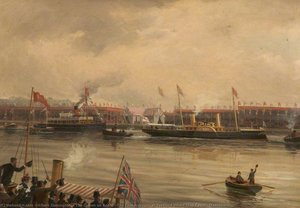
Tintern Abbey
Giclée / Art Print
Reproduction Size
-


Total Price
$ 81
A Description of the Painting
The scene depicts a serene river landscape at sunset, with a man rowing a boat in the center. The surrounding mountains and clouds add depth and drama to the painting, while the warm colors of the setting sun create a sense of tranquility. A bench on the right side of the image invites the viewer to sit and enjoy the view.Artist and Style
Albert Dunington's style is characterized by his use of soft brushstrokes and muted colors, which creates a sense of calmness in his paintings. His work is often compared to that of other notable artists, such as Thomas Stuart Smith, who also created beautiful landscape paintings like Forest and Gondola. For more information on these artists and their works, visit Albert Dunington's page on OriginalUniqueArt.com.Importance of the Painting
The Tintern Abbey painting is not only a beautiful representation of nature but also an important piece of art history. It showcases Dunington's skill in capturing light and atmosphere, making it a valuable addition to any art collection. For those interested in learning more about the artist and his work, OriginalUniqueArt.com offers a range of resources, including biographical information and articles on art history.- Painting title: Tintern Abbey
- Artist: Albert Dunington
- Museum: The Stirling Smith Art Gallery - Museum
For those interested in purchasing a handmade oil painting reproduction of Tintern Abbey, visit OriginalUniqueArt.com to explore their collection of high-quality reproductions.
Questions & Answers
How do the colors of "Tintern Abbey" relate to each other?
The colors of "Tintern Abbey" by Albert Dunington show a unified palette harmony. Harmony describes how the colors relate to each other.
How is the color composition of "Tintern Abbey" by Albert Dunington built?
The color composition of "Tintern Abbey" by Albert Dunington combines a bold contrast with a unified palette harmony.
How can I get a print of "Tintern Abbey" by Albert Dunington?
A print of "Tintern Abbey" by Albert Dunington can be ordered directly on its Fine Art Print page: a fine art print on cotton canvas or archival canvas paper.
Artist Biography
The Visionary of the Victorian Canal
Albert Dunington (1860–1941) remains a singular and evocative figure in the annals of British watercolour and oil painting, a master who captured the very soul of a transforming nation. Born in Lewisham, Kent, Dunington emerged from the prestigious Slade School of Fine Art, where his artistic sensibilities were forged under the watchful eyes of titans such as Frederic Leighton and Joseph Noel Paton. This rigorous classical training provided him with a profound command over composition and anatomy, yet it was his unique ability to marry this academic precision with a Romantic sensibility that truly defined his legacy. His work does not merely document landscapes; it breathes life into the industrializing veins of late nineteenth-century Britain, offering a window into an era where the pastoral beauty of the countryside met the burgeoning might of engineering progress.
The essence of Dunington’s oeuvre lies in his unparalleled ability to render the atmospheric nuances of the British landscape. He possessed an almost scientific eye for the subtle interplay of light, mist, and shadow, techniques that allowed him to imbue even the most industrial scenes with an ethereal, dreamlike quality. Whether he was capturing the quiet ripples of the Worcestershire Canal or the dramatic sunset over a river landscape, his brushwork conveyed a deep emotional resonance. His dedication to realism was never hollow; rather, it was underpinned by a sophisticated understanding of colour theory that allowed him to recreate the textures of stone, water, and sky with breathtaking fidelity. In his hands, the damp air of an English morning or the golden warmth of a departing sun became palpable elements that the viewer could almost feel.
A Legacy of Progress and Pastoral Serenity
Dunington’s artistic journey was marked by a fascinating tension between the celebration of natural beauty and the documentation of human achievement. He was an artist who found profound meaning in the intersection of nature and industry, a theme most vibrantly expressed in his depictions of the Manchester Ship Canal. His celebrated work, ‘The Snowdrop’ with the Directors of the Manchester Ship Canal Passing Barton Bridges (1893), serves as a magnificent historical document, capturing the grandeur of steamships and the excitement of engineering marvels set against the timeless backdrop of the Sussex countryside. This ability to find beauty in the mechanical and the monumental allowed him to transcend simple landscape painting, turning his canvases into narratives of national identity and progress.
Beyond the industrial, Dunington’s repertoire extended into the deeply tranquil and the classically sublime. His paintings often invite a sense of quiet contemplation, as seen in works like Tintern Abbey, where he masterfully utilizes soft brushstrokes and muted tones to evoke a sense of peace. In these pieces, the artist explores the relationship between man and the environment, often placing solitary figures within vast, sweeping vistas to emphasize the grandeur of the natural world. His prolific output, which includes over 300 paintings, demonstrates a lifelong commitment to exploring these diverse themes:
- The Industrial Landscape: Capturing the monumental scale of new canals and bridges, documenting the era of great engineering feats.
- Rural Life: Detailed portrayals of agricultural scenes, such as Lancing Mill, Sussex, which offer a nostalgic glimpse into the rhythms of late Victorian farming.
- Atmospheric Studies: A mastery of light and weather, from the heavy mists of river valleys to the dramatic clarity of mountain vistas.
- Historical Documentation: Creating lasting visual records of specific events and landmarks that shaped the British landscape.
Today, the works of Albert Dunington continue to resonate within public collections across Britain and beyond. His significance lies not only in his technical virtuosity but in his role as a visual chronicler of a pivotal moment in history. He captured a world in transition—a world where the ancient traditions of the English landscape were being reshaped by the relentless march of the industrial revolution, leaving behind a legacy of art that is as much about the enduring spirit of nature as it is about the indelible mark of human progress.

Albert Dunington
1860 - 1941
Quick Facts
- Artistic Movement Or Style: Victorian Watercolor Art
- Artists Or Movements Influenced By This Artist: ['Pre-Raphaelites']
- Artists Who Influenced This Artist: ['William Holman Hunt']
- Date Of Birth: 1860
- Date Of Death: 1941
- Full Name: Albert Dunington
- Nationality: British
- Notable Artworks: ['The Snowdrop with the Directors of the Manchester Ship Canal Passing Barton Bridges']
- Place Of Birth: England