Preview
 Send
Send Share
Share
 Details
 Guide
Guide

 Download
 Similars
 X-Ray
X-Ray Diaporama
 Stats
StatsWithout Devices
 2004
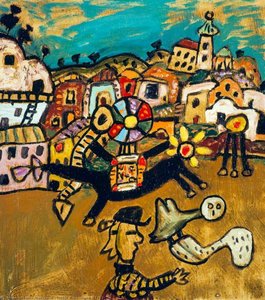
2004 36.0 x 31.0 cm
 Pembroke College Oxford Jcr Art Collection
 Read More
The artwork displayed on this page is protected by copyright law, which means we cannot legally create or sell an identical reproduction. This protection is enforced under international agreements such as the Berne Convention and by national laws, including those outlined by the U.S. Copyright Law - Title 17.
As a respectful and legal alternative, we offer custom, hand-painted artworks inspired by the original. Our skilled and professional artists carefully study the original's style, mood, and artistic essence to create a new, unique piece that evokes the same feeling - while remaining an original creation in its own right.
This method fully complies with copyright regulations because it does not involve copying or duplicating the protected artwork. Instead, it is a creative reinterpretation - a new painting that is influenced by the original but not identical to it.
Hand Made Oil Reproduction
Hand-painted oil on canvas in your size and frame, made to order by our artists. ( Switch to Print Switch to Digital Image)




































Pick from our preset sizes that match the artwork's original proportions.

Type the width and the height you need, to fit your frame or your wall. This is hand-painted, so for a size with a different shape the artist can paint a bit more around the picture, or cut a bit — you choose. We send you a digital mockup to approve before the painting starts. The picture shown on this page does not show the real result — only the mockup does.
After order, OriginalUniqueArt.com team will email client for instructions and provide a mockup preview
Worldwide Delivery () in 3/4 weeks instead of standard 5 weeks. (25 October). No compromise on quality.

Free Worldwide Express Shipping

High-Quality Linen Canvas

Full Shipping Insurance

Customs Tax Refund Guarantee

True Color Matching Guarantee

100-Day Return Policy (Defects Only)

100% Money-Back Guarantee

Bulk Discount Offer
 Glass option is only available in size under 110 CM

Without Devices
Reproduction Medium
Reproduction Size
-


Total Price
$ 300
Artist Biography
Alan Davie: A Visionary Bridging Zen and Surrealism
James Alan Davie (September 28, 1920 – April 5, 2014) was a Scottish painter and musician whose distinctive style fused abstract expressionism with influences from Zen Buddhism and surrealist art. Born in Grangemouth, Scotland, Davie’s artistic journey began at Edinburgh College of Art in the late 1930s where he honed his skills before serving in World War II. His early exhibitions showcased a burgeoning talent for capturing ethereal landscapes and exploring profound symbolic representations.- Early Influences: Davie's formative years were marked by exposure to European avant-garde movements, particularly Surrealism. He was deeply impacted by artists like Joan Miró and Paul Klee, whose playful use of form and color resonated with his own artistic sensibilities.
- Zen Buddhism’s Impact: A pivotal moment arrived when Davie encountered Eugen Herrigel's book “Zen in the Art of Archery,” sparking an interest in Zen philosophy. He embraced its emphasis on spontaneity and intuitive action, believing that true creativity stemmed from releasing conscious control—a principle he actively applied to his painting process.
- Technique & Method: Davie’s approach was revolutionary. Often working on paper, he employed a technique of layering paint until the original canvas was obscured, creating textured surfaces brimming with hidden depths. He famously stood above his paintings during execution, allowing gravity and chance to guide the application of pigment—a method mirroring Pollock's drip painting style.
Exploring Symbolism & Jungian Psychology
Davie’s artistic vision extended beyond mere visual aesthetics; he viewed art as a conduit for spiritual exploration, drawing inspiration from Carl Jung’s theories of archetypes and the unconscious mind. Like Pollock and Miró, he sought to tap into primal energies and communicate universal symbols—a conviction rooted in his belief that cultures across the globe share fundamental artistic expressions. He likened himself to a shaman, recognizing art's capacity to connect with realms beyond rational comprehension.- Celtic Roots: Davie’s fascination with Celtic mythology and symbolism profoundly shaped his imagery. Recurring motifs of spirals, circles, and stylized landscapes reflected ancient traditions and conveyed ideas of interconnectedness and transformation.
- Jungian Resonance: Influenced by Jung's concept of the collective unconscious, Davie aimed to depict hidden patterns and archetypal energies—a deliberate effort to engage viewers on a subconscious level.
Notable Works & Artistic Achievements
Davie’s oeuvre comprises numerous paintings and screenprints that exemplify his distinctive style. Among his most celebrated pieces are “Woman Arranging Flowers” (1945), “Entrance For A Red Temple No. 4” (1960) and "The Magician's Mirror No.3 (Opus 1450)" (2000). These works demonstrate his mastery of color, texture, and compositional dynamism—characteristics that solidified his reputation as a leading figure in British abstract expressionism. His paintings are held in collections worldwide, including the Fine Arts Gallery in San Diego.Legacy & Historical Significance
Alan Davie’s contribution to art history lies in his pioneering blend of Zen philosophy and Surrealist techniques—a synthesis that challenged conventional artistic norms and paved the way for a more expansive understanding of creative expression. He remains an influential artist whose work continues to inspire contemporary artists and collectors alike, embodying a spirit of experimentation and unwavering devotion to conveying profound symbolic meaning. His enduring legacy resides in his ability to capture the essence of human experience through evocative imagery and transformative textures—a testament to the power of art as a vehicle for spiritual contemplation.
Alan Davie
1920 - 2014
Quick Facts
- Artistic Movement Or Style: Zen Painting Style, Surrealism, Abstract Expressionism
- Artists Or Movements Influenced By This Artist:
- Zen
- Surrealism
- Artists Who Influenced This Artist:
- Paul Klee
- Jackson Pollock
- Joan Miró
- Date Of Birth: 1920
- Date Of Death: 2014
- Full Name: James Alan Davie
- Nationality: Scottish
- Notable Artworks:
- The Magician’s Mirror No.3
- Woman Arranging Flowers
- Entrance For A Red Temple No. 4
- Place Of Birth: Grangemouth, Scotland