Preview
 Send
Send Share
Share
 Details
 Guide
Guide

 Download
 Similars
 X-Ray
X-Ray Diaporama
 Q&A
Q&A Stats
StatsThe night
 Oil On Canvas
- WallArt
- Expressionism
 1920
1920- Modern
 50.0 x 61.0 cm
 Private Collection
 Read More
Giclée / Art Print
Museum-quality giclée or canvas print with fast production and flexible finish options. ( Buy Hand Made Painting Switch to Digital Image)




P118B $10

P118H $10

P118W $10

P438Z $10

P508JH $12

P508YH $12

P805H $10

P805Z $10

P919BZ $10

P919G $10

P919XJ $10

P959ZH $10

P968JZ $12

W106C $8

W218G $10

W218JH $8

W218Y $10

W307PJ $10

W316G $10

W316PJ $8

W316Y $10

W398PJ $8

W4111J $10

W500HY $15

W500JH $15

W692G $12

W849H $8

W940BG $15

W953PJ $8




Pick from our preset sizes that match the artwork's original proportions.

Type the width and the height you need, to fit your frame or your wall. A print can only be cut, never made bigger than the picture, so a size with a different shape loses a part of the image. We send you a digital mockup to approve before we print anything. The picture shown on this page does not show the real cut — only the mockup does.
Worldwide Delivery () in 2 weeks instead of standard 4/5 weeks. (28 October)

Free Worldwide Express Shipping

High-Quality Linen Canvas

Full Shipping Insurance

Customs Tax Refund Guarantee

True Color Matching Guarantee

100-Day Return Policy (Defects Only)

100% Money-Back Guarantee

Bulk Discount Offer
 Glass option is only available in size under 110 CM

The night
Giclée / Art Print
Reproduction Size
-


Total Price
$ 81
A Midnight Meditation: The Soul of Johannessen’s Expressionism
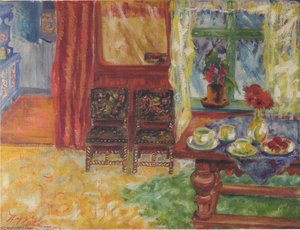
In the quietude of the early 20th century, few voices captured the intersection of human vulnerability and natural serenity as poignantly as Aksel Waldemar Johannessen. His masterpiece, "The Night," serves as a profound window into a world where the boundaries between the self and the environment begin to dissolve. The painting presents a breathtakingly tranquil scene, centered upon a solitary woman standing before a weathered bench. She is not merely a figure within a landscape; she is the emotional anchor of the composition. As she stands in a moment of deep introspection, her presence invites the viewer into a shared state of contemplation, making the artwork an ideal centerpiece for those seeking to bring a sense of peace and spiritual depth into a curated interior space.
The technical execution of "The Night" is a testament to the power of the Expressionist movement. Johannessen employs a loose, almost rhythmic brushwork that suggests the rich texture of an impasto technique. This tactile quality gives the foliage a dense, layered appearance, while the woman’s pale blue dress provides a soft, luminous contrast against the darker, more mysterious greens and purples of the surrounding woods. The lines are intentionally blurred, eschewing sharp realism in favor of a dreamlike, atmospheric quality. This softness creates a sense of movement within the stillness, as if the very air of the night is breathing alongside the subject.
Symbolism and the Language of Color
Color serves as the primary emotional conductor in this work. The palette is dominated by cool, nocturnal tones—deep blues, muted greens, and subtle violets—which immediately establish a mood of profound calm. There is no harsh sunlight here to disrupt the sanctity of the moment; instead, a diffused, even light bathes the scene, minimizing shadows and creating a flattened, almost ethereal perspective. This lack of dramatic contrast emphasizes the unity between the woman and the earth. Her clasped hands and steady gaze suggest a state of prayer or meditation, imbuing the canvas with spiritual undertones that resonate far beyond the frame.
For the discerning collector or interior designer, this painting offers more than mere decoration; it offers an atmosphere. The organic shapes of the trees and the geometric stability of the bench create a balanced composition that can anchor a room, providing a focal point that encourages slow looking and quiet thought. Whether placed in a contemporary gallery-style living room or a classic study, "The Night" acts as a silent interlocutor, evoking themes of solitude, connection to nature, and the enduring beauty found in life's most private moments.
Questions & Answers
What does "The night" by Aksel Waldemar Johannessen bring to an interior?
The serene atmosphere of "The night" by Aksel Waldemar Johannessen matches its recommended space: a bedroom.
At what age did Aksel Waldemar Johannessen make "The night"?
Aksel Waldemar Johannessen was 40 years old when creating "The night" in 1920. The age is computed from the artist's birth year, 1880.
Why is the copyright status of "The night" what it is?
"The night" by Aksel Waldemar Johannessen is in the public domain - its copyright has expired. Copyright duration runs from the artist's death, which occurred in 1922.
Artist Biography
Aksel Waldemar Johannessen: A Rediscovered Voice of the Norwegian Working Class
The art world often rewards those who are immediately recognized, lauded for their innovations and contributions. But sometimes, brilliance is obscured by circumstance, forgotten amidst the currents of time. Aksel Waldemar Johannessen (1880-1922) represents precisely such a rediscovery – a Norwegian Expressionist painter whose powerful depictions of the lives of workers and his unflinching social commentary were largely ignored during his lifetime, only to be resurrected with renewed appreciation in recent decades. His work offers a poignant glimpse into the realities of early 20th-century Norway, revealing a uniquely sensitive and critical perspective rarely seen in contemporary art.
Born in Oslo’s Hammersborg district – a neighborhood characterized by poverty and industrial labor – Johannessen's upbringing profoundly shaped his artistic vision. Growing up amidst the struggles of working-class families instilled within him a deep empathy for their plight, which he translated into his paintings with remarkable honesty. He initially studied sculpting at the state-run art school in Oslo, finding mentorship under Lars Utne, before marrying Anna Nilsen and relocating to Gjøvik around 1910. This move brought him a position as a furniture designer, providing a practical grounding while simultaneously fueling his artistic explorations. It was during this period that he began to develop his distinctive style – a potent blend of realism and emotional intensity, informed by the influence of Edvard Munch, though possessing a uniquely Nordic sensibility.
The Palette of Struggle: Style and Technique
Johannessen’s paintings are immediately recognizable for their raw emotion and unflinching portrayal of everyday life. He eschewed idealized representations in favor of depicting the harsh realities faced by laborers – miners, factory workers, and domestic servants – with a directness that was both unsettling and profoundly moving. His brushwork is often loose and expressive, conveying a sense of urgency and turmoil. He frequently employed muted earth tones—browns, grays, and ochres—to create a somber atmosphere, reflecting the bleak conditions he depicted. Light plays a crucial role in his work, often diffused and melancholic, casting long shadows that emphasize the isolation and vulnerability of his subjects.
Consider “Washing Hair,” a particularly evocative piece from 1920. The painting captures a moment of quiet intimacy within a cramped dwelling, yet it’s imbued with an underlying sense of hardship. The woman's face is etched with weariness, her movements deliberate and economical. The loose brushstrokes and subtle use of light create a palpable atmosphere of fatigue and resignation. Similarly, “Card Players,” showcases the starkness of working-class life, presenting a scene of men engaged in a simple pastime, their faces reflecting the burdens they carry.
A Forgotten Master: Influences and Context
While Johannessen’s work bears clear affinities with Edvard Munch – particularly his exploration of psychological intensity and emotional landscapes – he forged his own distinct path. The influence of Northern European realism is also evident, grounding his depictions in a tangible sense of place and time. The social context of early 20th-century Norway—a nation grappling with rapid industrialization and social inequality—provided the backdrop for his artistic concerns. He was part of a broader movement seeking to depict the lives of ordinary people, challenging prevailing notions of beauty and heroism.
Interestingly, Johannessen’s work remained largely unknown until 1990, when art collector Haakon Mehren stumbled upon a collection of his paintings. This rediscovery sparked renewed interest in his oeuvre, leading to exhibitions and critical reassessment. The play “The Forgotten Painter” by Alexander Kratzer further cemented his place in the cultural consciousness, bringing his story to a wider audience.
Legacy and Recognition
Aksel Waldemar Johannessen’s life was tragically cut short at the age of 42, succumbing to pneumonia after battling alcoholism. Despite his untimely death, his artistic legacy has experienced a remarkable resurgence. His paintings now command significant attention within the art world, recognized for their raw emotional power and social commentary. His work stands as a testament to the importance of remembering those whose voices have been historically marginalized – a poignant reminder that true artistry often lies hidden beneath the surface, waiting to be rediscovered.
Johannessen’s story serves as a powerful illustration of how art can reflect and shape our understanding of society. His paintings offer a vital window into the lives of ordinary people, prompting us to confront uncomfortable truths about social inequality and human suffering. He remains a significant figure in Norwegian Expressionism, a forgotten master whose voice is finally being heard.

Aksel Waldemar Johannessen
1880 - 1922
Quick Facts
- Full Name: Aksel Waldemar Johannessen
- Nationality: Norwegian
- Date Of Birth: 1880
- Date Of Death: 1922
- Place Of Birth: Oslo, Norway
- Notable Artworks:
- Card Players
- Washing Hair
- Artistic Movement Or Style: Expressionism, Realism
- Artists Who Influenced This Artist: ['Edvard Munch']
Related Articles
Monet's Masterpieces: 25 Iconic Artworks to Transform Your Home
Journey through 25 iconic Claude Monet masterpieces! Explore Impressionism’s beauty, from Water Lilies to Rouen Cathedral. Discover stunning art reproductions & curated decor ideas – explore the full collection online at OriginalUniqueArt.com.

Slate Blue Masterpieces: 10 Iconic Paintings & Timeless Home Decor Ideas
Immerse yourself in the captivating world of slate blue! Explore 10 iconic paintings by Monet, Van Gogh & Renoir. Discover their stories, techniques & find museum-quality art reproductions for your home at .
The Allure of Azure: Exploring the Symbolic & Aesthetic Depths of Blue in Art History
Explore the rich history of blue in art! Discover its symbolism, from ancient pigments to modern masterpieces by Kandinsky & Seurat. Uncover the psychological impact and cultural meanings behind this captivating hue.
Serene Masterpieces: 10 Artworks for Peaceful Decor |
Find peace with 10 serene masterpieces! Explore calming landscapes by Monet & Van Gogh, tranquil Japanese art like Hokusai’s Great Wave, and more. Discover the stories behind these iconic paintings & bring museum-quality art to your home with . Explore the full collection online.
Azure Visions: Exploring Representations of the Blue Dress in Western Art History
Explore the rich history of the blue dress in Western art! Discover its symbolism, from Renaissance masterpieces to modern interpretations by artists like Martin & Schiele. Uncover cultural meanings and artistic techniques.