Preview
 Send
Send Share
Share
 Details
 Guide
Guide

 Download
 Similars
 X-Ray
X-Ray Diaporama
 Stats
StatsTitian
 Engraving
- WallArt
- Baroque Renaissance
 1587
1587- Renaissance
 327.0 x 236.0 cm
 Staatliche Museen zu Berlin
 Read More
Giclée / Art Print
Museum-quality giclée or canvas print with fast production and flexible finish options. ( Buy Hand Made Painting Switch to Digital Image)




P118B $10

P118H $10

P118W $10

P438Z $10

P508JH $12

P508YH $12

P805H $10

P805Z $10

P919BZ $10

P919G $10

P919XJ $10

P959ZH $10

P968JZ $12

W106C $8

W218G $10

W218JH $8

W218Y $10

W307PJ $10

W316G $10

W316PJ $8

W316Y $10

W398PJ $8

W4111J $10

W500HY $15

W500JH $15

W692G $12

W849H $8

W940BG $15

W953PJ $8




Pick from our preset sizes that match the artwork's original proportions.

Type the width and the height you need, to fit your frame or your wall. A print can only be cut, never made bigger than the picture, so a size with a different shape loses a part of the image. We send you a digital mockup to approve before we print anything. The picture shown on this page does not show the real cut — only the mockup does.
Worldwide Delivery () in 2 weeks instead of standard 4/5 weeks. (24 October)

Free Worldwide Express Shipping

High-Quality Linen Canvas

Full Shipping Insurance

Customs Tax Refund Guarantee

True Color Matching Guarantee

100-Day Return Policy (Defects Only)

100% Money-Back Guarantee

Bulk Discount Offer
 Glass option is only available in size under 110 CM

Titian
Giclée / Art Print
Reproduction Size
-


Total Price
$ 81
A Glimpse into Renaissance Dignity: The Portrait of Agostino Carracci's Subject
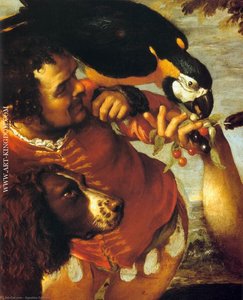
To stand before this masterful engraving is to encounter a moment suspended in the amber glow of the late sixteenth century. This portrait, executed with the meticulous precision characteristic of printmaking from the era, draws us intimately close to the subject—a man whose bearing speaks volumes without uttering a single word. The composition centers him formally, yet his slight turn of the head injects a subtle, captivating dynamism into what might otherwise be a static homage. It is a study in controlled intensity; the viewer is immediately drawn past the rich texture of the fur-lined garment to the profound depth held within the subject's gaze.
Mastery in Line: The Art of Engraving
What elevates this piece beyond mere likeness is the sheer technical virtuosity displayed. This work is not painted with pigment, but etched into metal, a testament to the skill of the printmaker. Observe how the artist has manipulated line itself to create illusion. Through expert hatching and cross-hatching—those delicate, intersecting networks of fine lines—the engraver has sculpted shadow and highlight. These techniques allow for an astonishing simulation of texture: the soft resilience of hair against the coarse nap of beard, the luxurious depth of fur, and the subtle folds of heavy fabric. The entire portrait breathes through these controlled, deliberate marks.
Historical Echoes and Emotional Resonance
The style firmly roots us in the transition between Mannerism and the burgeoning naturalism that would define the Baroque period. While the subject possesses an undeniable air of status—suggested by his attire and composed bearing—the emotional undercurrent is one of profound solemnity. This seriousness suggests a man accustomed to weighty matters, perhaps a scholar, patron, or figure of civic importance. The use of directional lighting, creating that dramatic chiaroscuro effect so beloved in Renaissance art, doesn't just illuminate; it sculpts the soul visible on his face, lending an air of timeless dignity.
Curating History for Your Space
For the discerning collector or designer seeking to infuse a room with the gravitas and artistry of Old Master techniques, this reproduction offers unparalleled depth. Owning such a piece is not simply acquiring decoration; it is curating a dialogue across centuries. The monochromatic palette ensures that its power lies in form, texture, and narrative rather than fleeting color trends. Imagine this engraving lending an intellectual weight to a library, or providing a historical anchor within a formal drawing-room. It invites contemplation, demanding that the viewer slow down and appreciate the enduring human spirit captured by the finest hand of the printmaker.
Questions & Answers
What is the dominant hue of "Titian" by Agostino Carracci?
A green to violet spectrum hue runs through "Titian" by Agostino Carracci.
Did "Titian" stay in its artist's homeland?
No - the artwork is kept abroad. The birth country of Agostino Carracci is Italy, and the museum holding the original of "Titian" is in Germany.
What are the reproduction rights of "Titian" at the Staatliche Museen zu Berlin?
The copyright status of "Titian" by Agostino Carracci is clear: the work is in the public domain - its copyright has expired. Its presence at the Staatliche Museen zu Berlin does not change that status.
Artist Biography
The Architect of Naturalism: The Life and Legacy of Agostino Carracci
Agostino Carracci stands as a pivotal figure in the burgeoning Baroque movement within Bologna, Italy. Often overshadowed by his more celebrated brother, Annibale, Agostino’s artistic vision—characterized by a deliberate rejection of Mannerist formalism and an embrace of classical ideals—established him as a crucial innovator who profoundly impacted the stylistic trajectory of Bolognese painting. He was not merely a craftsman but a visionary pedagogue, shaping the future generation of artists through the Accademia degli Incamminati, alongside Annibale and Ludovico Carracci. This academy became a crucible for a new era of art, moving away from the artificiality of the late Renaissance toward a more profound connection with reality. Born in Bologna in 1557 to Giovanni Battista Carracci and Lucrezia Panciatichi, Agostino’s artistic journey began under the tutelage of Domenico Tiberiadi. This early training instilled in him a foundational understanding of disegno—the humanist concept of drawing—which was essential for mastering classical proportions and perspective. While his contemporaries often leaned into the stylized forms and exaggerated poses of Mannerism, Agostino sought inspiration from the enduring strength of antiquity. He looked toward Roman sculpture and architecture as the ultimate models for achieving artistic excellence, believing that true beauty resided in the balance between idealized form and natural truth.The Mastery of Line and Light
Before he achieved renown for monumental frescoes and portraits, Carracci’s career found its footing through the intricate medium of engraving. This period was transformative, as he utilized the printmaker's tool to reproduce masterpieces by titans such as Federico Barocci, Tintoretto, Veronese, and Correggio. For Agostino, engraving was far more than a method of reproduction; it was a vital intellectual exercise in disseminating artistic knowledge across Europe. His prints demonstrated an acute sensitivity to tonal variations and chiaroscuro—the dramatic interplay of light and shadow—which would later become a hallmark of the Baroque style. Through these meticulous lines, he translated the fluid textures of paint into the permanent language of ink, elevating the status of printmaking within the fine arts. His technical prowess is perhaps most intimately captured in his preparatory works, where the boundary between study and masterpiece dissolves. In works such as his Study of a Spaniel’s Head, one can witness the artist's commitment to naturalism. Created around 1598, this drawing avoids all artifice, presenting the subject with remarkable realism—from the attentive eyes to the textured, curly fur of the ears. Such studies served as the essential building blocks for his larger compositions, proving that his devotion to the minute details of the natural world was the foundation upon which his grander, more classical visions were built.A Lasting Impression on the Baroque Era
The historical significance of Agostino Carracci lies in his role as a bridge between two eras. By challenging the intellectualized complexity of Mannerism with a renewed focus on clarity and natural observation, he helped midwife the birth of the Bolognese School. His ability to blend the classical elegance of the Renaissance with the emotional depth and dramatic lighting of the Baroque provided a blueprint for generations of painters. Whether through the ethereal beauty found in his The Three Graces or the familial intimacy captured in portraits of himself and his brothers, Agostino’s work remains a testament to a period of profound transition. Though his life was tragically short, ending in 1602, his influence endured far beyond his years. Through the Accademia degli Incamminati, he helped establish a pedagogical tradition that prioritized direct observation and classical study, ensuring that the principles of naturalism would become a cornerstone of Western art. His legacy is not found merely in individual canvases, but in the very way we perceive light, shadow, and the human form—a legacy of precision, passion, and an unwavering pursuit of truth in art.
Agostino Carracci
1557 - 1602 , Italy
Quick Facts
- Artistic Movement Or Style: Baroque, Naturalism
- Artists Or Movements Influenced By This Artist:
- Bolognese School
- Accademia degli Incamminati
- Artists Who Influenced This Artist:
- Domenico Tiberiadi
- Federico Barocci
- Tintoretto
- Veronese
- Correggio
- Full Name: Agostino Carracci
- Nationality: Italian
- Notable Artworks:
- The Three Graces
- Jupiter
- Study of a Spaniel’s Head
- Place Of Birth: Bologna, Italy
- Date Of Birth: 1557
- Date Of Death: 1602
Related Articles
Annibale Carracci: Bridging Renaissance Ideals & Baroque Innovation
Explore the life & art of Annibale Carracci, a pivotal figure bridging Renaissance ideals with Baroque innovation. Discover his masterpieces and lasting influence on Italian painting.

Drama and Light: A Definitive Guide to the Italian Baroque Masterpieces and the Revolution of Chiaroscuro
Explore the dramatic world of Italian Baroque art. Discover how masters like Caravaggio used chiaroscuro and tenebrism to revolutionize painting through light, shadow, and profound realism. A definitive guide for history lovers and art collectors.

Baroque Drama: Bringing Opulence & Emotion into Contemporary Interiors
Explore the opulent world of Baroque interior design! Discover key elements, modern applications & how to bring dramatic elegance into your home with OriginalUniqueArt.com's authentic reproductions.

Engraving: A Historical Survey of Technique, Artistic Expression & Enduring Legacy
Explore the rich history of engraving with OriginalUniqueArt. Discover techniques, iconic artists like Dürer & Callot, collecting tips, and expert guidance for preserving your art investment. Learn about intaglio printing & more!

Engraving's Golden Age: 10 Masterpieces That Redefined Art | OriginalUniqueArt
Journey through art history with our Top 10 Legendary Engravings! Explore masterpieces by Dürer, Rembrandt & Goya. Discover the stories behind these iconic prints and find museum-quality reproductions for your home at OriginalUniqueArt.com.