Text size

() ·

A painting made for you, by hand

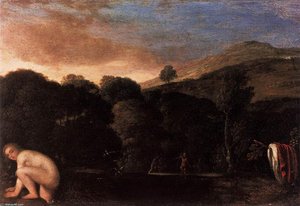
The Flight into Egypt

Hand Made Oil Reproduction

Hand-painted oil on canvas in your size and frame, made to order by our artists. ( Switch to Print Switch to Digital Image)

Collectible Description

Adam Elsheimer's 'Flight into Egypt' (1609) is a stunning cabinet painting showcasing the Holy Family amidst a dramatic, star-filled night sky – a masterpiece of Baroque artistry and innovative landscape depiction.

Artist Biography

Adam Elsheimer (1578-1610): German Baroque master of small-scale cabinet paintings & innovative landscapes. Influenced Rembrandt, Rubens & pioneered nocturnal scenes! Explore his art.

from ·

Chapter 1

How large should it be?

Slide to change the size; the picture on the left shows the frame at its real width. The proportions of the original are kept.

Standard
custom
CM
INCH

Pick from our preset sizes that match the artwork's original proportions.

width
height

Type the width and the height you need, to fit your frame or your wall. This is hand-painted, so for a size with a different shape the artist can paint a bit more around the picture, or cut a bit — you choose. We send you a digital mockup to approve before the painting starts. The picture shown on this page does not show the real result — only the mockup does.

Chapter 2

How should it arrive?

Choose the edges of the stretched canvas

Choose your frame

Corner sample of the WhiteWrap canvas edge finish, stretched on solid wood bars
White $1
Corner sample of the BlurSideWrap canvas edge finish, stretched on solid wood bars
Blurside $1
Corner sample of the ExtendedWrap canvas edge finish, stretched on solid wood bars
Extended $1
Corner sample of the P118B picture frame: moulded polystyrene, 5 cm wide and 3 cm thick
P118B $10
Corner sample of the P118H picture frame: moulded polystyrene, 5 cm wide and 3 cm thick
P118H $10
Corner sample of the P118W picture frame: moulded polystyrene, 5 cm wide and 3 cm thick
P118W $10
Corner sample of the P438Z picture frame: moulded polystyrene, 5.5 cm wide and 3.5 cm thick
P438Z $10
Corner sample of the P508JH picture frame: moulded polystyrene, 7 cm wide and 3.5 cm thick
P508JH $12
Corner sample of the P508YH picture frame: moulded polystyrene, 7 cm wide and 3.5 cm thick
P508YH $12
Corner sample of the P805H picture frame: moulded polystyrene, 5 cm wide and 3.5 cm thick
P805H $10
Corner sample of the P805Z picture frame: moulded polystyrene, 5 cm wide and 3.5 cm thick
P805Z $10
Corner sample of the P919BZ picture frame: moulded polystyrene, 7 cm wide and 3.5 cm thick
P919BZ $10
Corner sample of the P919G picture frame: moulded polystyrene, 7 cm wide and 3.5 cm thick
P919G $10
Corner sample of the P919XJ picture frame: moulded polystyrene, 7 cm wide and 3.5 cm thick
P919XJ $10
Corner sample of the P959ZH picture frame: moulded polystyrene, 5 cm wide and 3 cm thick
P959ZH $10
Corner sample of the P968JZ picture frame: moulded polystyrene, 6 cm wide and 4 cm thick
P968JZ $12
Corner sample of the W106C picture frame: solid wood, 5 cm wide and 3 cm thick
W106C $8
Corner sample of the W218G picture frame: solid wood, 5 cm wide and 3 cm thick
W218G $10
Corner sample of the W218JH picture frame: solid wood, 5 cm wide and 3 cm thick
W218JH $8
Corner sample of the W218Y picture frame: solid wood, 5 cm wide and 3 cm thick
W218Y $10
Corner sample of the W307PJ picture frame: solid wood, 6 cm wide and 3 cm thick
W307PJ $10
Corner sample of the W316G picture frame: solid wood, 6 cm wide and 3 cm thick
W316G $10
Corner sample of the W316PJ picture frame: solid wood, 6 cm wide and 3 cm thick
W316PJ $8
Corner sample of the W316Y picture frame: solid wood, 6 cm wide and 3 cm thick
W316Y $10
Corner sample of the W398PJ picture frame: solid wood, 5 cm wide and 3 cm thick
W398PJ $8
Corner sample of the W4111J picture frame: solid wood, 6.5 cm wide and 3.5 cm thick
W4111J $10
Corner sample of the W500HY picture frame: solid wood, 7 cm wide and 5 cm thick
W500HY $15
Corner sample of the W500JH picture frame: solid wood, 7 cm wide and 5 cm thick
W500JH $15
Corner sample of the W692G picture frame: solid wood, 8 cm wide and 4 cm thick
W692G $12
Corner sample of the W849H picture frame: solid wood, 5 cm wide and 3 cm thick
W849H $8
Corner sample of the W940BG picture frame: solid wood, 7.5 cm wide and 4.5 cm thick
W940BG $15
Corner sample of the W953PJ picture frame: solid wood, 6 cm wide and 3.5 cm thick
W953PJ $8
Corner sample of the H24-GOLD picture frame: carved wood with gesso, 10 cm wide and 6 cm thick
H24-GOLD $30
Corner sample of the H24-SILVER picture frame: carved wood with gesso, 10 cm wide and 6 cm thick
H24-SILVER $30
Corner sample of the H36-GOLD picture frame: carved wood with gesso, 15 cm wide and 6.5 cm thick
H36-GOLD $45
Corner sample of the H36-SILVER picture frame: carved wood with gesso, 15 cm wide and 6.5 cm thick
H36-SILVER $45
Frame preview
Framed

Moulding: . Overall size with the frame: .

Chapter 3

Who paints it, and should anything change?

Examples of what can be changed: Replace face with customer photo; Add pet (e.g., replace cat with dog); Include hidden message in background; Change background landscape or elements.
After order, OriginalUniqueArt.com team will email client for instructions and provide a mockup preview

Worldwide Delivery () in 3/4 weeks instead of standard 5 weeks. (5 November). No compromise on quality.

Chapter 4

The finishing touches

A nameplate, as in a museum?

Engraved Bronze Plaque Details

This elegant plaque features the artist's name and the title of the artwork, finely engraved for a timeless presentation.

It is made from bronze with a refined, elegant finish. The text is precisely laser-engraved for a sharp and permanent result. Measuring 9x2 cm, the plaque is compact yet easy to read. It's built to be durable and scratch-resistant, offering a professional, museum-quality look. Mounting is simple thanks to the included adhesive backing.

Transparent Acrylic Plaque Details

The plaque includes essential engraved details such as the artist's name, the title of the artwork, the date it was created, the type of media used-like oil on canvas or watercolor-a brief description of the piece, and a QR code that links to the complete artwork information.

It is crafted from clear acrylic, offering a sleek, modern appearance. The text is UV-engraved in black to ensure strong visual contrast. With a size of 10x15 cm, it ensures optimal readability. It comes equipped with two metal hooks for secure wall mounting. The plaque is designed to be weather-resistant, making it suitable for various environments, and it includes interactive features that work seamlessly with smartphone scanning.

Black Acrylic Plaque Details

This elegant plaque includes engraved information such as the artist's name, the title of the artwork, the date it was created, the type of media used (like oil on canvas or watercolor), a short description of the artwork, and a QR code for quick access to more information.

The plaque itself is made from refined black acrylic with a premium finish. The text is laser-engraved in white for high contrast and readability. Its size is 10x15 cm, designed to be easy to read. It comes with two metal hooks for professional mounting. The design is sleek and fits any interior style. It is also weather-resistant and durable, with built-in digital integration for mobile compatibility.

A protective varnish?

When do you need it?

Chapter 5

Your painting, as you ordered it

The Flight into Egypt

Reproduction Medium

Reproduction Size

-

Elite Senior Artist

More detail, finesse, and extra production time

-

Reproduction Frame

-

-

For artworks or reproductions larger than 105 cm (approximately 41 inches) on any side, the frame will be shipped as a kit, disassembled. This method ensures safe delivery and prevents damage during transport.

Professional assembly required - this is not a DIY product.
The kit must be assembled and the canvas stretched by an experienced professional framer, using wood glue (not supplied), a canvas stretching plier and clamps to hold the bars square while the glue dries. Incorrect assembly or uneven canvas tension can permanently damage the artwork and is not covered by our warranty.

  • All solid wood bars are included, precisely cut to size.

  • Assembled with the screws provided, plus wood glue for the corner joints, which is not supplied and must be sourced by your framer.

  • Professional tools are required and not included: a canvas stretching plier (tensioner) and clamps to hold the bars square while the glue dries.

Important:
The corner joints require wood glue, the bars must be held with clamps until the glue is fully dry, and tightening the canvas on the assembled frame requires a canvas stretching plier. None of these are included in the kit. Please arrange an experienced professional framer before ordering this size.

Nameplate

-

-

Protective Varnish

Glossy Varnish (enhances colors, protects against light/moisture)

-

Customize My Artwork

Examples of what can be changed: Replace face with customer photo; Add pet (e.g., replace cat with dog); Include hidden message in background; Change background landscape or elements.

-

Urgent

Worldwide Delivery () in 3/4 weeks instead of standard 5 weeks. (5 November). No compromise on quality.

-

Express Shipping

Worldwide Delivery () in 5 weeks. (12 November).

Included

Total Price

$ 300

Total Price $ 300

Glass option is only available in size under 110 CM

Included with every order

  • Free Worldwide Express Shipping
  • High-Quality Linen Canvas
  • Full Shipping Insurance
  • Customs Tax Refund Guarantee
  • True Color Matching Guarantee
  • 100-Day Return Policy (Defects Only)
  • 100% Money-Back Guarantee
  • Bulk Discount Offer

A Nocturnal Pilgrimage: Adam Elsheimer’s “The Flight into Egypt”

Adam Elsheimer's "The Flight into Egypt," painted around 1609 during his brief but brilliant Roman period, isn’t merely a biblical depiction; it’s an immersive experience of light, shadow, and profound spiritual contemplation. Far removed from the grand scale of many Baroque masterpieces, this small oil-on-copper panel—a mere 9 x 7 centimeters—holds within its diminutive frame a universe of artistic innovation and emotional resonance. It's a testament to Elsheimer’s singular vision: a master of capturing fleeting moments of intense feeling with remarkable technical precision.

The scene unfolds against a dramatically rendered night sky, an audacious choice for the time. Elsheimer wasn’t simply illustrating a biblical narrative; he was wrestling with the mysteries of darkness and light, mirroring the human condition's inherent struggle between fear and hope. The composition is dominated by this evocative sky, meticulously constructed with a startling accuracy that suggests Elsheimer’s deep engagement with astronomical observations – a detail often overlooked in discussions of his work. The Milky Way stretches across the heavens like a river of stardust, punctuated by recognizable constellations such as Ursa Major and Leo, each rendered with an almost photographic realism. This wasn't merely decorative; it was a deliberate attempt to connect the earthly drama unfolding below with the vastness and order of the cosmos.

The Anatomy of Light: Technique and Innovation

Elsheimer’s mastery lies in his manipulation of light and shadow, techniques that were revolutionary for his time. He employed a technique known as “pointillé,” using tiny dots of paint to build up color and texture—a method borrowed from the Flemish masters but pushed to an unprecedented level of detail. This creates a shimmering effect, particularly noticeable in the depiction of the moon’s reflection on the water and the subtle gradations of light across the landscape. The use of chiaroscuro – the dramatic contrast between light and dark – is not employed for theatricality, but rather to heighten the sense of intimacy and vulnerability within the scene.

The copper panel itself played a crucial role in Elsheimer’s artistic process. It allowed him to work with greater precision and achieve a luminosity that was difficult to replicate on wood panels. The reflective surface also contributed to the painting's ethereal quality, as light bounced off the metal and created an almost otherworldly glow. Furthermore, the small size of the panel demanded careful consideration of composition; every element—from the figures’ clothing to the texture of the trees—had to be rendered with exquisite detail.

Symbolism and Spiritual Depth

Beyond its technical brilliance, “The Flight into Egypt” is rich in symbolic meaning. The journey itself represents a perilous pilgrimage toward salvation, mirroring the Exodus narrative and offering a potent metaphor for humanity’s ongoing quest for redemption. The broad-brimmed hats worn by Joseph and Mary are not merely decorative; they symbolize protection from the harsh realities of the world—a visual reminder of their vulnerability and dependence on divine grace.

The prominent oak tree, bathed in a divine light, is particularly significant. It’s an allusion to the Tree of Life, rooted in biblical tradition and representing immortality – a direct reference to the cross of Christ, whose wood bestowed eternal life upon humanity. The scene subtly suggests that this humble family, fleeing persecution, are also enacting a sacred drama, embodying the promise of salvation through faith and obedience.

A Legacy of Intimacy

Adam Elsheimer’s “The Flight into Egypt” is more than just a beautiful painting; it's a poignant meditation on faith, family, and the human condition. His innovative use of light, his meticulous attention to detail, and his profound understanding of symbolism combine to create an artwork that continues to captivate viewers centuries later. Despite producing only a handful of finished works during his tragically short life, Elsheimer left behind a legacy of artistic innovation and emotional depth—a testament to the power of art to illuminate the darkest corners of our souls.

Questions & Answers

What palette and what feeling does "The Flight into Egypt" combine?

"The Flight into Egypt" by Adam Elsheimer combines an earthy palette with a melancholic tone.

Is "The Flight into Egypt" by Adam Elsheimer a bright or a dark artwork?

The perceived brightness of "The Flight into Egypt" by Adam Elsheimer is balanced. It can be matched to the light of the intended space.

How old was Adam Elsheimer when creating "The Flight into Egypt" in 1605?

Adam Elsheimer made "The Flight into Egypt" at the age of 27. The artist was born in 1578 and the work is dated 1605.

More about this painting

Preview AR preview Switch to Print Switch to Digital Image Send
Details Guide Add to favorites Download Similars X-Ray Diaporama Q&A Stats

In numbers

  • 1605the year it was painted
  • 29frames to choose from
  • standard sizes, in its own proportions
  • 5weeks to paint and deliver it
Adam Elsheimer

Adam Elsheimer

1578 - 1610, Germany

Quick facts about Adam Elsheimer

  • Full Name: Adam Elsheimer
  • Nationality: German
  • Date Of Birth: 1578
  • Date Of Death: 1610
  • Place Of Birth: Frankfurt, Germany
  • Notable Artworks:
    • Tobias and the Angel
    • The Burning of Troy
    • Apollo and Coronis
    • The Stoning of St. Stephen
  • Artistic Movement Or Style: Baroque painting
  • Artists Who Influenced This Artist:
    • Albrecht Dürer
    • Tintoretto
    • Paolo Veronese
  • Artists Or Movements Influenced By This Artist:
    • Rembrandt
    • Peter Paul Rubens

Artist Biography

A Luminous Life Cut Short: The World of Adam Elsheimer

Adam Elsheimer, a name perhaps less instantly recognizable than those of his Baroque contemporaries Rubens or Rembrandt, nonetheless occupies a pivotal position in the history of art. Born in Frankfurt am Main in 1578, his tragically short life – he died at just thirty-two years old in Rome in 1610 – belied an artistic output that resonated deeply with his peers and continues to captivate viewers today. Elsheimer wasn’t a painter of grand scale or prolific production; instead, he specialized in exquisitely detailed cabinet paintings, small works executed primarily on copper plates, which allowed for a level of precision and luminosity rarely seen before. These intimate canvases weren't intended for public display but rather for the private contemplation of connoisseurs – a testament to the burgeoning art market and the growing appreciation for individual artistic expression during the early 17th century. His father, a master tailor, provided a stable upbringing, and young Adam’s early talent was recognized through an apprenticeship with local artist Philipp Uffenbach. This foundational training instilled in him the technical skills that would later blossom under different influences. A likely sojourn to Strasbourg around 1596 exposed him to broader artistic currents, but it was his journey to Italy via Munich in 1598 that truly ignited his creative development.

From Venice to Rome: Forging a Unique Artistic Voice

Italy proved transformative for Elsheimer. He spent considerable time in Venice, absorbing the vibrant color palettes and dramatic compositions of masters like Tintoretto and Paolo Veronese. The influence of these Venetian giants is evident in his early works – a boldness of form and a sensuous use of light that would become hallmarks of his style. Around 1600, he settled in Rome, becoming integrated into the bustling artistic community. A crucial period followed as an assistant to Johann Rottenhammer, a German painter specializing in cabinet paintings. This mentorship provided invaluable technical expertise, particularly in the demanding medium of painting on copper. However, Elsheimer didn’t simply mimic his teacher; he began to forge his own unique path, moving away from strict Mannerist conventions towards a more naturalistic approach. His landscapes, in particular, were innovative for their time, seamlessly integrating figures into harmonious natural settings. He cultivated important friendships with Giovanni Faber, a papal doctor and botanist connected to the Accademia dei Lincei – a scientific society dedicated to observation and experimentation – and Paul Bril, a Flemish landscape painter. These connections exposed him to new ideas and fostered an intellectual curiosity that informed his art.

Master of Light and Shadow: Defining Elsheimer’s Style

Elsheimer's artistic reputation rests on his mastery of light and shadow – *chiaroscuro* – and his pioneering depictions of nocturnal scenes. He was among the first artists to accurately represent constellations in night skies, a testament to his scientific curiosity and meticulous observation. Paintings like “The Flight into Egypt” are breathtaking examples of this skill, where moonlight illuminates the landscape with an ethereal glow, creating a sense of mystery and wonder. His works frequently depicted mythological and biblical scenes, rendered with a lyrical temperament and painstaking detail. "Tobias and the Angel," "The Burning of Troy," "Apollo and Coronis," and “Ceres and Stellio” are all prime examples of his ability to imbue classical narratives with emotional depth and visual poetry. The small scale of his paintings encouraged intimate viewing, allowing audiences to fully appreciate the intricate details and subtle nuances of his technique. He didn’t merely depict scenes; he created worlds – miniature universes brimming with atmosphere and emotion.

A Lasting Legacy: Influence and Rediscovery

Despite his brief career, Adam Elsheimer exerted a considerable influence on subsequent generations of artists. His work was highly regarded by contemporaries, including Peter Paul Rubens, who deeply lamented his early death and praised his exceptional talent. The dissemination of his art was aided by engravings made by Hendrick Goudt, which brought his compositions to a wider European audience. Rembrandt van Rijn, in particular, demonstrably drew inspiration from Elsheimer’s nocturnal scenes and innovative landscapes, incorporating similar effects of light and shadow into his own work. Elsheimer's influence extended beyond the Dutch masters; numerous 17th-century artists across Europe were impacted by his pioneering approach to landscape painting and dramatic lighting techniques. However, after his death, Elsheimer’s reputation waned for centuries. It wasn’t until the 20th century that a renewed appreciation for his work emerged, fueled by scholarly research and a growing recognition of his importance in the development of Baroque art. Today, Adam Elsheimer is celebrated as a visionary artist whose small-scale paintings possess an enduring power to move and inspire. His legacy lies not only in his technical brilliance but also in his ability to capture the beauty and mystery of the world around him with unparalleled sensitivity and grace.

A Life Marked by Struggle

Elsheimer’s life, though artistically fruitful, was not without its hardships. He faced persistent financial difficulties throughout his career, leading to periods of debt and even imprisonment. His marriage in 1606 to Carola Antonia Stuarda da Francoforte brought a brief period of happiness, but the tragic death of their son cast a shadow over his later years. Around 1608, he converted to Catholicism, perhaps seeking solace or hoping for greater acceptance within Roman society. Despite these personal struggles, Elsheimer continued to paint with unwavering dedication until his untimely death in Rome in December 1610 at the age of thirty-two. He left behind a relatively small but profoundly influential body of work – a testament to the power of artistic vision and the enduring legacy of a luminous life cut short.

Quick Facts

  • Artistic style: Baroque
  • Title: The Flight into Egypt
  • Location: Alte Pinakothek, Munich
  • Dimensions: 9 x 7 cm
  • Medium: Oil on copper

Art Quiz

There is only one correct answer for each question.

Question 1:
What is the primary subject of Adam Elsheimer’s ‘The Flight into Egypt’?
Question 2:
According to the description, what is unique about Elsheimer's depiction of the night sky in ‘The Flight into Egypt’?
Question 3:
What medium did Elsheimer predominantly use for his cabinet paintings like ‘The Flight into Egypt’?
Question 4:
In the description, what does the ‘broad-brimmed hats’ symbolize in relation to the figures depicted?
Question 5:
The description mentions that Elsheimer was part of a circle of artists in Rome. Which of the following artists was also associated with this group?