1854
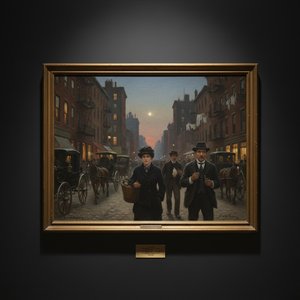
Second Class - the parting: (Abraham Solomon, 1854)
Abraham Solomon (1823–1862) made Second Class - the parting: . It dates from 1854. It is kept at National Gallery of Australia in Canberra, Australia. It measures 694 × 966 cm.
- 1854
- 694 × 966 cm
- National Gallery of Australia, Canberra

 Preview

 Hand Made Oil Painting
 Send
 Share
 Fact sheet


 Download
 Similars
 X-Ray
 Diaporama
 Q&A

 Stats
Second Class - the parting: , in brief
- Title
- Second Class - the parting:
- Artist
- Abraham Solomon (1823–1862)
- Artist born in
- London, United Kingdom
- Date
- 1854
- Dimensions
- 694 × 966 cm
- Where to see it
- National Gallery of Australia, Canberra, Australia
What does Second Class - the parting: depict?
Which museum holds Second Class - the parting: ?
National Gallery of Australia
Canberra, Australia
A Sanctuary of Australian Soul and Global Vision Nestled within the heart of Canberra, the National Gallery of Australia stands as much more than a mere repository for fine art; it is a vibrant, breathing articulation of Australian identity and a crucial bridge connecting the nation’s unique artistic heritage with the world's most profound masterpieces. Since its establishment in 1967, this institution has blossomed from modest beginnings into a powerhouse of visual culture, now safeguarding over 166,000 works that span centuries and continents. To walk through its halls is to embark on an unparalleled journey through Australia’s story, told through the delicate nuances of brushstrokes, the weight of sculpted forms, and the ephemeral beauty of captured moments.


High-resolution images of Second Class - the parting:

Abraham Solomon, Second Class - the parting: (1854), National Gallery of Australia. Public domain.
Questions on Second Class - the parting: , answered
Where is "Second Class - the parting:" by Abraham Solomon on display today?
"Second Class - the parting:" by Abraham Solomon is on display at the National Gallery of Australia, Canberra, Australia. The museum listing refers to the original work, not to reproductions.
In what year was "Second Class - the parting:" by Abraham Solomon created?
"Second Class - the parting:" dates from 1854. The date places the work within Abraham Solomon's career and its era.
How big is the original "Second Class - the parting:"?
"Second Class - the parting:" measures 966 x 694 cm in its original form. Original dimensions are a useful reference when choosing a reproduction size.
Is "Second Class - the parting:" free of copyright?
The copyright answer for "Second Class - the parting:" by Abraham Solomon: the work is in the public domain - its copyright has expired. This determines whether reproductions of the image may be freely made.
Which artist is "Second Class - the parting:" attributed to?
The artist behind "Second Class - the parting:" is Abraham Solomon. The work is catalogued under Abraham Solomon's name.
What was Abraham Solomon's age when "Second Class - the parting:" was created?
When "Second Class - the parting:" was created in 1854, Abraham Solomon - born in 1823 - was 31 years old.
Is "Second Class - the parting:" by Abraham Solomon in the public domain, and why?
"Second Class - the parting:" by Abraham Solomon is in the public domain - its copyright has expired. Copyright duration runs from the artist's death, which occurred in 1862.
Did "Second Class - the parting:" stay in its artist's homeland?
No - the artwork is kept abroad. "Second Class - the parting:" is held in Australia, while Abraham Solomon was born in United Kingdom.
About the artist, Abraham Solomon

1823–1862, United Kingdom
Abraham Solomon
Abraham Solomon: A Victorian Vision of Jewish Life Born in the heart of London’s East End in 1823, Abraham Solomon emerged as a significant figure within the vibrant artistic landscape of 19th-century Britain. The second son of Meyer Solomon, a Leghorn hat manufacturer and a man who broke barriers by becoming one of the first Jews admitted to the freedom of the city, Solomon’s upbringing instilled in him both an appreciation for craftsmanship and a unique perspective on his heritage. His family's history of artistic endeavor—his sister Rebecca and brother Simeon both achieving acclaim—created a fertile environment for his own creative development, shaping not only his technical skills but also his thematic interests. Solomon’s early training began at Sass’s School of Art in Bloomsbury, a prestigious institution that nurtured the talents of many future artists.
Also by Abraham Solomon
 Waiting for the Verdict1859
 Conversation Piece1847
 First Class: The Meeting…and at First Meeting Loved1854
 A portrait of two girls with their governess

Essays around Second Class - the parting:
 American Realism: Social Commentary & Artistic Representation in Early 20th-Century PaintingExplore the powerful social commentary & artistic representation of American Realism. Discover key artists like Bellows & Sloan, and unders…
 John Gould: A Life Immersed in Avian Illustration – Biodiversity, Scientific Precision, and Artistic LegacyExplore the life & legacy of John Gould, pioneering ornithologist & artist. Discover his stunning bird illustrations, the impact of chromol…
 John Sloan: Capturing the Soul of American Urban Life – A Realist MasterExplore the life & art of John Sloan, a key figure of American Realism and the Ashcan School. Discover his evocative NYC scenes, socialist …