Portrait of William Henry Holmes

The 63 Most Famous William Henry Holmes Paintings, Each One of a Kind

Updated October 2026 · ranked by our popularity score (searches, visits and orders for each work) · 63 works by William Henry Holmes in our catalogue

In short

A Mexican Laundry (1895) is the William Henry Holmes painting that draws the most eyes; the original belongs to the Smithsonian American Art Museum, Washington, D.C.. After it, the eye goes to Cliff Houses on the Rio Mancos, Colorado (1878) and The Normal Rock Creek (1910). Among the 63 works of William Henry Holmes in our catalog, these 63 are the most famous, each a unique original presented with its year, its museum and the reason it endures.

1846 – 1933, Harrison County Impressionism Most works: Smithsonian American Art Museum

Top 10 paintings by William Henry Holmes, through the gallery's eye

2
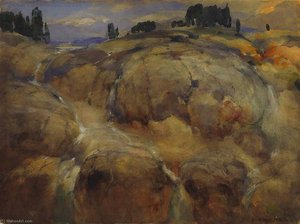
Cliff Houses on the Rio Mancos, Colorado (1878) by William Henry Holmes

Cliff Houses on the Rio Mancos, Colorado

1878 · Watercolor · Smithsonian American Art Museum, Washington, D.C.

The scene unfolds in the rugged terrain of Colorado, where the Rio Mancos carves its way through the landscape. Here, the work titled Cliff Houses on the Rio Mancos, Colorado captures a specific moment in the American West. The artist, William Henry Holmes, brings this vista to life through his unique perspective as both a scientist and a draftsman. He approaches the landscape with an eye that understands the geological…

3
The Normal Rock Creek (1910) by William Henry Holmes

The Normal Rock Creek

1910 · Watercolor · Smithsonian American Art Museum, Washington, D.C.

The Normal Rock Creek is a watercolor by William Henry Holmes. This work, dated 1910, captures a specific stillness through the fluid medium of watercolor. The artist, William Henry Holmes, applied pigment to paper to fix a moment of quietude by the water.

William Henry Holmes's famous paintings, numbers 11 to 63

11Munich Model (1880) by William Henry HolmesMunich Model1880 · Smithsonian American Art Museum 12Pompeian Fountain and Horse Trough, 1880 (1880) by William Henry HolmesPompeian Fountain and Horse Trough, 18801880 · Smithsonian American Art Museum 13Capri (1880) by William Henry HolmesCapri1880 · Smithsonian American Art Museum 14Yuccaland--Chihuahua, Mexico (1889) by William Henry HolmesYuccaland--Chihuahua, Mexico1889 · Smithsonian American Art Museum 15Windmills (1889) by William Henry HolmesWindmills1889 · Smithsonian American Art Museum 16The Open Sea (1904) by William Henry HolmesThe Open Sea1904 · Smithsonian American Art Museum 17On the Coast of California by William Henry HolmesOn the Coast of CaliforniaSmithsonian American Art Museum 18(Haymaking Scene) by William Henry Holmes(Haymaking Scene)Smithsonian American Art Museum 19Haines Point (1908) by William Henry HolmesHaines Point1908 · Smithsonian American Art Museum 20Flowery Meadow (1910) by William Henry HolmesFlowery Meadow1910 · Smithsonian American Art Museum 21Unmodified Rock Creek, about 1910 (1910) by William Henry HolmesUnmodified Rock Creek, about 19101910 · Smithsonian American Art Museum 22The Wanderlusters' Rest (1915) by William Henry HolmesThe Wanderlusters' Rest1915 · Smithsonian American Art Museum 23Original sketch of The Wanderlusters' Rest (1915) by William Henry HolmesOriginal sketch of The Wanderlusters' Rest1915 · Smithsonian American Art Museum 24(Summer Scene) (1920) by William Henry Holmes(Summer Scene)1920 · Smithsonian American Art Museum 25Autumn Tangle (1920) by William Henry HolmesAutumn Tangle1920 · Smithsonian American Art Museum 26Field of Blossoms (1927) by William Henry HolmesField of Blossoms1927 · Smithsonian American Art Museum 27Blossoms (1927) by William Henry HolmesBlossoms1927 · Smithsonian American Art Museum 28The Enchanted Mesa (1927) by William Henry HolmesThe Enchanted Mesa1927 · Smithsonian American Art Museum 29On the Sunset Hill, 1926 (1926) by William Henry HolmesOn the Sunset Hill, 19261926 · Smithsonian American Art Museum 30Mountain Gorge, Colorado (1923) by William Henry HolmesMountain Gorge, Colorado1923 · Smithsonian American Art Museum 31A Cliff Dweller's Ceremony, Colorado (1924) by William Henry HolmesA Cliff Dweller's Ceremony, Colorado1924 · Smithsonian American Art Museum 32The Shaded Walk (1927) by William Henry HolmesThe Shaded Walk1927 · Smithsonian American Art Museum 33The Maryland Fields (1929) by William Henry HolmesThe Maryland Fields1929 · Smithsonian American Art Museum 34In the Plateau Country, with an Inhabited Pueblo (1929) by William Henry HolmesIn the Plateau Country, with an Inhabited Pueblo1929 · Smithsonian American Art Museum 35View on the Potomac (1930) by William Henry HolmesView on the Potomac1930 · Smithsonian American Art Museum 36In the Plateau Country, Colorado (1931) by William Henry HolmesIn the Plateau Country, Colorado1931 · Smithsonian American Art Museum 37In the Cliff House Country (1929) by William Henry HolmesIn the Cliff House Country1929 · Smithsonian American Art Museum 38Michigan (1932) by William Henry HolmesMichigan1932 · Smithsonian American Art Museum 39Royal Oak (1932) by William Henry HolmesRoyal Oak1932 · Smithsonian American Art Museum 40In Mexico (1918) by William Henry HolmesIn Mexico1918 · Smithsonian American Art Museum 41In Jamaica by William Henry HolmesIn JamaicaSmithsonian American Art Museum 42Wyoming Foot Hills (1921) by William Henry HolmesWyoming Foot Hills1921 · Smithsonian American Art Museum 43On the California Coast by William Henry HolmesOn the California CoastSmithsonian American Art Museum 44Untitled by William Henry HolmesUntitledSmithsonian American Art Museum 45Indian Village, Cozumel Island, Yucatan by William Henry HolmesIndian Village, Cozumel Island, YucatanSmithsonian American Art Museum 46In Holland by William Henry HolmesIn HollandSmithsonian American Art Museum 47Windmills by William Henry HolmesWindmills 48Venetian Freight Boats by William Henry HolmesVenetian Freight BoatsSmithsonian American Art Museum 49Playing with the Colours by William Henry HolmesPlaying with the ColoursSmithsonian American Art Museum 50Field of Wheat Shock by William Henry HolmesField of Wheat ShockSmithsonian American Art Museum 51Still Life Apples and Bottle by William Henry HolmesStill Life Apples and BottleSmithsonian American Art Museum 52Cherry Blossoms by William Henry HolmesCherry BlossomsSmithsonian American Art Museum 53My Old Mill, Holmescroft, near Rockville by William Henry HolmesMy Old Mill, Holmescroft, near RockvilleSmithsonian American Art Museum 54Field of Varicolored Grasses in Late Summer (In the Virginia Hills) by William Henry HolmesField of Varicolored Grasses in Late Summer (In the Virginia Hills)Smithsonian American Art Museum 55Field of Joe Pie Weeds (Pride of the Meadow) by William Henry HolmesField of Joe Pie Weeds (Pride of the Meadow)Smithsonian American Art Museum 56A Gypsy Camp by William Henry HolmesA Gypsy CampSmithsonian American Art Museum 57Autumn in the Meadow Edge by William Henry HolmesAutumn in the Meadow EdgeSmithsonian American Art Museum 58The Placid Potomac by William Henry HolmesThe Placid PotomacSmithsonian American Art Museum 59Landscape by William Henry HolmesLandscapeSmithsonian American Art Museum 60The Babbling Brook by William Henry HolmesThe Babbling BrookSmithsonian American Art Museum 61Deserted Bed of a Glacier by William Henry HolmesDeserted Bed of a GlacierSmithsonian American Art Museum 62Maryland Wheat Fields by William Henry HolmesMaryland Wheat FieldsSmithsonian American Art Museum 63Over the Maryland Fields by William Henry HolmesOver the Maryland FieldsSmithsonian American Art Museum

The subjects that held William Henry Holmes's eye

The four subjects that come back most often in these originals, each with its finest example.

The museums that keep William Henry Holmes's originals

The museum that holds the most of the paintings on this page.

Museum City Works by William Henry Holmes Paintings from this list
Smithsonian American Art Museum, Washington, D.C.Smithsonian American Art Museum Washington, D.C. 62 A Mexican Laundry, Cliff Houses on the Rio Mancos, Colorado, The Normal Rock Creek

William Henry Holmes across the decades: one unique original for each

Works per decade

Pick a decade to see the original that defines it.

William Henry Holmes's paintings: questions for the gallery

What is the single most famous work of William Henry Holmes?Reveal the answer

A Mexican Laundry (1895), Smithsonian American Art Museum, Washington, D.C.. Cliff Houses on the Rio Mancos, Colorado (1878) and The Normal Rock Creek (1910) come next.

At what age did William Henry Holmes create A Mexican Laundry?Reveal the answer

49 years old: A Mexican Laundry dates from 1895, and William Henry Holmes was born in 1846.

Which ten paintings by William Henry Holmes are the most famous?Reveal the answer

A Mexican Laundry, Cliff Houses on the Rio Mancos, Colorado, The Normal Rock Creek, The Almighty's Own, An Impression of the High Andes, Chestnut Trees in Bloom, Cliff Houses of the Rio Mancos, Colorado, (painting), Folded Strata, a Great Geological Arch, Colorado, Ancient Stone Round Tower, Long's Peak, Colorado, 1874 and On the Steamer Bremen, off Nova Scotia, 1880. The ranking above gives each one's year and museum.

How many works by William Henry Holmes are known?Reveal the answer

Our catalog holds 63 works by William Henry Holmes, dated from 1874 to 1932.

Where can the most famous William Henry Holmes originals be seen?Reveal the answer

Mostly in Smithsonian American Art Museum (Washington, D.C.). The museum table above lists them all.

During which period did William Henry Holmes create the best-known paintings?Reveal the answer

In 1920s: 13 of the 63 works on this page were made then, (Summer Scene) among them.

Which famous William Henry Holmes painting is the earliest, and which the latest?Reveal the answer

On this page, the earliest is Folded Strata, a Great Geological Arch, Colorado (1874) and the latest Michigan (1932).

What subjects did William Henry Holmes favour?Reveal the answer

Landscape (4), River (3) and Rocks (3), across the 63 works on this page.

What materials did William Henry Holmes paint with most?Reveal the answer

Watercolor, for 4 of the 63 works on this page.

Which movement does the work of William Henry Holmes belong to?Reveal the answer

Impressionism, judging by the originals on this page.

What William Henry Holmes originals can I see at the Smithsonian American Art Museum?Reveal the answer

A Mexican Laundry, Cliff Houses on the Rio Mancos, Colorado and The Normal Rock Creek: the Smithsonian American Art Museum, Washington, D.C. holds 62 of the works on this page.

William Henry Holmes: a portrait of the artist

Early Life and Education

  • Born: Harrison County, United States of America (1846)
  • Died: 1933
  • William Henry Holmes was born on a farm near Cadiz, in Harrison County, Ohio, to Joseph and Mary Heberling Holmes on December 1, 1846.
  • He graduated from the McNeely Normal School, Hopedale, Ohio in 1870.
  • Briefly taught drawing, painting, natural history, and geology at the school.
  • Received an honorary A.B. (Bachelor of Arts) degree from the school in 1889.
  • Received an honorary Doctor of Science degree from The George Washington University in 1918.

Career as Artist, Illustrator and Geologist

  • In 1871, he went to Washington, D.C., to study art under Theodore Kaufmann.
  • Employed by the Smithsonian Institution drawing and sketching fossil shells and shells of live mollusks.
  • Became an artist/topographer with the government survey of Ferdinand Vandeveer Hayden in 1872, replacing Thomas Moran.
  • First trip out West was to Yellowstone National Park.
  • Gained a national reputation as a scientific illustrator, cartographer, pioneering archaeologist, and geologist during the 1870s.
  • His work on the laccolith influenced Grove Karl Gilbert's own work.
  • Worked closely with photographer William H. Jackson.
  • Helped produce Hayden’s Geological and Geographical Atlas of Colorado (1877, 1881).
  • Studied at Munich, Germany under Frank Duveneck to further his art studies.
  • Took lessons in "museum making" from Adolphe B. Meyer of Dresden's Anthropology Museum.
  • Assigned to Clarence Dutton as a geologist and illustrator after returning to the U.S.
  • Illustrated the atlas for Dutton’s Tertiary History of the Grand Canyon District (1882).
  • Created a triptych panorama of the Grand Canyon from Point Sublime, considered a masterpiece.

Archaeological Work and Ethnological Studies

  • Began studying Ancestral Pueblo culture remains in Utah in 1875.
  • His models of ancient Indian ruins were displayed at the Centennial International Exhibition in Philadelphia.
  • Became an expert in prehistoric pottery, shell art, textiles, and Native American arts.
  • Discovered and reported Indian petroglyphs in central West Virginia in 1889.
  • Published "Art in Shell of the American Indians" (1883) and "Pottery of the Ancient Pueblos" (1886).
  • Studied the Etowah Indian Mounds of the Mississippian culture in Georgia.
  • Published his synthesis of pottery in 1903.

Museum Directorship and Later Life

  • Served as head curator of anthropology at the U.S. National Museum (1897-1932).
  • Chief of the Bureau of American Ethnology (1902–1909).
  • Director of National Gallery of Art (now Smithsonian American Art Museum) (1920–32).
  • Assembled exhibits of Indian arts from the Northwest Coast.
  • Published "Handbook of Aboriginal American Antiquities" (1919).
  • Lived in Royal Oak, Michigan upon retirement in 1932.
  • Died April 20, 1933.

Legacy and Significance

  • Known for his contributions to scientific illustration, archaeology, and anthropology.
  • Influential figure in establishing professional archaeology in the United States.
  • His work on the antiquity of humans in the Americas had a conservative influence on archaeological research.
  • A "Renaissance Man" with diverse talents and interests.
  • His detailed illustrations significantly contributed to geological and anthropological understanding.