Portrait of Vasily Surikov

The 100 Most Famous Vasily Surikov Paintings, a Gallery Selection

Updated November 2026 · ranked by our popularity score (searches, visits and orders for each work) · 285 works by Vasily Surikov in our catalogue

In short

Of all the originals Vasily Surikov left, the most famous is Boyarynya Morozova (1887), in the collection of the Tretyakov Gallery, Moscow. Close behind it come Morning of the Strelets’ Execution (1881) and Townswoman (also known as A. Yemelyanova, née Schreider) (1902). Our catalog holds 285 works by Vasily Surikov; the gallery has kept the 100 the world admires most, each shown with its date, its museum and its story.

1848 – 1916, Krasnoyarsk Realism Most works: Tretyakov Gallery

Vasily Surikov's top 10 paintings: the gallery's choice

1
Boyarynya Morozova (1887) by Vasily Surikov

Boyarynya Morozova

1887 · Oil On Canvas · Tretyakov Gallery, Moscow

Vasily Surikov painted Boyarynya Morozova in 1887. The canvas captures a moment of profound tension from the 17th-century church schism. At the center of this frozen movement, Feodosia Morozova is being taken to the ostrog. She sits within a sledge-rozvalnyh, a vessel of wood and shadow amidst the winter crowd.

2
Morning of the Strelets’ Execution (1881) by Vasily Surikov

Morning of the Strelets’ Execution

1881 · Oil On Canvas · Tretyakov Gallery, Moscow

Morning of the Strelets’ Execution, painted by Vasily Surikov in 1881, is a significant work of history painting. The canvas captures a moment of profound political upheaval within the Russian Empire. It focuses on the execution of rebellious Streltsy soldiers, the elite firearm infantry units, following their failed uprising against the authority of Peter the Great.

3
Townswoman (also known as A. Yemelyanova, née Schreider) (1902) by Vasily Surikov

Townswoman (also known as A. Yemelyanova, née Schreider)

1902 · Oil On Canvas · Tretyakov Gallery, Moscow

Vasili Ivanovich Surikov’s “Townswoman,” painted in 1902, isn't merely a portrait; it’s an arresting study in quiet strength and understated dignity. The canvas immediately draws the eye to its subject – a woman seated with a remarkable composure, her hands crossed before her chest, radiating an aura of self-assuredness that belies the simplicity of her attire. She wears a richly patterned scarf, a traditional head covering signifying modesty and respect,…

4
Suvorov Crossing the Alps (1899) by Vasily Surikov

Suvorov Crossing the Alps

1899 · Oil On Canvas

A massive column of Russian troops navigates a treacherous mountain pass during the winter of 1799. The scene captures the descent from the Panix ridge, a grueling segment of the Swiss campaign where soldiers faced extreme cold and vertical terrain. Amidst the chaos of the descent, General Alexander Suvorov appears on a white horse, maintaining a calm presence to steady his men. The composition uses a vertical orientation to emphasize…

5
Stretlets Bidding Farewell to the People (1879) by Vasily Surikov

Stretlets Bidding Farewell to the People

1879 · Oil On Canvas · Tretyakov Gallery, Moscow

Vasili Ivanovich Surikov's "Stretlets Bidding Farewell to the People," painted in 1879, isn’t merely a historical depiction; it’s a profound meditation on injustice, loyalty, and the enduring spirit of a nation grappling with change. Housed within the hallowed halls of the Tretyakov Gallery in Moscow, this monumental canvas—measuring 57 x 33 centimeters—captures a pivotal, yet often overlooked, moment in Russian history: the execution of Streltsy, elite soldiers within the Tsar’s…

6
A Tartar Horseman (1894) by Vasily Surikov

A Tartar Horseman

1894 · Oil On Canvas · Tretyakov Gallery, Moscow

Vasili Ivanovich Surikov’s “A Tartar Horseman,” completed in 1894, is more than just a depiction of a man riding a horse; it's an immersive journey into the heartland of Russia during the late nineteenth century. Housed prominently at the Tretyakov Gallery in Moscow—a testament to its enduring significance—the painting exemplifies Surikov’s masterful approach to Russian Realism.

7
Foreigner (1879) by Vasily Surikov

Foreigner

1879 · Oil On Canvas · Tretyakov Gallery, Moscow

In the vertical portrait titled "Foreigner" by Vasily Surikov, the composition focuses primarily on a single male figure that fills most of the frame. The subject is depicted in an elaborate period costume, positioned in a way that creates a sense of intimacy through the lack of significant depth in the background. He is captured in a contemplative pose, holding a finger to his lips in a gesture that suggests…

8
Siberian Belle (also known as E. Rachkovskaya) (1891) by Vasily Surikov

Siberian Belle (also known as E. Rachkovskaya)

1891 · Oil On Canvas · Tretyakov Gallery, Moscow

A Portrait of Siberian Resilience: Vasily Ivanovich Surikov’s “Siberian Belle” Vasili Ivanovich Surikov (1848-1916) stands as one of the most revered figures in Russian art history, a painter whose canvases transcend mere visual representation to embody profound explorations of Russia's spirit. Born in Krasnoyarsk, Siberia—a landscape steeped in hardship and tradition—Surikov’s formative years instilled within him an unwavering dedication to portraying the realities of rural Russian society with unflinching honesty.…

9
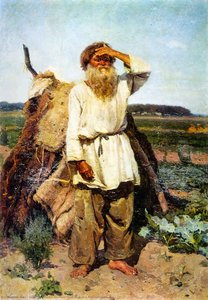
Old Man in a Kitchen Garden (1882) by Vasily Surikov

Old Man in a Kitchen Garden

1882 · Oil On Canvas

In the vast landscape of Russian Realism, few moments feel as intimate or as profoundly human as Vasily Ivanovich Surikov’s 1882 masterpiece, Old Man in a Kitchen Garden. This evocative oil on canvas invites the viewer into a private, silent world, far removed from the grand, sweeping historical dramas for which Surikov is often celebrated. Here, the focus shifts from the clash of empires to the quiet dignity of the…

10
Belshazzar's Feast (1874) by Vasily Surikov

Belshazzar's Feast

1874 · Oil On Canvas

The oil on canvas work titled Belshazzar's Feast was executed by the artist Vasily Surikov. This specific piece was completed in 1874. It is categorized as a religious painting, focusing on a scene from the biblical narrative found in the Book of Daniel.

The Vasily Surikov selection continues, 11 to 100

11Isba (1873) by Vasily SurikovIsba1873 12Portrait of A. I. Surikov (1889) by Vasily SurikovPortrait of A. I. Surikov1889 13The old woman with a patterned headscarf (1886) by Vasily SurikovThe old woman with a patterned headscarf1886 14Evening in Petersburg (1871) by Vasily SurikovEvening in Petersburg1871 15Milan's Cathedral (1884) by Vasily SurikovMilan's Cathedral1884 16Self-Portrait (1879) by Vasily SurikovSelf-Portrait1879 · Tretyakov Gallery 17Monk (1907) by Vasily SurikovMonk1907 18The fight of good spirits against evil spirits (1875) by Vasily SurikovThe fight of good spirits against evil spirits1875 19Wife of the bearded archer (Etude for the picture morning of the execution of the Strelitz," 1881)" (1879) by Vasily SurikovWife of the bearded archer (Etude for the picture morning of the execution of the Strelitz," 1881)"1879 · Yekaterinburg Museum of Fine Arts 20Venice. Saint Mark's Basilica. (1884) by Vasily SurikovVenice. Saint Mark's Basilica.1884 21I. Ostroukov at the Easel (1884) by Vasily SurikovI. Ostroukov at the Easel1884 22The model in the ancient russian costume (1882) by Vasily SurikovThe model in the ancient russian costume1882 23Whacky, seated on the snow (Study to "Boyarynya Morozova") (1885) by Vasily SurikovWhacky, seated on the snow (Study to "Boyarynya Morozova")1885 24Italian women (1884) by Vasily SurikovItalian women1884 25Cossack-rower (1892) by Vasily SurikovCossack-rower1892 26Study of khakasy (1892) by Vasily SurikovStudy of khakasy1892 27Boyarynya Morozova (study) (1887) by Vasily SurikovBoyarynya Morozova (study)1887 28Krasnoyarsk rebellion (1902) by Vasily SurikovKrasnoyarsk rebellion1902 29Executioner (1891) by Vasily SurikovExecutioner1891 30Kneeling beggar (1886) by Vasily SurikovKneeling beggar1886 31Girl with a red jacket (1892) by Vasily SurikovGirl with a red jacket1892 32Kyrgyz (1894) by Vasily SurikovKyrgyz1894 33Soldier's head in a cocked hat (1898) by Vasily SurikovSoldier's head in a cocked hat1898 34Head of khakasy (1893) by Vasily SurikovHead of khakasy1893 35Soldier (1898) by Vasily SurikovSoldier1898 36Soldier with drum (1898) by Vasily SurikovSoldier with drum1898 37Soldier with gun (1898) by Vasily SurikovSoldier with gun1898 38Old soldier descending from the snowy mountain (1898) by Vasily SurikovOld soldier descending from the snowy mountain1898 39The head of soldier-drummer (1898) by Vasily SurikovThe head of soldier-drummer1898 40Big masquerade in 1772 on the streets of Moscow with the participation of Peter I and princer I. F. Romodanovsky (1900) by Vasily SurikovBig masquerade in 1772 on the streets of Moscow with the participation of Peter I and princer I. F. Romodanovsky1900 41Pugachev (1911) by Vasily SurikovPugachev1911 42Self-Portrait (1910) by Vasily SurikovSelf-Portrait1910 43Stepan Razin (1910) by Vasily SurikovStepan Razin1910 44Portrait of woman with yellow background (1911) by Vasily SurikovPortrait of woman with yellow background1911 45Stepan Razin (1906) by Vasily SurikovStepan Razin1906 46Portrait of M. P. Konchalovsky in childhood (1915) by Vasily SurikovPortrait of M. P. Konchalovsky in childhood1915 47Man with an Injured Arm (1913) by Vasily SurikovMan with an Injured Arm1913 48Third Ecumenical Council of Ephesus (1876) by Vasily SurikovThird Ecumenical Council of Ephesus1876 49Strelets in a Cap (study) (1879) by Vasily SurikovStrelets in a Cap (study)1879 · Tretyakov Gallery 50T. Domozhilova (1891) by Vasily SurikovT. Domozhilova1891 · Tretyakov Gallery 51Head of a Fool (1885) by Vasily SurikovHead of a Fool1885 · Tretyakov Gallery 52Russian Troops under Suvorov Crossing the Alps (study) (1899) by Vasily SurikovRussian Troops under Suvorov Crossing the Alps (study)1899 53Hand of boyarynya Morozova by Vasily SurikovHand of boyarynya Morozova 54Mountains near Krasnoyarsk (1909) by Vasily SurikovMountains near Krasnoyarsk1909 55The Persian (1902) by Vasily SurikovThe Persian1902 56Boyarynya Morozova (study) (1883) by Vasily SurikovBoyarynya Morozova (study)1883 57An Italian Girl (1884) by Vasily SurikovAn Italian Girl1884 · Tretyakov Gallery 58Cossack Dmitry Sokol (1893) by Vasily SurikovCossack Dmitry Sokol1893 59Head of a Grinning Priest (1885) by Vasily SurikovHead of a Grinning Priest1885 · Tretyakov Gallery 60Cossack with gun (1893) by Vasily SurikovCossack with gun1893 61Portrait of governor Zamyatnin (1865) by Vasily SurikovPortrait of governor Zamyatnin1865 62Under the rain by the coach to Black River (1871) by Vasily SurikovUnder the rain by the coach to Black River1871 63Temptation of Christ (1872) by Vasily SurikovTemptation of Christ1872 64Samovar (1876) by Vasily SurikovSamovar1876 65Assassination of Julius Caesar (1875) by Vasily SurikovAssassination of Julius Caesar1875 66Minusinsk steppe (1873) by Vasily SurikovMinusinsk steppe1873 67Belfry Ivan the Great (1876) by Vasily SurikovBelfry Ivan the Great1876 68View of Kremlin at winter (1876) by Vasily SurikovView of Kremlin at winter1876 69Tartar Woman from Minusinsk (1873) by Vasily SurikovTartar Woman from Minusinsk1873 70Siberian landscape. Torgoshyno. (1873) by Vasily SurikovSiberian landscape. Torgoshyno.1873 71Minusinsk Steppe (1873) by Vasily SurikovMinusinsk Steppe1873 72Wanderer (1885) by Vasily SurikovWanderer1885 73The Good Samaritan (1874) by Vasily SurikovThe Good Samaritan1874 74Samovar (1876) by Vasily SurikovSamovar1876 75Minusinsk. On the way. (1873) by Vasily SurikovMinusinsk. On the way.1873 76Khakasy with his feet bound with chains (1873) by Vasily SurikovKhakasy with his feet bound with chains1873 77A rich man and Lazarus (1873) by Vasily SurikovA rich man and Lazarus1873 78Christ Driving the Merchants from the Temple (1873) by Vasily SurikovChrist Driving the Merchants from the Temple1873 79Fourth Ecumenical Council of Chalcedon (1876) by Vasily SurikovFourth Ecumenical Council of Chalcedon1876 80Male nude (1874) by Vasily SurikovMale nude1874 81On Nevsky Prospekt on day (1874) by Vasily SurikovOn Nevsky Prospekt on day1874 82Second Ecumenical Council of Constantinople (1876) by Vasily SurikovSecond Ecumenical Council of Constantinople1876 83On Nevsky Prospekt at night (1874) by Vasily SurikovOn Nevsky Prospekt at night1874 84First Ecumenical Council of Nicaea (1876) by Vasily SurikovFirst Ecumenical Council of Nicaea1876 85Naples. Vesuvius. (1884) by Vasily SurikovNaples. Vesuvius.1884 86Saint Peter's Cathedral in Rome (1884) by Vasily SurikovSaint Peter's Cathedral in Rome1884 87Female figures, wanderer, whacky (Study to ''Boyarynya Morozova'') (1884) by Vasily SurikovFemale figures, wanderer, whacky (Study to ''Boyarynya Morozova'')1884 88Roses in a Goblet (1884) by Vasily SurikovRoses in a Goblet1884 89Moscow yard (1880) by Vasily SurikovMoscow yard1880 90Zubovsky boulevard in winter (1881) by Vasily SurikovZubovsky boulevard in winter1881 91Blackbearded old man (1879) by Vasily SurikovBlackbearded old man1879 92Bit of Moscow (1880) by Vasily SurikovBit of Moscow1880 93Portrait of I. S. Ostroukhov (1884) by Vasily SurikovPortrait of I. S. Ostroukhov1884 94Sophia Kropotkina with a Guitar (1879) by Vasily SurikovSophia Kropotkina with a Guitar1879 95St. Peter's in Rome (1884) by Vasily SurikovSt. Peter's in Rome1884 96Road in Khotkovo (1884) by Vasily SurikovRoad in Khotkovo1884 97Winter in Moscow (1885) by Vasily SurikovWinter in Moscow1885 98Portrait of N. S. Matveev (1881) by Vasily SurikovPortrait of N. S. Matveev1881 99The elder Menshikov's daughter (1882) by Vasily SurikovThe elder Menshikov's daughter1882 100Naples (1884) by Vasily SurikovNaples1884

Vasily Surikov's famous paintings, period by period

The subjects that held Vasily Surikov's eye

The four subjects that come back most often in these originals, each with its finest example.

The museums that keep Vasily Surikov's originals

The 2 museums that hold the most of the paintings on this page.

Museum City Works by Vasily Surikov Paintings from this list
Tretyakov Gallery, MoscowTretyakov Gallery Moscow 15 Boyarynya Morozova, Morning of the Strelets’ Execution, Townswoman (also known as A. Yemelyanova, née Schreider)
Yekaterinburg Museum of Fine Arts, YekaterinburgYekaterinburg Museum of Fine Arts Yekaterinburg 1 Wife of the bearded archer (Etude for the picture morning of the execution of the Strelitz," 1881)"

Vasily Surikov decade by decade: the original that defines each

Works per decade

Pick a decade to see the original that defines it.

Collectors' questions about Vasily Surikov's paintings

Which work is Vasily Surikov most famous for?Reveal the answer

Boyarynya Morozova (1887), Tretyakov Gallery, Moscow. Morning of the Strelets’ Execution (1881) and Townswoman (also known as A. Yemelyanova, née Schreider) (1902) come next.

What age was Vasily Surikov when Boyarynya Morozova was made?Reveal the answer

39 years old: Boyarynya Morozova dates from 1887, and Vasily Surikov was born in 1848.

What are the ten most famous Vasily Surikov paintings?Reveal the answer

Boyarynya Morozova, Morning of the Strelets’ Execution, Townswoman (also known as A. Yemelyanova, née Schreider), Suvorov Crossing the Alps, Stretlets Bidding Farewell to the People, A Tartar Horseman, Foreigner, Siberian Belle (also known as E. Rachkovskaya), Old Man in a Kitchen Garden and Belshazzar's Feast. The ranking above gives each one's year and museum.

How many paintings did Vasily Surikov leave?Reveal the answer

Our catalog holds 285 works by Vasily Surikov, dated from 1865 to 1915.

In which museums do Vasily Surikov's masterpieces hang?Reveal the answer

Mostly in Tretyakov Gallery (Moscow) and Yekaterinburg Museum of Fine Arts (Yekaterinburg). The museum table above lists them all.

In which years did Vasily Surikov paint the most famous works?Reveal the answer

In 1870s: 34 of the 100 works on this page were made then, Stretlets Bidding Farewell to the People among them.

What are the first and the last famous originals of Vasily Surikov?Reveal the answer

On this page, the earliest is Portrait of governor Zamyatnin (1865) and the latest Portrait of M. P. Konchalovsky in childhood (1915).

Which subjects did Vasily Surikov choose most often?Reveal the answer

Portrait (12), Man (11) and 19th century russia (9), across the 100 works on this page.

Which technique did Vasily Surikov use most?Reveal the answer

Oil On Canvas, for 28 of the 100 works on this page.

To which art movement does Vasily Surikov belong?Reveal the answer

Realism, judging by the originals on this page.

Which Vasily Surikov works hang at the Tretyakov Gallery?Reveal the answer

Boyarynya Morozova, Morning of the Strelets’ Execution and Townswoman (also known as A. Yemelyanova, née Schreider): the Tretyakov Gallery, Moscow holds 13 of the works on this page.

Vasily Surikov: life and work

The Soul of a Nation Captured in Paint

Vasily Ivanovich Surikov stands as one of the most celebrated figures in Russian art history, a painter whose canvases capture not merely visual representations but profound explorations of Russia’s soul. Born in 1848 in Krasnoyarsk, Siberia, Surikov's early life was marked by hardship and familial struggles—a formative experience that instilled within him an unwavering dedication to portraying the realities of rural Russian society with unflutched honesty. This commitment would become the cornerstone of his artistic vision, propelling him to create monumental works that continue to resonate powerfully today.

His artistic sensibilities were nurtured by a fascination with folklore and peasant life, themes deeply prevalent in Siberian culture. His father, a teacher, instilled in him a love for literature and history, shaping his intellectual curiosity and providing the foundation for his meticulous research into historical subjects. Recognizing Surikov’s talent, his father secured him admission to the St Petersburg Academy of Arts, where he honed his skills under the guidance of masters like Konstantin Dmitrievich Makovsky and Ivan Alekseyevich Kramskoy. These influential figures championed Realism as a dominant artistic style, encouraging Surikov to depict everyday life with psychological depth and emotional resonance.

A Master of Historical Epic and Psychological Depth

Surikov’s oeuvre is characterized by an extraordinary ability to convey atmosphere and emotion through masterful technique. He employed a distinctive approach to painting, meticulously studying the nuances of light and color to achieve unparalleled realism. His brushstrokes were deliberate and expressive, capturing not just what was seen but also what was felt—a hallmark of the Realist movement’s ambition to depict human experience truthfully. His canvases are renowned for their dramatic compositions and evocative lighting, transporting viewers directly into the heart of Russia's most turbulent eras.

The artist gained wide recognition for his large-scale paintings devoted to pivotal episodes from Russian history. These works were distinguished by their immense scale, rigorous attention to historical detail, and a profound psychological expressiveness that breathed life into historical figures. Some of his most enduring contributions to the art world include:

  • The Morning of the Streltsy Execution: A hauntingly powerful depiction of political upheaval and human tragedy.
  • Boyarynya Morozova: A monumental exploration of religious conviction and social conflict.
  • Suvorov Crossing the Alps: A breathtaking scene of military leadership and epic endurance.
  • Yermak’s Conquest of Siberia: A tribute to the expansion and rugged spirit of the Russian frontier.

Legacy and Historical Significance

As a prominent member of the Peredvizhniki (The Wanderers) movement and the Union of Russian Artists, Surikov played a vital role in shifting the focus of Russian art toward national identity and social truth. His work bridged the gap between academic tradition and a new, visceral realism that sought to document the struggles and triumphs of the common people alongside the grand narratives of the Tsars. Through his lens, history was not merely a collection of dates, but a living, breathing drama of human will.

Today, the masterpieces of Vasily Surikov are preserved in the world's most prestigious collections, including the State Tretyakov Gallery in Moscow and the State Russian Museum in Saint Petersburg. His influence persists as a testament to his ability to transform historical research into emotional truth, ensuring that his vision of the Russian spirit remains an indelible part of the global artistic heritage.