Portrait of Sidney Richard Percy

The 50 Most Famous Sidney Richard Percy Paintings, Each One of a Kind

Updated November 2026 · ranked by our popularity score (searches, visits and orders for each work) · 50 works by Sidney Richard Percy in our catalogue

In short

Loch Coruisk, Isle of Skye (1874) is the Sidney Richard Percy painting that draws the most eyes. After it, the eye goes to A Rest On The Roadside and Path to the Bay, Fairlight Cove (1860). Among the 50 works of Sidney Richard Percy in our catalog, these 50 are the most famous, each a unique original presented with its year, its museum and the reason it endures.

1821 – 1886, London Romanticism Most works: Royal Collection

Top 10 paintings by Sidney Richard Percy, through the gallery's eye

1
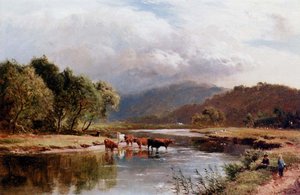
Loch Coruisk, Isle of Skye (1874) by Sidney Richard Percy

Loch Coruisk, Isle of Skye

1874 · Oil On Canvas

A Masterpiece of Landscape Painting 'CITE>Sidney Richard Percy's Loch Coruisk, Isle of Skye, created in 1874, is a breathtaking oil on canvas painting that captures the essence of nature's grandeur. Measuring 116 x 182 cm, this artwork is a testament to Percy's skill in depicting serene landscapes. The Scene Unfolds The painting presents a majestic scene with a lake in the foreground, surrounded by towering mountains. A herd of cows…

2
A Rest On The Roadside by Sidney Richard Percy

A Rest On The Roadside

Oil On Canvas

A Rest On The Roadside by Sidney Richard Percy presents a serene landscape scene. The composition centers on a family taking a break along a winding path. This roadside pause occurs alongside a body of water, set against a backdrop of rugged mountains.

3
Path to the Bay, Fairlight Cove (1860) by Sidney Richard Percy

Path to the Bay, Fairlight Cove

1860 · Oil On Canvas

Path to the Bay, Fairlight Cove is an artwork by Sidney Richard Percy. Created about 1860, this oil painting captures a specific moment of coastal stillness. The artist, Sidney Richard Percy, was born in London, United Kingdom, and lived from 1821 to 1886.

Sidney Richard Percy's famous paintings, numbers 11 to 50

The subjects that held Sidney Richard Percy's eye

The four subjects that come back most often in these originals, each with its finest example.

The museums that keep Sidney Richard Percy's originals

The 2 museums that hold the most of the paintings on this page.

Museum City Works by Sidney Richard Percy Paintings from this list
Royal Collection, LondonRoyal Collection London 1 A view of Llyn Dulyn
Dordrechts Museum, DordrechtDordrechts Museum Dordrecht 1 River Landscape Pair Part 2

Sidney Richard Percy across the decades: one unique original for each

Works per decade

Pick a decade to see the original that defines it.

Sidney Richard Percy's paintings: questions for the gallery

What is the single most famous work of Sidney Richard Percy?Reveal the answer

Loch Coruisk, Isle of Skye (1874). A Rest On The Roadside and Path to the Bay, Fairlight Cove (1860) come next.

At what age did Sidney Richard Percy create Loch Coruisk, Isle of Skye?Reveal the answer

53 years old: Loch Coruisk, Isle of Skye dates from 1874, and Sidney Richard Percy was born in 1821.

Which ten paintings by Sidney Richard Percy are the most famous?Reveal the answer

Loch Coruisk, Isle of Skye, A Rest On The Roadside, Path to the Bay, Fairlight Cove, Kilchum Castle Loch Awe, Lock Coruisk, In Snowdonia, A view of Llyn Dulyn, The Angler's Corner, Homeward Bound and Snowdon. The ranking above gives each one's year and museum.

How many works by Sidney Richard Percy are known?Reveal the answer

Our catalog holds 50 works by Sidney Richard Percy, dated from 1851 to 1883.

Where can the most famous Sidney Richard Percy originals be seen?Reveal the answer

Mostly in Royal Collection (London) and Dordrechts Museum (Dordrecht). The museum table above lists them all.

During which period did Sidney Richard Percy create the best-known paintings?Reveal the answer

In 1850s: 5 of the 50 works on this page were made then, In Snowdonia among them.

Which famous Sidney Richard Percy painting is the earliest, and which the latest?Reveal the answer

On this page, the earliest is The Angler's Corner (1851) and the latest Grizedale, Westmorland (1883).

What subjects did Sidney Richard Percy favour?Reveal the answer

Landscape (5), Roads (5) and Lakes (4), across the 50 works on this page.

What materials did Sidney Richard Percy paint with most?Reveal the answer

Oil On Canvas, for 3 of the 50 works on this page.

Which movement does the work of Sidney Richard Percy belong to?Reveal the answer

Romanticism, judging by the originals on this page.

Sidney Richard Percy: a portrait of the artist

The Legacy of Sidney Richard Percy: Master of the Barnes School

Sidney Richard Percy (1821–1886) stands as a cornerstone of the Barnes School, an artistic movement that flourished in London’s southwest during the Victorian era. Born into a family steeped in artistic tradition—his father, Edward Williams, was himself a celebrated painter—Percy inherited not only talent but also a profound connection to the rural landscapes of Britain. This familial lineage shaped his oeuvre with meticulous observation and a distinctive aesthetic that would eventually define much of the 19th-century English landscape tradition.

His upbringing within the Williams family fostered an environment where artistic pursuits were deeply valued. The siblings—including Henry John Boddington and Arthur Gilbert—all pursued careers as artists, establishing a remarkable familial tradition. While Percy’s development was largely self-directed, his apprenticeship under Thomas Hilliard, a respected gilder and engraver in Carnaby Street, provided him with invaluable technical insights. This early exposure to the precision of engraving profoundly influenced his approach to composition, allowing him to master the delicate interplay of light and shadow that characterizes his most celebrated works.

Atmospheric Landscapes and the Romantic Spirit

The relocation to Barnes, a tranquil village bordering the Thames River, marked a pivotal moment in Percy’s artistic life. Surrounded by marshes, farms, and rolling hills, this landscape provided an unparalleled source of inspiration. Embracing the Romantic tradition championed by masters such as James Ward and George Moront, Percy prioritized atmospheric perspective to capture the sublime beauty of the British countryside. His work often transcends mere documentation, instead evoking a sense of nostalgia and peace through the use of soft, luminous light and earthy tones.

Percy’s technical mastery is most evident in his ability to render diverse terrains with emotional depth:

Historical Significance and Artistic Achievement

Throughout his career, Percy achieved significant recognition within the British art establishment. Debuting at the Royal Academy in 1842, he quickly established himself as a professional force, launching his career with vigor during the 1840s. His ability to blend the realism of the landscape with the emotional resonance of Luminism allowed his work to resonate with both contemporary Victorian audiences and modern collectors alike.

The historical significance of Sidney Richard Percy lies in his role as a chronicler of a vanishing era. As the Industrial Revolution began to reshape the British landscape, Percy’s paintings preserved the memory of an untouched, pastoral England. Through his detailed depictions of grazing cattle, winding paths, and misty valleys, he created a timeless visual record of the sublime. Today, his work remains a testament to the enduring beauty of the natural world and a definitive contribution to the legacy of English landscape painting.