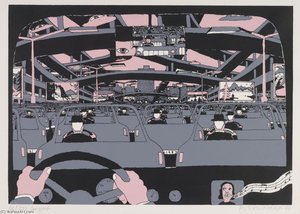
The Visionary of Urban Alienation
Born Terje Brofos in Oslo, Norway, the artist known to the world as Hariton Pushwagner crafted a visual language that was as haunting as it was vibrant. His life began amidst the turbulence of 1940, and his early years in the Berg neighborhood were marked by both physical resilience and a burgeoning creative spirit. Before he became a titan of Norwegian Pop art, he was an accomplished athlete, excelling in tennis and finding success on the court. However, it was through the disciplined study of art at the State's School of Art and Design of Oslo that he began to forge a path toward a deeply personal and idiosyncratic style—a style that would eventually bridge the gap between the aesthetics of comic books and the profound anxieties of modern existence.
Pushwagner’s artistic journey was not a straight line but rather a complex evolution of motifs and themes. After his formal education, he navigated a period of searching, struggling to find a voice that could adequately capture the tension of the contemporary era. This search led him to a spiritual and creative kinship with the Norwegian author Axel Jensen. Together, they explored narratives that blended reality with dystopian speculation. His work became a vessel for exploring the homogeneity of capitalist society, utilizing a science fiction-like language to critique the crowded high-rise buildings and the remote technological warfare that characterized the modern age.
A World of Soft Cities and Apocalypse
The heart of Pushwagner’s legacy lies in his ability to transform the mundane elements of urban life into surreal, often unsettling, landscapes. He is perhaps most celebrated for his Soft City series, a monumental achievement that captures the essence of urban alienation through vibrant colors and intricate detail. In these works, the city is not merely a setting but a living, breathing character—a place of both fascination and profound loneliness. His ability to use the visual vocabulary of comics to address heavy sociological themes allowed him to reach audiences far beyond the traditional art world.
His thematic repertoire extended into even more dramatic territories, such as the Apocalypse Frieze. In pieces like Jobkill, one can witness his mastery of Pop art techniques used to depict a sense of impending doom and social decay. His work often features:
- Geometric Abstraction: The use of blocky figures and structured shapes to evoke a sense of ritual and procession.
- Urban Dystopia: Depictions of crowded, impersonal metropolitan environments that reflect the loss of individuality.
- Vibrant Color Palettes: A striking use of color that contrasts sharply with the often bleak or unsettling subject matter.
Legacy and Global Recognition
Throughout his career, Pushwagner’s reach extended far beyond the borders of Norway. His exhibitions in prestigious institutions such as the MK Gallery in London, the Museum Boijmans van Beuningen in the Netherlands, and the Astrup Fearnley Museet in Oslo solidified his status as an international figure. His work has been studied and admired in New York, Berlin, Sydney, and Paris, proving that the themes of alienation and technological encroachment are truly universal. Even when his original works, such as the lost Soft City manuscripts, were rediscovered, they reignited a global fascination with his unique ability to map the human psyche onto the concrete sprawl of the modern city.
By blending the aesthetics of popular culture with deep-seated social critique, Hariton Pushwagner left behind an indelible mark on the history of 20th-century art. He remains a singular figure whose work continues to resonate with anyone who has ever felt like a stranger in their own city, reminding us that within the rigid structures of modern life, there is always a profound, albeit often dark, beauty to be found.