Cubism · 1941
Bar and Grill (Jacob Lawrence, 1941)
Jacob Lawrence (1917–2000) made Bar and Grill. It dates from 1941. It belongs to the Cubism movement. It is made in painting. It is kept at Smithsonian American Art Museum in Washington, D.C., United States of America. It measures 42 × 57 cm.
- 1941
- Painting
- 42 × 57 cm
- Smithsonian American Art Museum, Washington, D.C.

 Preview

 Hand Made Oil Painting
 Send
 Share
 Fact sheet


 Download
 Similars
 X-Ray
 Diaporama
 Q&A

 Stats
Bar and Grill, in brief
- Title
- Bar and Grill
- Artist
- Jacob Lawrence (1917–2000)
- Artist born in
- Atlantic City, United States
- Date
- 1941
- Medium
- Painting
- Dimensions
- 42 × 57 cm
- Where to see it
- Smithsonian American Art Museum, Washington, D.C., United States of America
- Movement
- Cubism
- Subject
- segregation, cafe interior, blackwhitepainting, lawrenceartist, jimcrowlaws, americanarthistory
What does Bar and Grill depict?
The Unveiling of Division: Jacob Lawrence's "Bar and Grill"
Jacob Lawrence’s powerful 1941 work, "Bar and Grill," is far more than a mere depiction of an American social scene; it is a searing document etched in paint, capturing the suffocating reality of Jim Crow segregation. The painting plunges the viewer into the interior of a café, yet the atmosphere is anything but convivial. Lawrence masterfully uses composition to confront us with the visible, yet deeply ingrained, artificiality of racial division. One cannot look at this piece without feeling the weight of history pressing down—a palpable tension emanating from every corner of the depicted space.
A Study in Segregated Spaces and Skewed Perspectives
The most arresting element of "Bar and Grill" is the stark, physical wall that cleaves the composition into two distinct realms. This division is not merely decorative; it is legislative, representing the enforced separation of lives. Lawrence directs our gaze through a skewed vantage point from behind the bar, an angle that immediately implicates the viewer in observing this uncomfortable tableau. While the photo description notes the lively social engagement—the cups on tables, the man at the center—it is the underlying structure of exclusion that dominates the emotional landscape. The subtle details, such as the ceiling fan cooling only certain areas or the grouping of figures on either side of the divide, speak volumes about unequal treatment and systemic injustice.
Technique and Emotional Resonance
Lawrence’s technique here is characterized by a narrative clarity that belies the profound emotional turmoil beneath the surface. Though rendered in a palette suggesting black and white photography, the energy of his brushwork keeps the scene vibrant, forcing us to acknowledge the humanity present even within rigid boundaries. The style belongs to Lawrence's powerful commitment to American experience, transforming social commentary into monumental art. For collectors and designers alike, this piece offers an unparalleled opportunity to integrate a work steeped in vital American history into a modern setting, serving as both decoration and potent conversation starter.
A Timeless Reflection on Equality
To own a reproduction of "Bar and Grill" is to possess a piece of art that refuses silence. It compels contemplation on the enduring nature of prejudice and the persistent human yearning for true community. The painting’s emotional impact lingers long after one steps away from it; it demands empathy and critical thought. It reminds us that the most profound divisions are often those built not with brick and mortar, but with law and assumption. This work remains a vital touchstone, urging us toward a vision of shared space and undeniable equality.
Which museum holds Bar and Grill?
Smithsonian American Art Museum
Washington, D.C., United States of America
A Chronicle of American Identity The Smithsonian American Art Museum, located in Washington, D.C., is the nation's first collection of American art. As a part of the Smithsonian Institution, it holds one of the largest and most inclusive collections of art made in the United States. The holdings represent a continuous record of the American experience, capturing the aspirations, character, and imagination of the people from the colonial period to the present day.


High-resolution images of Bar and Grill

Protected by copyright: these files are for personal reference, not a licence to republish.
Jacob Lawrence, Bar and Grill (1941), Smithsonian American Art Museum.
Questions on Bar and Grill, answered
Where is "Bar and Grill" by Jacob Lawrence on display today?
The original "Bar and Grill" by Jacob Lawrence is held at the Smithsonian American Art Museum, Washington, D.C., United States of America. A reproduction allows the work to be displayed at home.
What is the creation date of "Bar and Grill" by Jacob Lawrence?
"Bar and Grill" by Jacob Lawrence was created in 1941.
What is "Bar and Grill" made with?
The medium of "Bar and Grill" by Jacob Lawrence is painting. Reproductions aim to render the appearance of this technique.
What size is "Bar and Grill" by Jacob Lawrence in real life?
The original "Bar and Grill" by Jacob Lawrence measures 42 x 57 cm.
What subjects appear in "Bar and Grill" by Jacob Lawrence?
The themes present in "Bar and Grill" by Jacob Lawrence include segregation, cafe interior, blackwhitepainting, lawrenceartist, jimcrowlaws, americanarthistory, dynamiccubism. Together they summarize the artwork's subject matter.
Is "Bar and Grill" by Jacob Lawrence in the public domain?
Regarding copyright, "Bar and Grill" is still protected by copyright.
Which artist is "Bar and Grill" attributed to?
"Bar and Grill" is attributed to Jacob Lawrence.
What style does "Bar and Grill" belong to?
"Bar and Grill" by Jacob Lawrence belongs to the Cubism movement. This movement provides the stylistic context of the work.
What stage of Jacob Lawrence's development does "Bar and Grill" represent?
"Bar and Grill" belongs to the Harlem Renaissance of Jacob Lawrence's career. This classification relates the work to the artist's development.
About the artist, Jacob Lawrence

1917–2000, United States
Jacob Lawrence
A Life Painted in Story: The World of Jacob Lawrence Jacob Armstead Lawrence, born in Atlantic City, New Jersey, in 1917, emerged as one of the most significant American artists of the 20th century. His life story is intrinsically woven into his art—a powerful narrative shaped by the realities of being African-American during a period of profound social change. Following his parents’ divorce in 1924, Lawrence experienced a childhood marked by movement and adaptation, spending time in foster care in Philadelphia before ultimately finding a home with his mother in Harlem during the vibrant years of the Harlem Renaissance. This immersion into the cultural heart of Black America would become the wellspring of his artistic vision.
Also by Jacob Lawrence
 The Library1960
 Genesis Creation Sermon V: And God Created All the Fowls of the Air and Fishes of the Seas1989
 Genesis Creation Sermon IV: And God Created the Day and the Night and God Creatied and Put Stars in the Skies1989
 Migration Series No.11: Food had doubled in price because of the war1941
Essays around Bar and Grill
 Art Nouveau vs. Art Deco: How to Distinguish These Two Iconic StylesMaster the differences between Art Nouveau and Art Deco with our expert guide. Learn to identify these iconic styles today.
 Art for Every Course: Curating Visual Rhythm in Bar, Lounge, and Dining SpacesElevate hospitality design with curated fine art. Discover how bespoke oil reproductions, historical masterpieces, and large-scale murals t…
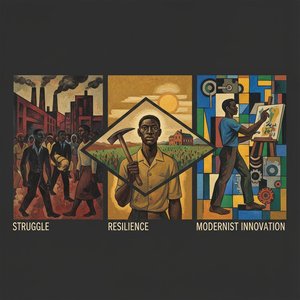 Jacob Lawrence: Narratives of Struggle, Resilience & Modernist InnovationExplore the powerful narratives of Jacob Lawrence, a pivotal African American artist of the Harlem Renaissance. Discover his iconic 'Migrat…