Preview
 Send
Send Share
Share
 Details
 Guide
Guide

 Download
 Similars
 X-Ray
X-Ray Diaporama
 Stats
StatsApple Blossom


 Read More
Hand Made Oil Reproduction
Hand-painted oil on canvas in your size and frame, made to order by our artists. ( Switch to Print Switch to Digital Image)




P118B $10

P118H $10

P118W $10

P438Z $10

P508JH $12

P508YH $12

P805H $10

P805Z $10

P919BZ $10

P919G $10

P919XJ $10

P959ZH $10

P968JZ $12

W106C $8

W218G $10

W218JH $8

W218Y $10

W307PJ $10

W316G $10

W316PJ $8

W316Y $10

W398PJ $8

W4111J $10

W500HY $15

W500JH $15

W692G $12

W849H $8

W940BG $15

W953PJ $8




Pick from our preset sizes that match the artwork's original proportions.

Type the width and the height you need, to fit your frame or your wall. This is hand-painted, so for a size with a different shape the artist can paint a bit more around the picture, or cut a bit — you choose. We send you a digital mockup to approve before the painting starts. The picture shown on this page does not show the real result — only the mockup does.
After order, OriginalUniqueArt.com team will email client for instructions and provide a mockup preview
Worldwide Delivery () in 3/4 weeks instead of standard 5 weeks. (19 October). No compromise on quality.

Free Worldwide Express Shipping

High-Quality Linen Canvas

Full Shipping Insurance

Customs Tax Refund Guarantee

True Color Matching Guarantee

100-Day Return Policy (Defects Only)

100% Money-Back Guarantee

Bulk Discount Offer
 Glass option is only available in size under 110 CM

Apple Blossom
Reproduction Medium
Reproduction Size
-


Total Price
$ 300
The Geometric Heart of Nature
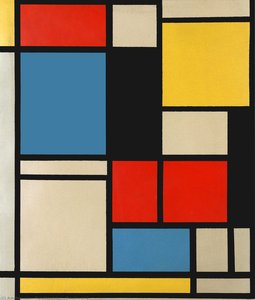
Piet Mondrian, a visionary figure who irrevocably altered the landscape of modern art, gifted us Apple Blossom—a painting that embodies his singular approach to cubism and elevates the seemingly simple depiction of a blossoming tree into an exploration of fundamental artistic principles. More than just a visual representation, it’s a deliberate manifesto of Mondrian's belief in the power of abstraction to capture universal truths. This artwork isn’t merely about what is seen; it’s about how it feels—a quiet contemplation on balance and harmony achieved through rigorously controlled geometric forms.The Evolution Towards Pure Abstraction
Mondrian’s artistic journey began with landscapes infused with Impressionistic hues, mirroring the vibrant atmosphere of The Hague’s artistic milieu. However, he swiftly recognized that true beauty resided beyond mere imitation of nature. Driven by an idealistic quest for spiritual resonance—a pursuit championed by thinkers like Nietzsche—he embarked on a transformative path toward pure abstraction. Piet Mondrian (1872-1944), born Pieter Cornelis Mondriaan, wasn’t simply abandoning representational art; he was actively rejecting it as inadequate to express the essence of existence. He sought a language that transcended sensory experience, prioritizing geometric shapes—primarily horizontal and vertical lines—to convey spiritual harmony.Key Elements: A Symphony in Squares and Rectangles
Apple Blossom exemplifies Mondrian’s masterful manipulation of visual elements. At its core is a tree—not rendered in detail but fragmented into intersecting rectangles and squares—a deliberate simplification that underscores the artist's preoccupation with geometric abstraction. Scattered amongst these forms are birds—also stylized representations—suggesting movement and vitality within the rigid framework. Crucially, an apple blossom itself punctuates the composition, introducing a splash of color—primarily yellow—that contrasts subtly against the dominant hues of black, white, and gray. This careful orchestration of color and shape isn’t accidental; it reflects Mondrian's belief that these elements could communicate spiritual values more effectively than naturalistic depictions.Influence and Context: The Hague School and Beyond
Mondrian’s artistic vision was profoundly shaped by his association with the Museum Gemeentemuseum Netherlands, where he encountered masterpieces from the Gothic and Renaissance periods—inspiring him to synthesize classical ideals with modern geometric abstraction. This museum served as a crucible for artistic experimentation during that era, fostering dialogues between artists and intellectuals alike. Furthermore, Mondrian’s work aligns closely with De Stijl, an influential art movement founded by himself and Theo van Doesburg, which championed the use of primary colors (red, yellow, blue), geometric forms (squares, rectangles, triangles), and orthogonal lines as instruments for achieving universal harmony.Notable Companions: Exploring Mondrian’s Diverse Artistic Output
Beyond Apple Blossom, Mondrian produced a remarkable body of work demonstrating his versatility and unwavering commitment to Neoplasticism—his signature style. Consider Silver Tree (Haags Gemeentemuseum), a striking example of cubist influence combined with geometric abstraction. Similarly, Flowering Trees—another testament to Mondrian’s exploration of natural forms through a geometric lens—continues to captivate viewers with its understated elegance and profound symbolic resonance. Piet Mondrian on OriginalUniqueArt offers an unparalleled opportunity to delve deeper into his artistic legacy, showcasing high-quality reproductions of his paintings alongside scholarly essays that illuminate the intellectual and aesthetic currents shaping his oeuvre. For a comprehensive understanding of Mondrian’s life and work, consult Piet Mondrian on Wikipedia.Questions & Answers
How do medium and movement combine in "Apple Blossom"?
"Apple Blossom" by Piet Mondrian combines the acrylic on canvas technique with the Cubism style. Technique and movement describe the making and the style of the work.
What is the recommended print size for "Apple Blossom" by Piet Mondrian?
"Apple Blossom" is recommended at a large print size. Other sizes are available with the same proportions.
What underlying hue runs through "Apple Blossom" by Piet Mondrian?
An ochre to sepia hue runs through "Apple Blossom" by Piet Mondrian.
Artist Biography
The Architecture of Order
To look at a Mondrian today is to see the blueprint of modern visual culture. We encounter his logic every time we interact with a clean graphic layout or a minimalist building facade. He stripped away the unnecessary until only the essential remained. This was not an act of destruction, but one of extreme distillation. By reducing his vocabulary to straight lines, right angles, and a strict palette of red, blue, and yellow, he removed the distraction of reality to reveal a structural truth.
His early work in the Netherlands followed much more traditional paths. He began with landscapes that captured the windmills and rivers of the Dutch countryside, heavily influenced by the Hague School and Impressionism. Pieces like The Red Mill show an artist focused on naturalistic detail and the soft light of his homeland. However, even in these early years, a drive toward simplification was present. He moved through Pointillism and Fauvism, testing how much color and form could be compressed before the subject disappeared entirely.
The Parisian Shift and Neoplasticism
The move to Paris in 1912 changed everything. Encountering Cubism forced him to deconstruct objects into geometric components. He stopped trying to depict what he saw and began exploring how he saw it. This period was deeply tied to his interest in Theosophy, a mystical philosophy that sought universal principles beneath surface appearances. He believed art could express these hidden truths through pure abstraction.
By 1917, this search resulted in Neoplasticism, or "pure plastic art." Alongside Theo van Doesburg, he co-founded the De Stijl movement to promote a rigid aesthetic of horizontal and vertical lines. The rules were absolute:
- The use of primary colors: red, blue, and yellow.
- The use of primary values: black, white, and gray.
- A focus on right angles and straight lines.
This reduction was a deliberate attempt to manifest spiritual order through visual balance. Works like Composition with Red, Blue and Yellow demonstrate this commitment to geometric purity.
New York and the Final Rhythm
The arrival of World War II forced Mondrian to flee Europe for New York City in 1940. The transition from the organic landscapes of his youth to the rigid grid of Manhattan provided a new, unexpected energy. His late works, such as Broadway Boogie Woogie, show a shift in rhythm. While he maintained his core principles, the lines began to dance with a new, syncopated movement inspired by the city's pulse and jazz music.
His death in 1944 ended a career that had fundamentally altered the trajectory of 20th-century art. He left behind a legacy that moved far beyond the canvas, influencing everything from architecture to fashion, including the famous 1965 collection by Yves Saint Laurent. His work remains a standard for anyone seeking clarity and structural integrity in a chaotic visual age.

Piet Mondrian
1872 - 1944 , Netherlands
Related Articles
Beyond Form & Color: Geometric Abstraction's Enduring Legacy in Art History
Explore the captivating world of geometric abstraction! Discover its origins, key artists like Malevich & Mondrian, and why this movement remains highly valued by art collectors today. Expert insights at OriginalUniqueArt.

Geometric Abstraction's 10 Defining Masterpieces | Art for Your Home - OriginalUniqueArt
Explore 10 defining masterpieces of Geometric Abstraction! Discover Kandinsky, Mondrian & Malevich’s iconic works. Find museum-quality art reproductions and curated decor ideas to elevate your home at OriginalUniqueArt.com.

Beyond Form & Color: Geometric Abstraction's Evolution in 20th/21st Century Art
Explore the evolution of geometric abstraction from Cubism to contemporary art. Discover key artists like Malevich & Mondrian, investment insights, and expert collecting advice at OriginalUniqueArt.
Beyond Form: Exploring the Philosophical Foundations of Geometric Abstraction
Explore the philosophical roots & artistic evolution of geometric abstraction with OriginalUniqueArt. Discover Mondrian, Malevich, De Stijl & more. Expert insights for collectors and art enthusiasts.

Beyond Form: Exploring Geometric Abstraction's Enduring Legacy in Art History
Explore the captivating world of geometric abstraction! Discover its origins, key artists like Kandinsky & Mondrian, and why this movement remains highly valued by art collectors today. Expert insights at OriginalUniqueArt.