The Alchemist of Light
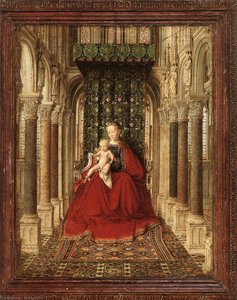
To look at a Jan van Eyck painting is to witness the moment Western art stopped pretending and started observing. We often hear the myth that he invented oil paint, but the truth is more grounded and far more impressive: he mastered it. By applying thin, translucent glazes of pigment over one another, he achieved a depth of color and a precision of texture that tempera simply could not sustain. He did not just paint surfaces; he captured how light interacts with them. When you see the gleam of a single candle or the heavy weight of a velvet robe in his work, you are seeing the result of a technical revolution that changed the visual language of Europe.
His career was built on more than just brushwork. Van Eyck operated within the high-stakes environment of the Burgundian court, serving Philip the Good. This position required him to be much more than a craftsman; he functioned as a diplomat, traveling to places like Portugal and Spain on official missions. This access to power provided the financial stability necessary for his technical experiments. He was a man of intellect and discretion, qualities that allowed him to move between the worlds of high politics and fine art with ease.
The Precision of the Northern Eye
The work of Van Eyck is defined by an almost obsessive attention to the minute details of the physical world. In his portraits, he does not merely record a face; he records the texture of skin, the individual strands of hair, and the specific way light hits a turban. This level of realism was driven by a shift in focus toward the individual and the tangible. His ability to render atmospheric perspective—the way distant landscapes soften into a blue haze—showed a sophisticated understanding of how the human eye perceives depth.
His most significant technical achievements can be seen in several key works:
- The Ghent Altarpiece: A massive twelve-panel polyptych that demonstrates his ability to manage complex religious symbolism alongside realistic figures.
- The Arnolfini Portrait: A 1434 work where every object, from the dog representing fidelity to the discarded shoes on holy ground, carries specific weight. The mirror in the background reflects a whole other layer of reality.
- Portrait of a Man (Self Portrait?): A 1433 oil painting that features his personal motto, "Als ich kan" (As well as I can), etched directly onto the frame.
A Lasting Technical Standard
The influence of Jan van Eyck is not found in a vague sense of inspiration, but in the concrete standards he set for the medium. He moved the needle from the matte, flat surfaces of the medieval era toward a luminous, three-dimensional reality. His signature, "JOHANNES DE EYCK," and his frequent use of his motto served as a direct challenge to his contemporaries. He was not interested in the anonymity common to many medieval painters; he wanted his technical prowess to be recognized and attributed.
Even after his death in Bruges in 1441, the methods he perfected continued to dictate how artists approached light and texture for generations. His work remains a benchmark because it represents the successful marriage of scientific observation and artistic skill. He transformed pigments into something that feels alive, leaving behind a body of work that remains as sharp and clear today as it was in the fifteenth century.
Questions & Answers
How do I find works by Jan van Eyck on a specific theme?
The By Keywords page of Jan van Eyck groups the artist's artworks by their keywords.
In which movements did Jan van Eyck work?
Jan van Eyck's works can be browsed by movement on the artist's All Movements page.
What are the birthplace and birth year of Jan van Eyck?
Jan van Eyck was born in Maastricht in 1390.