Early Life, Family and Training
Pierre Louis Omer Charlet was born on January 2, 1809, in Le Château-d'Oléron, France. He grew up in a household where his father held the position of mayor of Le Château-d'Oléron, a role he had occupied since 1808. As the only boy among three sisters, his early years were shaped by the specific expectations of his family. In an effort to honor his mother's wishes, he initially set aside his creative inclinations to pursue the study of law in Poitiers. He later described this period as a kind of exile, a time spent studying to defend or prosecute the innocent or the guilty.
Before fully committing to the visual arts, Pierre Louis Omer Charlet explored the written word. By the age of 24, he had already published three small works titled Chahut, La Ganipote, and Coups de pinceaux. These writings preceded his formal transition into the world of painting. His path eventually led him away from the legal texts of Poitiers and toward the studios of Paris, where his true training began.
His formal education in art commenced in the studio of M. Lethière. This period marked the beginning of his professional development as a painter, moving him from the academic study of law toward the technical rigors of the canvas. This foundation in Paris would eventually lead him to the École des Beaux-Arts, setting the stage for a career defined by both his brush and his civic involvement.
Artistic Training and Paris Career
After beginning his studies in the atelier of M. Lethière, Charlet moved toward a more formal education in Paris. In 1833, he entered the École des Beaux-Arts, where he found himself under the guidance of Jean-Auguste-Dominique Ingres and Antoine-Jean Gros. This period of intense study helped shape his approach to genre and historical painting. He was a student of the era, learning the technical discipline required to navigate the competitive art circles of the French capital.
His presence in the Paris Salon became a regular occurrence starting in 1835. As he established himself within the professional landscape, he began to use a double name, exhibiting his work as Omer-Charlet from 1841 onward. His ability to hold his own in these exhibitions was recognized by his peers, and he eventually received a third-class medal for his contributions to the Salon.
During these years, his output reflected a deep interest in religious and historical subjects. His work often focused on the human condition, capturing moments of spiritual or historical weight. Some of his notable paintings from this period include:
- Enfance de Métastase, 1845
- Un jeune républicain sur une barricade..., 1848
Political Life and Later Years
Charlet was a man deeply embedded in the shifting currents of 19th-century French life. Beyond the studio, he was a figure of political significance, guided by strong Bonapartist convictions. This commitment was not a passing interest but a lifelong engagement with the civic duties of his country. He moved through the social and political circles of the era, balancing his identity as a painter with his responsibilities as a citizen.
His influence extended into local governance, where he became a steady presence in the Charente-Inférieure region. From 1852 until his death, he served as a general councillor, a role he held for three decades. This period of his life saw him navigating the complexities of French politics while maintaining his standing in the artistic community. He remained active in these public affairs until his final years.
In the end, Charlet's life reached its conclusion in Hyères. He passed away on February 3, 1882. His long career, marked by both the brush and the political assembly, left a footprint on the history of his time.
Key Works and Artistic Themes
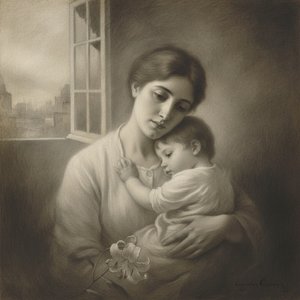
Charlet’s brush captured a wide range of human experiences, moving between the sacred and the everyday. As a painter of genre, allegory, church, and history scenes, he often focused on the emotional weight of a moment. His religious works, such as Christ Descendu de la Croix, show a deep interest in spiritual subjects. He also turned his attention to more allegorical concepts, creating Allegory of time about 1850.
There was a certain tenderness in his ability to depict life's smaller, more poignant scenes. In 1845, he painted Enfance de Métastase, a work that reflects his skill in historical storytelling. Later in his life, his focus remained on the human condition, as seen in Deux enfants surpris par la marée, which he created in 1874. These works reveal an artist who was as comfortable with the grand narratives of history as he was with the quiet, moving details of a single, fleeting instant.
Where to See the Works Today
Finding the traces of Charlet’s hand often requires a trip to the places that shaped his early life. Many of his paintings remain in the churches of his home island, Oléron, where they continue to hold their original, spiritual context. These works are part of the local landscape, preserved in the quiet spaces where they were first intended to be seen. The Musée des Beaux-Arts de La Rochelle also keeps several of his creations, ensuring his presence in the region's history is maintained.
Beyond the coast of France, his art has traveled much further. The Cathédrale Saint-Louis exhibits his works, allowing viewers to encounter his religious and historical scenes in a grand setting. His reach extends even to Poland, where the Museum of John Paul II Collection in Warsaw holds his work titled Allegory of time.
Questions & Answers
Is there an overview of all the subjects Pierre Louis Omer Charlet painted?
The Subject Atlas page maps Pierre Louis Omer Charlet's artworks by subject.
What other names is Pierre Louis Omer Charlet known by?
Pierre Louis Omer Charlet appears under the alternate names Omer-Charlet.
Can I visit a virtual museum of Pierre Louis Omer Charlet's works?
A virtual visit is possible: the 3D Museum page of Pierre Louis Omer Charlet presents the artist's works in a three-dimensional gallery.
How many artworks by Pierre Louis Omer Charlet are available to browse?
You can browse 2 artworks by Pierre Louis Omer Charlet on the All Artworks page.