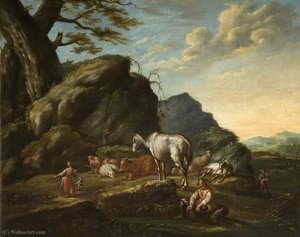
Goats and Flock of Sheep
Goats and Flock of Sheep is an oil painting by Philipp Peter Roos. The artist, who was also known by the moniker Rosa di Tivoli, produced this work about 1681. He was a German Baroque painter born in Sankt Goar, Germany.
Kratek opis
Med vsemi originali, ki jih je pustil Philipp Peter Roos, je najbolj znan Goats and Flock of Sheep (1681), ki se nahaja v kolekciji Bavarske državne slikopisne zbirke, München. Takoj za njima sta Piece of Livestock (1681) in Landscape with Cattle and Shepherd (1681). Naš katalog vsebuje 93 del umetnika Philipp Peter Roos; galerija je ohranila 92 del, ki jih svet najbolj oboževa, odlikovanih z datumom nastanka, pripadajočim muzajem in zgodbojo.
Goats and Flock of Sheep is an oil painting by Philipp Peter Roos. The artist, who was also known by the moniker Rosa di Tivoli, produced this work about 1681. He was a German Baroque painter born in Sankt Goar, Germany.
Piece of Livestock is an oil painting by Philipp Peter Roos, executed in 1681. The work originates from the Baroque period, a time when the artist was establishing his presence within the Italianate landscape tradition.
Landscape with Cattle and Shepherd is a work by the German Baroque painter Philipp Peter Roos. Created about 1681, the painting reflects the artist's specialized focus on pastoral scenes and animal subjects. Roos was a significant figure in the development of Italianate landscapes, often characterized by his intimate study of livestock and the natural environment.
In Piece of Livestock, Philipp Peter Roos organizes a pastoral scene through a close-up, ground-level perspective that establishes an immediate intimacy with the subjects. The composition is dominated by a large, seated cow positioned slightly to the right of the center. To the left, a smaller lamb or calf provides a sense of scale, while a woman interacts with a dog in the space behind the primary subject. This arrangement…
Resting Flock with Shepherds is an oil painting by the German Baroque artist Philipp Peter Roos. Created about 1681, this work captures a quiet moment within a rugged landscape. The composition focuses on a group of livestock and a shepherd, rendered with a sense of immediate presence that draws the viewer into the scene.
Resting Flock with Shepherds is an oil painting by Philipp Peter Roos. The canvas captures a heavy stillness among livestock and their guardian. This work was created about 1681. It presents a scene of animals and men gathered in a quiet, layered space under a turbulent sky.
In this Baroque-style oil painting, the mythological drama of the Liberation of Io unfolds with a sudden, heavy intensity. Created by Philipp Peter Roos about 1681, the scene captures a moment of profound tension between the divine and the mortal. A massive, powerful bull dominates the foreground, its muscular form rendered with a weight that feels almost tangible. This central figure looms over the landscape, its presence commanding the space…
This oil on canvas painting, dated 1681, presents a monochromatic scene rendered in various shades of gray. In the foreground, a young woman is positioned amidst a group of livestock, including sheep or goats. The composition is a medium shot, placing the human subject and the animals in the immediate front and middle ground. The terrain is undulating, forming rolling hills that recede into a background of hazy mountains and…
Returning Flock with Shepherds is an oil painting by Philipp Peter Roos. Created about 1681, the work captures a quiet moment of pastoral movement. The artist, a German Baroque painter, was born in Sankt Goar. He would later become known by the moniker Rosa di Tivoli.
The scene unfolds in Shepherd with Cow, Sheep and Goats in Italian Mountain Landscape, a work that captures a quiet moment of pastoral life. This painting, created about 1680, brings together a shepherd and his diverse herd amidst a rugged, mountainous setting. The figures and animals exist within a landscape that feels both immediate and deeply rooted in the natural world.
Četiri teme, ki se v teh originalih najpogosteje ponavljajo, vsaka z svojim vrhunskim primerom.
8 muzejev, ki vsebujo največ slik na tej strani.
| Muzej | Mesto | Sloga Philipp Peter Roos | Slike iz tega seznama |
|---|---|---|---|
| München | 15 | Goats and Flock of Sheep, Piece of Livestock, Landscape with Cattle and Shepherd | |
| Kopenhagen | 5 | Cattle Piece, Landscape with a Bull, Sheep and Goats, A Shepherd with his Herd | |
| Buenos Aires | 4 | Landscape with shepherd and animals, Landscape with figures and animals, Shepherd and animals in a landscape | |
| Bratislava | 3 | Goat Herd with a Goatherd, Shepherd's Idyl in a Romantic Landscape with Ruins, Herd by an Ancient Well | |
| Praga | 3 | Ravine with a Stream, a Shepherd and His Herd, Horse and Goats Grazing, Shepherd with a Herd of Sheep and Goats | |
| Dunaj | 3 | Herd with Sleeping Shepherds, Rider Meeting, Landscape with Flock of Sheep | |
| Sankt Peterburg | 3 | Landscape with a Grotto, Landscape with a Waterfall, Landscape with a Herd | |
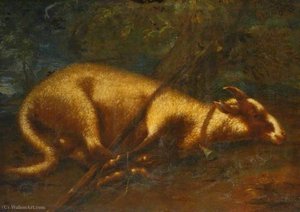
| Stockholm | 3 | Dead Hare, Landskap med hjord, A Goat Resting |
Izberite desetletje, da si ogledate original, ki ga opredeljuje.
This large-scale oil painting, dated 1669, presents a crowded, maximalist composition of diverse animal species. The arrangement is packed, with various animals overlapping to create a sense of density and movement. The color palette relies on deep, earthy tones, including rich browns, blacks, and dark ochres. These dark shades are interrupted by specific highlights of white and cream, alongside splashes of red from a rooster and parrots. The lighting follows…
Goats and Flock of Sheep is an oil painting by Philipp Peter Roos. The artist, who was also known by the moniker Rosa di Tivoli, produced this work about 1681. He was a German Baroque painter born in Sankt Goar, Germany.
A heavy, dark-colored cow anchors the center of this scene, its presence felt in the weight of its silhouette. To the left, two goats rest upon the ground, one a pale contrast of white and light tan against the shadows. A man sits nearby, leaning back in a moment of stillness, his gaze directed toward the animals or perhaps the viewer. The air in the enclosure feels thick and dim,…
In this work, titled Shepherd's Idyl in a Romantic Landscape with Ruins, the artist Philipp Peter Roos presents a quiet moment of rural existence. Created about 1700, the painting captures a shepherd tending to his flock amidst a landscape of rolling hills and weathered stone structures. There is a sense of stillness in the way the figures and animals occupy the space, suggesting a life governed by the rhythms of…
Goats and Flock of Sheep (1681), Bavarske državne slikopisne zbirke, München. Zatem sledeta Piece of Livestock (1681) in Landscape with Cattle and Shepherd (1681).
24 let: delo Goats and Flock of Sheep iz leta 1681, Philipp Peter Roos pa je bil/a rojen/a leta 1657.
Goats and Flock of Sheep, Piece of Livestock, Landscape with Cattle and Shepherd, Piece of Livestock, Resting Flock with Shepherds, Resting Flock with Shepherds, Liberation of Io, Piece of Cattle, Returning Flock with Shepherds in Shepherd with Cow, Sheep and Goats in Italian Mountain Landscape. Zgornja lestica prikazuje leto nastanka in muzej za vsako delo.
Naš katalog vsebuje 93 del avtorja Philipp Peter Roos, datiranih od 1669 do 1700.
Večini v Bavarske državne slikopisne zbirke (München), Statens Museum For Kunst (Kopenhagen) in National Museum of Fine Arts (Buenos Aires). Zgoraj navedena tabela muzejev vsebuje njihov celoten seznam.
V obdobju 1680s: 21 od 92 del na tej strani je bilo izdelovanih takrat, med njimi pa Goats and Flock of Sheep.
Na tej strani je najstarejše delo iz Various animals gathered before Noah's Ark (1669) in najstarejše iz Shepherd's Idyl in a Romantic Landscape with Ruins (1700).
Landscape (33), Animals (29) in Goats (19), na 92 delih na tej strani.
Oil On Canvas, za 18 od 92 del na tej strani.
Baroque, glede na originala na tej strani.
Goats and Flock of Sheep, Piece of Livestock in Landscape with Cattle and Shepherd: v muzeju Bavarske državne slikopisne zbirke, München se nahaja 15 del z te strani.
V zlatem svetu italiane baroka je malo imen vzbudi pastoralno spokojnost podeželskega življenja tako močno kot Philipp Peter Roos. Zgodovini znano pod njegovo značilno aliževim priimkom, Rosa di Tivoli, je ta nemški mojster transformiral žanr krajine z globoko, skoraj visceralno povezanostjo z naravnim svetom. Rodjen leta 1655 v regiji Rhen, natančneje v bližini Sankt Goarja, je bil Roos že od najmlajših let predviden za čoprc za sliko. Bil je sin Johann Heinricha Roosa, spoštovanega slikarja krajin, ki mu je podal temeljne lekcije o tonski harmoniji in komposicijski ravnovesji, ki bodo kasneje opredelile avtorjev zrel stil. To zgodnje učenje ni bilo le stvar tehnike; bil je to včerajšnji skok v način opazovanja sveta skozi prizmo svetlobe, senčevine in tihe dostojnosti zemlje.
Roosova življenjska pot se je dramatično spremenila leta 1677, ko je to sprožil Karlo I, dežarni grof Hesse-Kassel, s svojo velikodušnostjo. Prepoznavajoč vzrastajoči talent mladega slikarja, je dežarni grof zagotovil finančna sredstva za Roosovo preobrazbeno pot v Rim. Ta migracija iz germanskih tradicij v srce italiana baroka je Roosu omogočila, da je vdel v živopisno energijo rimske umetnosti. Prav tukaj je poiskal mentorstvo pri znamenitem Giacintu Brandiju, čiji vpliv je pomagal izpopolniti Roosovo sposobnost združevanja klasične strukture z bolj spontanim, atmosferskim realizmom. Ta obdobje v Rimu je bilo tudi globoko osebno; prav v teh letih se je Roos zaljubil v Isabello Brandi, hčerko svojega mentorja. Njuna zveza ga je končno vodila v Tivoli, v naselje, ki bo za vedno povezalo njegovo identiteto z naravo, ki jo je tako ljubil.
Tisto, kar Resnično loči opus Rosa di Tivoli, je nepremagljiva avtentičnost njegovih živalskih motivov. Za razliko od mnogih njegovih sodobnikov, ki so živali v krajini uporabljali le kot dekorativne dodatke, je Roos vsako bitje – od masivnega vola do okretne kozle – obravnaval z spoštovanjem portretista. Njegovo prebivališče v Tivoliju je bilo znano po konceptu, ki je bil podoben živemu studiu; vzdrževal je obsežno zbirko eksotičnih in domačih živali, s čimer je svojo okolico spremil v nepretrlo raziskovanje gibanja, anatomije in temperamenta. Ta tesna bližina mu je omogočila, da je zajel subtilno trzljaj uha ali mišično napetost živali v težkih trenutkih, čimer je svoja platna opredelil z zapirajočo vitalnostjo.
Njegovo tehnično znanje je vidno v načinu, kako je obvladoval kompleksnost baročne estetike. Čeprav so njegove kompozicije pogosto prerašljale mirne, atmosferske kvalitete nizozemskega zlate dobe, so prepojene z dramatično intenzivnostjo, značilno za italijansko šolo. Njegova dela pogosto vključujejo:
Zgodovinski pomen Philippa Petera Roosa leži v njegovi sposobnosti, da je premostil razporeditev med strukturirano tradicijo severnoevropskih krajin in čustveno, svetlobno polno dramo Italije. Pojavil se je v času, ko je znanstveno raziskovanje obdobja že zahtevalo bolj natančna opazovanja naravnega sveta, kljub temu da so religijske in mitološke teme še vedno dominirale v umetniški zavesti. V njegovih slikah najdemo tako natančen detajl naturalista kot poetsko dušo romantičarja. Z dokumentiranjem flore in faune rimske podeželske krajine z tako predanostjo je ustvaril vizualni zapis, ki govori o duhu časa prav toliko, kot govori o samih motivih.
Čeprav je umrl leta 1706 in pustil za sobą dediščino, ki je bila vrezana v samo tla Tivolija, je njegov vpliv trajal. Ostaja ključna figura za vsakega, ki študira razvoj živalskega slikarstva in razvoj italijanske krajine. Skozi njegove oči ne vidimo le zbiralka živinske; pričakovali smo globoko proslavo življenja v njegovi najbolj osnovni, neprepretreni obliki. Njegovo del še vedno odmeva kot dokaz moči opazovanja in neminljive lepote pastoralnega ideala.