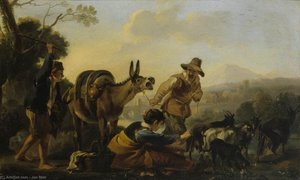
Portret Jan Miel

71 najbolj znanih slik umetnika Jan Miel, vsaka popolnoma edinstvena

Posodobljeno november 2026 · uvrščeno glede na naš skoraj priljubljenosti (iskanja, obiske in naročila za vsako delo) · 71 del v našem katalogu avtorja Jan Miel

Kratek opis

Scene from the Life of Tramps (Lazzaroni) (1650) je slika avtorja Jan Miel, ki pritegne največ pogledov; original se nahaja v muzeju Ermitaž, Sankt Peterburg. Nato se pogled smeri k Hunters at Rest (1650) in Carnival Entertainment (1635). Med 71 dela umetnika Jan Miel v našem katalogu so ta 71 najbolj znana; vsako je edinstven original, predstavljen z letnico nastanka, muzejem in razlogom za njegovo nečasenost.

1599 – 1663, Beveren Baroque Največ del: Ermitaž

10 najboljjših slik umetnika Jan Miel skozi oči galerije

1
Scene from the Life of Tramps (Lazzaroni) (1650) avtorja Jan Miel

Scene from the Life of Tramps (Lazzaroni)

1650 · Oil On Canvas · Ermitaž, Sankt Peterburg

A heavy, ochre light settles over the crumbling stone of ancient ruins. Here, the shadows are thick and deep, swallowing the corners of a chaotic street scene. Figures move through the haze of smoke and dust, their bodies caught in a sudden, sharp glare of sun. A man gestures with urgency, his hands carving shapes into the air, while others sit in the dirt, anchored by the weight of their…

2
Hunters at Rest (1650) avtorja Jan Miel

Hunters at Rest

1650 · Oil On Canvas · Ermitaž, Sankt Peterburg

is an oil on canvas painting by the Flemish artist Jan Miel. Created about 1650, the work captures a quiet moment within a pastoral scene. It depicts a hunting party finding respite amidst the landscape. The scene is anchored by the presence of horses and the sturdy silhouette of a fortified tower.

3
Carnival Entertainment (1635) avtorja Jan Miel

Carnival Entertainment

1635 · Oil On Canvas · Bavarske državne slikopisne zbirke, München

In "Carnival Entertainment" by Jan Miel, we find ourselves amidst a dense and dynamic urban scene. The composition is crowded, capturing a street festival where a large group of figures occupies the foreground and middle ground. These individuals—musicians, dancers, and various onlookers—are arranged to create a sense of constant movement. The perspective is a ground-level view, which provides a palpable sense of depth through the careful layering of people and…

4
Sine Cerere et Baccho Friget Venus (1645) avtorja Jan Miel

Sine Cerere et Baccho Friget Venus

1645 · Oil

The oil painting titled Sine Cerere et Baccho Friget Venus presents a mythological scene of abundance. Jan Miel rendered this work in 1645. It captures a moment where classical deities gather amidst the symbols of harvest and intoxication. The figures exist within a lush, Baroque-style arrangement of life and plenty.

5
The Veneration of St. Lambert (1648) avtorja Jan Miel

The Veneration of St. Lambert

1648 · Oil On Canvas · Fitzwilliam Museum

The air in the grand, classical space feels heavy with the scent of incense and the weight of sudden grief. In the center of this dramatic scene, St. Lambert lies in repose, his body a pale, still anchor amidst a sea of movement. Above him, the celestial realm breaks through the gloom; an angel descends with fluid, sweeping drapery that seems to catch a wind from another world. The light…

6
Soothsayer at an inn (1644) avtorja Jan Miel

Soothsayer at an inn

1644 · Oil

The air at the roadside inn feels heavy with the scent of dust and old stone. Under a rugged stone archway, a group of travelers huddles in a moment of quiet tension. A woman in a garment of lapis blue leans toward a man, her presence a cool contrast to the earthy ochre and deep crimson that define the crowd. He is the soothsayer, a figure caught in the flickering…

7
Two hunters resting in a landscape (the standing hunter is a woman in men's clothes) (1639) avtorja Jan Miel

Two hunters resting in a landscape (the standing hunter is a woman in men's clothes)

1639 · Oil On Canvas · New York Historical Society, New York City

The scene unfolds within the oil on canvas work titled Two hunters resting in a landscape (the standing hunter is a woman in men's clothes). This composition emerges from the hand of Jan Miel, a painter who brings a sense of immediate life to the quietude of the hunt. The work is dated 1639, capturing a specific moment of stillness amidst the natural world.

8
Three peasants having fun with music and dance (1639) avtorja Jan Miel

Three peasants having fun with music and dance

1639 · Oil On Panel · Rafael Valls Limited, City of Westminster

Three peasants having fun with music and dance by Jan Miel presents a lively genre scene centered on three figures engaged in rhythmic activity. The composition is dynamic, utilizing an intimate perspective that places the viewer in close proximity to the subjects. Within this shallow space, the central figure is captured mid-motion, a choice that establishes a sense of rhythmic movement throughout the scene. To the left of the main…

10
An Italianate Landscape with Peasants Dancing (1650) avtorja Jan Miel

An Italianate Landscape with Peasants Dancing

1650 · Oil On Canvas · Nostell Priory, Wakefield

We are looking at An Italianate Landscape with Peasants Dancing, a work by Jan Miel. This piece dates to about 1650, a period when the artist was deeply engaged with the stylistic shifts occurring within the Italian Baroque. It is a significant example of how Miel navigated the transition from the gritty, everyday observations of the Bamboccianti to more expansive, classical compositions.

Slavna platna umetnika Jan Miel, od številk 11 do 71

11Falcon hunters in front of an inn in a ruin (1650) avtorja Jan MielFalcon hunters in front of an inn in a ruin1650 12The beggar (1650) avtorja Jan MielThe beggar1650 13Barber and roulette players (1650) avtorja Jan MielBarber and roulette players1650 14Military resting with a fortune teller (1650) avtorja Jan MielMilitary resting with a fortune teller1650 15Carnival parade in Rome (1660) avtorja Jan MielCarnival parade in Rome1660 16Hannibal's dream (1661) avtorja Jan MielHannibal's dream1661 17Figures in the vicinity of architectural ruins (1650) avtorja Jan MielFigures in the vicinity of architectural ruins1650 18The gathering of the hunters (1660) avtorja Jan MielThe gathering of the hunters1660 · Galleria Sabauda 19Boar hunt (1660) avtorja Jan MielBoar hunt1660 · Royal Palace of Venaria 20Bear hunt (1659) avtorja Jan MielBear hunt1659 · Royal Palace of Venaria 21Diana the Huntress (1658) avtorja Jan MielDiana the Huntress1658 · Royal Palace of Venaria 22Adoration of the Shepherds (1650) avtorja Jan MielAdoration of the Shepherds1650 · Pushkin State Museum 23Serenade with dancers and musician (1650) avtorja Jan MielSerenade with dancers and musician1650 24The Race of the Berber Horses in Rome (1664) avtorja Jan MielThe Race of the Berber Horses in Rome1664 25Traveling theatre (1700) avtorja Jan MielTraveling theatre1700 26Harbour (1652) avtorja Jan MielHarbour1652 · Ermitaž 27La curea - curée - con corte Regale, Carlo Emanuele II e Franesca d (1661) avtorja Jan MielLa curea - curée - con corte Regale, Carlo Emanuele II e Franesca d1661 · Royal Palace of Venaria 28Dance in the Trattoria (1647) avtorja Jan MielDance in the Trattoria1647 · Akademija likovnih umetnosti v Dunaju 29LE BARBIER NAPOLITAIN avtorja Jan MielLE BARBIER NAPOLITAINLouvre 30St John the Baptist Preaching in the Desert avtorja Jan MielSt John the Baptist Preaching in the DesertNationalmuseum 31The Arch of Constantine in Rome (1648) avtorja Jan MielThe Arch of Constantine in Rome1648 · Barber Institute of Fine Arts 32Scene in front of a tavern (1638) avtorja Jan MielScene in front of a tavern1638 · Narodni muzej v Varšavi 33Figures Feasting at a Fair in Prati, Outside the Walls of Rome, with the Saint Peter's Basilica and Monte Mario Beyond (1650) avtorja Jan MielFigures Feasting at a Fair in Prati, Outside the Walls of Rome, with the Saint Peter's Basilica and Monte Mario Beyond1650 34Deer hunt (1661) avtorja Jan MielDeer hunt1661 · Royal Palace of Venaria 35The death of the deer (1660) avtorja Jan MielThe death of the deer1660 · Royal Palace of Venaria 36The Courtyard of Palazzo Nardini in Rome (1650) avtorja Jan MielThe Courtyard of Palazzo Nardini in Rome1650 · Palazzo Barberini 37Hunters at Rest avtorja Jan MielHunters at RestMuzej Prado 38Architectural Landscape (1638) avtorja Jan MielArchitectural Landscape1638 · Ermitaž 39Carnival Time in Rome (1653) avtorja Jan MielCarnival Time in Rome1653 · Muzej Prado 40The snack avtorja Jan MielThe snackMuzej Prado 41Cottage with inhabitants avtorja Jan MielCottage with inhabitantsMuzej Prado 42The local Barber avtorja Jan MielThe local BarberMuzej Prado 43Popular scene avtorja Jan MielPopular sceneMuzej Prado 44The Flight into Egypt avtorja Jan MielThe Flight into EgyptStatens Museum For Kunst 45Soldiers Resting avtorja Jan MielSoldiers RestingNationalmuseum 46Peasants Resting avtorja Jan MielPeasants RestingNationalmuseum 47Hunters Resting avtorja Jan MielHunters RestingNationalmuseum 48Fox hunting avtorja Jan MielFox huntingRoyal Palace of Venaria 49Jugglers passing – Carnival avtorja Jan MielJugglers passing – CarnivalNarodni muzej v Varšavi 50MARCHAND D'ESCARGOTS avtorja Jan MielMARCHAND D'ESCARGOTS 51Road in the Roman Campagna avtorja Jan MielRoad in the Roman CampagnaErmitaž 52PAYSAGE AVEC FIGURES avtorja Jan MielPAYSAGE AVEC FIGURES 53Maraudeurs italiens Une halte (autre titre) avtorja Jan MielMaraudeurs italiens Une halte (autre titre) 54Pastorale avec bergère endormie avtorja Jan MielPastorale avec bergère endormie 55The fugitive Erminia asks a fellow countryman for admission avtorja Jan MielThe fugitive Erminia asks a fellow countryman for admission 56The Assembly (1660) avtorja Jan MielThe Assembly1660 · Château de Versailles 57The vihuela player avtorja Jan MielThe vihuela playerMuzej Prado 58LA DINEE DES VOYAGEURS avtorja Jan MielLA DINEE DES VOYAGEURSLouvre 59Genre Scene (1650) avtorja Jan MielGenre Scene1650 · Ermitaž 60Landscape with herders avtorja Jan MielLandscape with herdersMuzej Prado 61LA HALTE MILITAIRE avtorja Jan MielLA HALTE MILITAIRELouvre 62Landscape with a Battle between Two Rams (1640) avtorja Jan MielLandscape with a Battle between Two Rams1640 · Metropolitanski muzej umetnosti 63Hunters at Rest avtorja Jan MielHunters at RestErmitaž 64Shepherds and herd in a mountainous landscape avtorja Jan MielShepherds and herd in a mountainous landscapeMusée Calvet 65Carnival in the Piazza Colonna, Rome avtorja Jan MielCarnival in the Piazza Colonna, RomeWadsworth Atheneum 66Roman Lime Kiln with Peasants Gambling avtorja Jan MielRoman Lime Kiln with Peasants Gambling 67Italian Peasants outside a Tavern avtorja Jan MielItalian Peasants outside a TavernKraljeva zbirka 68Un savetier avtorja Jan MielUn savetier 69The bowls players avtorja Jan MielThe bowls players 70LE MENDIANT avtorja Jan MielLE MENDIANTLouvre 71Charlatan avtorja Jan MielCharlatanErmitaž

Slavna platna umetnika Jan Miel, razdeljena po obdobjih

Motivi, ki so očarali Jan Miel

Četiri teme, ki se v teh originalih najpogosteje ponavljajo, vsaka z svojim vrhunskim primerom.

Muzeji, ki hranijo originala umetnika Jan Miel

8 muzejev, ki vsebujo največ slik na tej strani.

Muzej Mesto Sloga Jan Miel Slike iz tega seznama
Ermitaž, Sankt PeterburgErmitaž Sankt Peterburg 8 Scene from the Life of Tramps (Lazzaroni), Hunters at Rest, Harbour
Muzej Prado, MadridMuzej Prado Madrid 8 Hunters at Rest, Carnival Time in Rome, The snack
Royal Palace of Venaria, Venaria RealeRoyal Palace of Venaria Venaria Reale 7 Boar hunt, Bear hunt, Diana the Huntress
Louvre, ParizLouvre Pariz 4 LE BARBIER NAPOLITAIN, LA DINEE DES VOYAGEURS, LA HALTE MILITAIRE
Nationalmuseum, StockholmNationalmuseum Stockholm 4 St John the Baptist Preaching in the Desert, Soldiers Resting, Peasants Resting
Narodni muzej v Varšavi, VaršavaNarodni muzej v Varšavi Varšava 2 Scene in front of a tavern, Jugglers passing – Carnival
Bavarske državne slikopisne zbirke, MünchenBavarske državne slikopisne zbirke München 1 Carnival Entertainment
Fitzwilliam MuseumFitzwilliam Museum 1 The Veneration of St. Lambert

Jan Miel skozi desetetja: vsak unikatni original za vsako obdobje

Delo po desetletjih

Izberite desetletje, da si ogledate original, ki ga opredeljuje.

Slike umetnika Jan Miel: vprašanja za galerijo

Katero je najbolj znano delo umetnika Jan Miel?Razkriti odgovor

Scene from the Life of Tramps (Lazzaroni) (1650), Ermitaž, Sankt Peterburg. Zatem sledeta Hunters at Rest (1650) in Carnival Entertainment (1635).

Pri kateri dobe je Jan Miel ustvaril Scene from the Life of Tramps (Lazzaroni)?Razkriti odgovor

51 let: delo Scene from the Life of Tramps (Lazzaroni) iz leta 1650, Jan Miel pa je bil/a rojen/a leta 1599.

Katera desetina slik avtorja Jan Miel je najbolj znana?Razkriti odgovor

Scene from the Life of Tramps (Lazzaroni), Hunters at Rest, Carnival Entertainment, Sine Cerere et Baccho Friget Venus, The Veneration of St. Lambert, Soothsayer at an inn, Two hunters resting in a landscape (the standing hunter is a woman in men's clothes), Three peasants having fun with music and dance, The Travelers' Dinner. Peasants Eating Near an Inn or Resting in An Italianate Landscape with Peasants Dancing. Zgornja lestica prikazuje leto nastanka in muzej za vsako delo.

Koliko je znanih del avtorja Jan Miel?Razkriti odgovor

Naš katalog vsebuje 71 del avtorja Jan Miel, datiranih od 1635 do 1661.

Kje si lahko ogledate najslavnejše originale umetnika Jan Miel?Razkriti odgovor

Večini v Ermitaž (Sankt Peterburg), Muzej Prado (Madrid) in Royal Palace of Venaria (Venaria Reale). Zgoraj navedena tabela muzejev vsebuje njihov celoten seznam.

V katerem obdobju je Jan Miel ustvaril svoja najbolj znana dela?Razkriti odgovor

V obdobju 1650s: 18 od 71 del na tej strani je bilo izdelovanih takrat, med njimi pa Scene from the Life of Tramps (Lazzaroni).

Katero znano sliko je naslikal Jan Miel najprej in katero najpozdneje?Razkriti odgovor

Na tej strani je najstarejše delo iz Carnival Entertainment (1635) in najstarejše iz Hannibal's dream (1661).

Katere teme je Jan Miel najprej ravnate?Razkriti odgovor

People (21), Landscape (15) in Architecture (14), na 71 delih na tej strani.

S katerimi materiali je Jan Miel najpogosteje slikal?Razkriti odgovor

Oil On Canvas, za 34 od 71 del na tej strani.

Kateri umetniški slog predstavlja delo umetnika Jan Miel?Razkriti odgovor

Baroque, glede na originala na tej strani.

Katere originale Jan Miel lahko vidim v muzeju Ermitaž?Razkriti odgovor

Scene from the Life of Tramps (Lazzaroni), Hunters at Rest in Harbour: v muzeju Ermitaž, Sankt Peterburg se nahaja 8 del z te strani.

Jan Miel: portret umetnika

Jan Miel: Most med nizkim realizmom in baroknim veličastvom

Jan Miel (1599–1663) predstavlja ključno figuro v umetniški pokrajini sedemt عشرletja, saj v svojem delu utelja fascinantno stičišče flambrske tradicije in italijanske inovativnosti. Rodil se je v Beverenu v Belgiji—čeprav Antwerp in ’s-Hertogenbosch ostajata verodostojna kandidata za njegovo rojstno mesto—njegovo zgodnje življenje ostaja zavito v relativno nejasnost, zaradi česar so biografski podatki redki. Vendar pa iz znanstvenih raziskav izstopa izjemna umetniška pot, ki jo zaznamuje slogovna evolucija in sodelovanja, ki so mu utrdila mesto v živahnem kulturnem okolju Rima in Turina.

Svoje oblikovalne leta je preživel pri izkušanju svoje umetnosti predvsem v Antwerpu, kjer je sprejel vplive znamenitih flambrskih mojstrov, kot je bil Anthony van Dyck. Čepredo natančen obseg njegove izobrazbe ostaja neulovljiv, je nedvomno v njem vzpostavil spoštovanje do natančnega opazovanja in izpopoljene tehnike—lastnosti, ki bodo zaznamovale velik del njegove kasnejše tvorbe. Ta temeljita podlaga v klasičnem risarstvu in portretiranju je zagotovila bistven orodovnik za kariero, ki bo sčasoma presegla regionalne meje.

Rimska preobrazba in duh Bamboccianti

Mielov prihod v Rim okoli leta 1636 je označil prelomni trenutek v njegovi umetniški poti. Hitro se je pridružil Bentvueghels, vplivnemu združenju nizozemskih in flambrskih umetnikov, ki so prebivali v Večnem mestu. V tem bratstvu je sprejel nepozaben priimek ‘bieco’, kar je bil pripetje, ki odraža njegov značilen, skrenjen pogled—karakteristika, ki bo postala sinonim z njegovo umetniško osebnostjo. Ta pripadnost je spodbudila globoke povezave z širšo umetniško skupnostjo, ki je bila močno pod vplivom sloga Bamboccianti Pietersa van Laerja.

Ta gibanje je bilo posvečeno prikazovanju prizorov vsakdanjega življenja med nižjimi sloji v Rimu in okolici, saj je odrejalo idealizirano veličastje umetnosti visoke renesanse za nekaj veliko bolj vizceralnega in neposrednega. Miel je ta trend sprejel z vso močjo in ustvarjal očarljive žanrske slike, ki so s izjemnim realizmom in občutljivostjo zajele duh mestnega obstoja. Njegova dela so pogosto vključevala:

  • Živahne ulice, polne potnikov, trgovcev in delavcev.
  • Močno uporabo svetlobe za priklic prašne, soncem prežgane atmosfere rimskih uličic.
  • Subtilno prepletanje človeških čustev znotraj zastopenih in kaotičnih okolij.
  • Natančno pozornost teksturam tkanin, kamna in zemlje.

Evolucija proti klasicizmu in dvorski veličastnosti

Ko se je njegova kariera razvijala, je umetniška vizija Miela doživela pomembno metamorfozo. Čeprav je ostal mojster žanrske slike, se je začel oddaljevati od surovega realizma Bamboccianti v smeri bolj klasicističnih zgodovinskih slik. Ta premik je odražal širši trend v evropski umetnosti, kjer je surova energija baroka vedno bolj ublažena z željo po redisu, plemenitosti in klasični alegoriji.

Ta razvoj ga je končno vodil do prestižnih任命ov, najbolj izstopajoče pa je bila služba kot dvorski umetnik Charlesa Emanuela II, vojvoda Savoj. V službi turinskega dvora je Mielovo delo dobilo bolj formalen in veličasten karakter. Intimnost njegovih zgodnejših rimskih scen se je predala kompozicijam večjega obsega in kompleksnosti, zasnovanim tako, da odražajo moč in prestiž njegovega kraljevega pokrovitelja. To obdobje predstavlja vrhunec njegove profesionalne dosežbe, kjer so se njegove flambrske korenine v podrobnostih srečale z grandioznimi, širimi narrativami, ki jih je zahtevala evropska aristokracija.

Zgodovinski pomen Jana Miela leži v njegovi sposobnosti navigiranja med temi nesklajenimi svetovoma. Bil je umetnik, ki je lahko v skromnih težavah rimske ulične mladine našel lepoto in v epskih zgodah antike dostojnost. S tem ko je premostil vrzel med natančnim realizmom Severa in dramatičnim klasicizmom Smieta, je Miel pustil neizbrisno sled v kanonu sedemt عشرletja in zagotovil svojo dediščino pravega kosmopolita barokne dobe.