German Expressionism
Friends (Emil Nolde)
Emil Nolde (1867–1956) criou Friends. Pertence ao movimento German Expressionism. É feito em Oil On Canvas.
- Oil On Canvas

 Visualizar na parede

 Pintura a Óleo Feita à Mão
 Compartilhar
 Compartilhar
 Ficha técnica


 Baixar imagem
 Semelhantes
 Raio X
 Ver diaporama
 Perguntas e Respostas

 Estatísticas
Friends, em resumo
- Título
- Friends
- Artista
- Emil Nolde (1867–1956)
- Artista nascido em
- Nolde, Dinamarca
- Técnica
- Oil On Canvas
- Movimento
- German Expressionism
- Período
- Modern
- Tema
- landscape painting, german art scene, rural scenery, expressionist style, colorful palette”,, friendship theme”,
O que Friends retrata?
Identification of the Artwork and Artist
Friends is a work by the German painter and printmaker Emil Nolde. The piece focuses on the complexities of human connection, intimacy, and emotional vulnerability. Through a simplified and expressive visual language, the artist explores the fundamental themes of friendship or love.
Nolde, a prominent figure in the Expressionist movement and a member of the Die Brücke group, sought to move beyond mere surface representation. His approach prioritized the internal weight of a subject over literal likeness. In this work, the focus remains on the psychological depth of the figures, utilizing a directness that emphasizes feeling over anatomical precision.
Composition and Visual Elements
The composition is tightly cropped, focusing intensely on the faces and upper bodies of the individuals. The intertwined forms of the two figures dominate the frame, filling almost the entire space. This proximity creates a sense of intimacy, pressing the subjects almost directly against the picture plane. The figures occupy the foreground entirely, leaving little room for spatial recession.
The background remains minimal, providing no environmental context. This lack of detail ensures the viewer's attention remains fixed on the physical connection between the subjects. Organic shapes define the human forms, while loose, gestural lines contribute to a sense of movement and emotional intensity. The flattened perspective further emphasizes the closeness of the embrace, removing traditional depth in favor of immediate, tactile presence.
Technique and Material Application
Executed in oil, the work exhibits a rough, painterly texture. The application of pigment is direct, leaving visible brushstrokes across the surface. In certain areas, the paint is applied with enough thickness to suggest an impasto technique, adding a physical weight to the forms. This tactile approach emphasizes the materiality of the medium.
The linework is characterized by a loose, gestural quality rather than precision. Lines are frequently blurred and overlapping, which creates a sense of movement and visual tension. These indistinct boundaries contribute to a dynamic effect, prioritizing the sensation of the subject over anatomical or structural accuracy.
Color Palette and Lighting
The palette is grounded in earthy, muted tones. Dominant shades of brown, ochre, and grey establish a somber foundation for the composition. These neutral colors are interrupted by a striking red hue applied to a figure's hair or head covering, creating a singular point of visual intensity. Small accents of yellow appear in the background and around the faces of the figures, providing a subtle contrast to the darker, more subdued surroundings.
Lighting is diffused and uneven across the surface. There is no singular, identifiable light source; instead, the illumination creates a series of irregular shadows and highlights. This lack of uniform light emphasizes the contours of the faces and bodies, adding a sense of weight to the physical proximity of the subjects. The interplay of light and shadow contributes to the overall emotional density of the work.
Style and Artistic Expression
The work is characterized by a strong Expressionistic style, prioritizing emotional intensity over literal representation. Through the use of non-naturalistic colors and simplified forms, the artist moves away from academic realism toward a more subjective visual language. The composition relies on organic shapes that reflect the human form, creating a sense of physical and emotional closeness.
Facial features are suggested rather than realistically rendered, favoring abstraction to convey the internal state of the subjects. This approach utilizes simplified and somewhat abstracted shapes to emphasize the essence of the human connection. The resulting aesthetic is one of immediacy and raw feeling, where the distortion of form serves to heighten the psychological weight of the embrace.
Related Works by the Same Artist
Nolde’s exploration of human connection and psychological depth extends through various subjects, from religious narratives to landscape studies. His religious output includes Christ among the Children and the visceral 1909 work The Mocking of Christ. These pieces reflect a shift toward depicting the emotional weight of spiritual moments through non-naturalistic color and simplified forms.
The artist also engaged with the primal and the figurative in works such as Masks, executed about 1906-1907. His interest in the natural world and the atmospheric qualities of light is evident in Autumn Sea, painted about 1908, and in the composition of Two Women against a Blue Sky. Each work demonstrates a consistent preoccupation with using color as the primary substance of form.
Imagens em alta resolução de Friends
Emil Nolde, Friends. Domínio público.
Perguntas sobre Friends respondidas
De que técnica é feita a obra "Friends"?
"Friends" é executada em Oil On Canvas.
O que "Friends", de Emil Nolde retrata?
"Friends", de Emil Nolde retrata: landscape painting, german art scene, rural scenery, expressionist style, colorful palette”,, friendship theme”,, nolde’s landscapes”.
"Friends" está em domínio público?
Informação de direitos autorais para "Friends", de Emil Nolde: a obra está em em domínio público — seus direitos autorais expiraram. Isso determina se reproduções da imagem podem ser feitas livremente.
Quem é o artista por trás de "Friends"?
"Friends" é atribuída a Emil Nolde.
A qual movimento artístico pertence "Friends", de Emil Nolde?
O movimento associado a "Friends", de Emil Nolde é German Expressionism. Esta classificação situa a obra entre artistas e obras de arte relacionados.
A que período da carreira de Emil Nolde pertence "Friends"?
"Friends" representa o Early Modern de Emil Nolde.
"Friends", de Emil Nolde, está em domínio público? E por quê?
"Friends", de Emil Nolde está em em domínio público — seus direitos autorais expiraram. O período de direitos autorais conta a partir do falecimento do artista, ocorrido em 1956.
Como "Friends" se insere na trajetória artística de Emil Nolde?
"Friends" compartilha com as outras obras de Emil Nolde o seu estilo German Expressionism e os temas recorrentes: german expressionism, rural landscapes", friendship & nature, nolde's regional focus, "simple, emotive forms", spiritual undertones.
"Friends" é típico do que Emil Nolde costumava criar?
Os temas recorrentes de Emil Nolde incluem german expressionism, rural landscapes", friendship & nature, nolde's regional focus, "simple, emotive forms", spiritual undertones; "Friends" foca em landscape painting, german art scene, rural scenery, expressionist style, colorful palette”,, friendship theme”,, nolde’s landscapes”.
Sobre o artista, Emil Nolde
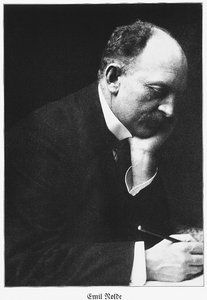
1867–1956, Dinamarca
Emil Nolde
A Vida e a Identidade de Emil Nolde Nascido como Hans Emil Hansen em 7 de agosto de 1867, o homem que viria a ser conhecido como Emil Nolde cresceu nas proximidades da aldeia de Nolde, no Ducado de Schleswig. Seus primeiros anos foram moldados pela vida rural e agrária de sua família, um cenário de tradições profundas que acabaria por influenciar sua visão artística. Eventualmente, ele se afastou desse caminho, optando por trabalhar como entalhador de madeira e decorador de móveis. Esse trabalho manual e tátil precedeu sua transição para a pintura e a gravura, servindo como uma base fundamental para sua sensibilidade estética.
Também de Emil Nolde
 Sunset
 Sea with Red Sky
 Couple on the beach1903
 Masks1911
Ensaios sobre Friends
 Norwegian artworks of the 1900sNorwegian Expressionism and the intense works of Edvard Munch, including The Scream and Anxiety, define this era. View the collection at Or…
 Nature’s Flow: How Organic Forms and Biomorphic Abstraction Bring Harmony to Modern Interior DesignDiscover how organic forms and biomorphic abstraction bring serenity to your home. Explore expert tips on integrating nature-inspired textu…
 Expressionism vs. New Objectivity: Emotion vs. Precision in German ArtMaster the tension between Expressionist emotion and New Objectivity precision. Explore the soul of German modern art now.