Portret Adam Elsheimer

Obrazy: 80 najsłynniejszych dzieł artysty Adam Elsheimer – spojrzenie galerii

Aktualizacja: Listopad 2026 · ranking według naszego wskaźnika popularności (liczba wyszukiwań, wizyt i zamówień dla każdego dzieła) · 81 dzieł Adam Elsheimer w naszym katalogu

W skrócie

Według opinii kuratorów galerii, najsłynniejszym obrazem Adam Elsheimer jest Portrait of Paul Bril (1594), którego oryginał znajduje się w Bawarskie Państwowe Zbiory Malarstwa w Monachium. Witch Riding Backwards on a Goat (1597) i Christ and the Disciples in Emmaus (1601) dopełniają trio, które zna każde oko. Z 81 dzieł Adam Elsheimer w naszym katalogu, galeria prezentuje poniżej 80 najsłynniejszych prac – każda z nich jest oryginałem z podaniem roku powstania, muzeum oraz cech wyróżniających ją na tle innych.

1578 – 1610, Frankfurt nad Menem Baroque Najwięcej dzieł: Städel Museum

10 najlepszych obrazów artysty Adam Elsheimer w galerii

1
Portrait of Paul Bril (1594) autorstwa Adam Elsheimer

Portrait of Paul Bril

1594 · Oil · Bawarskie Państwowe Zbiory Malarstwa, Monachium

Adam Elsheimer’s Portrait of Paul Bril, executed about 1594, presents a formal, bust-length study of a man. The subject is positioned in a three-quarter view, facing slightly toward the viewer's left. His gaze is directed forward, meeting the observer with a steady, direct presence. The composition is centered on the head and shoulders, isolating the sitter against a dark, indistinct background that creates a sense of shallow depth. This lack…

2
Witch Riding Backwards on a Goat (1597) autorstwa Adam Elsheimer

Witch Riding Backwards on a Goat

1597 · Oil On Copper · Pałac Hampton Court, Londyn

The painting presents a vertical arrangement of figures set against a dark, shadowy background. At the upper level, a pale-skinned female figure sits atop a dark mass, facing left while her gaze is directed toward the right. She wears lavender drapery that flows around her form and holds a staff topped with a small creature. Below this central figure, three winged, cherubic figures occupy the midground and foreground. One figure…

3
Christ and the Disciples in Emmaus (1601) autorstwa Adam Elsheimer

Christ and the Disciples in Emmaus

1601 · Oil On Copper · Statens Museum for Kunst, Kopenhaga

The scene unfolds in Christ and the Disciples in Emmaus, a profound moment where recognition dawns amidst a shared meal. Adam Elsheimer captures this sacred encounter, a moment where the divine meets the human in a quiet, intimate setting. The figures gather around a table, their lives momentarily suspended in the tension of sudden realization. This work by Adam Elsheimer brings the viewer into the immediate presence of the disciples…

4
Follwer of ) (1600) autorstwa Adam Elsheimer

Follwer of )

1600 · Oil On Copper

In this 1600 composition, the serenity of Eden is rendered through a delicate arrangement of figures and nature. Two primary angels occupy the foreground, positioned on opposite sides of the frame. The figure on the left stands beside a tree, holding an object with quiet intent, while the angel on the right holds a small creature, possibly a bird. Their presence anchors a landscape populated by smaller, distant figures and…

5
Saint Laurent (1605) autorstwa Adam Elsheimer

Saint Laurent

1605 · Oil On Copper · Musée Fabre, Montpellier

Saint Laurent is an oil painting executed by the artist Adam Elsheimer. The work dates to about 1605. This specific piece was created as part of a larger series consisting of ten panels that were intended to decorate a domestic altar.

6
Flight into Egypt (1609) autorstwa Adam Elsheimer

Flight into Egypt

1609 · Oil On Copper · Alte Pinakothek, Monachium

To gaze upon this depiction of the Flight into Egypt is to step directly into a moment suspended between earthly peril and divine grace. Adam Elsheimer, in his masterful handling of oil paint on copper, has captured not merely a biblical narrative, but an entire atmosphere—a profound meditation on journey, refuge, and enduring hope. The scene unfolds under a vast, star-dusted night sky, rendered with a luminous quality that speaks…

7
Apollo and Coronis (1608) autorstwa Adam Elsheimer

Apollo and Coronis

1608 · Oil On Copper · Walker Art Gallery, Liverpool

In the quiet intimacy of a cabinet painting, where every brushstroke is a whispered secret, Adam Elsheimer’s “Apollo and Coronis” unfolds as a profound meditation on betrayal and divine retribution. Created around 1608, this masterpiece captures a pivotal, heart-wrenching moment from Greek mythology: the instant when the sun god Apollo, driven by the discovery of his lover's infidelity, strikes down the pregnant Coronis. Though the work is executed on a…

8
Apollo and the Cattle of Admetus (1620) autorstwa Adam Elsheimer

Apollo and the Cattle of Admetus

1620 · Acrylic On Canvas · Galleria degli Uffizi, Florencja

A Fragmentary Vision of Mythic Harmony Adam Elsheimer, a luminary amidst the turbulent currents of Baroque Rome, achieved renown not through grand canvases or prolific output but rather through his mastery of miniature oil paintings on copper – “cabinet paintings,” as they were known – a format that prioritized exquisite detail and atmospheric luminescence. Born in Frankfurt am Main in 1578, Elsheimer’s tragically curtailed life—he succumbed to tuberculosis at just…

9
Saint John the Baptist in the Wilderness (1610) autorstwa Adam Elsheimer

Saint John the Baptist in the Wilderness

1610 · Oil On Copper · Art Institute of Chicago, Chicago

The oil on copper work titled Saint John the Baptist in the Wilderness was executed by the German artist Adam Elsheimer. Created between 1600 and 1610, this small-scale painting captures a moment of quietude within a dense, wooded landscape. The figure of the saint rests upon a rugged stone, his presence integrated into the thick foliage and the soft, diffused light of the forest.

10
Christ Crucified (1603) autorstwa Adam Elsheimer

Christ Crucified

1603 · Oil On Copper · Städel Museum, Frankfurt nad Menem

We are looking at Christ Crucified, a work by Adam Elsheimer. This piece was painted about 1603, a period during which the artist was establishing his presence within the intense artistic atmosphere of Italy. It is a quiet, intimate study of a profound moment, rendered with a precision that reflects the artist's specific technical focus.

Obrazy artysty Adam Elsheimer, uszeregowane od 11 do 80 miejsca

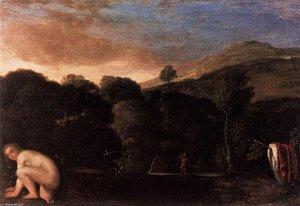
11Saint Lawrence, Reverse: Part of a Saint Christopher (1594) autorstwa Adam ElsheimerSaint Lawrence, Reverse: Part of a Saint Christopher1594 · Bawarskie Państwowe Zbiory Malarstwa 12Landscape with Tobias and Angel (1594) autorstwa Adam ElsheimerLandscape with Tobias and Angel1594 · Bawarskie Państwowe Zbiory Malarstwa 13Travel Altar with Six Scenes from the Life of Mary (1600) autorstwa Adam ElsheimerTravel Altar with Six Scenes from the Life of Mary1600 · Gemäldegalerie 14Tobias and the Angel (1607) autorstwa Adam ElsheimerTobias and the Angel1607 · Historisches Museum 15The Frankfurt Altarpiece of the Exaltation of the True Cross: The Questioning of the Jew (bottom left) (1604) autorstwa Adam ElsheimerThe Frankfurt Altarpiece of the Exaltation of the True Cross: The Questioning of the Jew (bottom left)1604 · Städel Museum 16The Frankfurt Altarpiece of the Exaltation of the True Cross: Heraclius on Horseback with the Cross (bottom right) (1604) autorstwa Adam ElsheimerThe Frankfurt Altarpiece of the Exaltation of the True Cross: Heraclius on Horseback with the Cross (bottom right)1604 · Städel Museum 17The Frankfurt Altarpiece of the Exaltation of the True Cross:  The Embarkation of the Empress Helena  (left) (1604) autorstwa Adam ElsheimerThe Frankfurt Altarpiece of the Exaltation of the True Cross: The Embarkation of the Empress Helena (left)1604 · Städel Museum 18The Frankfurt Altarpiece of the Exaltation of the True Cross: The Digging for the Cross (bottom middle left) (1604) autorstwa Adam ElsheimerThe Frankfurt Altarpiece of the Exaltation of the True Cross: The Digging for the Cross (bottom middle left)1604 · Städel Museum 19The Deluge (1599) autorstwa Adam ElsheimerThe Deluge1599 · Städel Museum 20Pan and Syrinx (1607) autorstwa Adam ElsheimerPan and Syrinx1607 · Städel Museum 21Mercury and Battus (1607) autorstwa Adam ElsheimerMercury and Battus1607 · Städel Museum 22Saint John the Baptist (1605) autorstwa Adam ElsheimerSaint John the Baptist1605 · Petworth House 23Saint Thomas Aquinas (1605) autorstwa Adam ElsheimerSaint Thomas Aquinas1605 · Petworth House 24The Virgin and Saint Anne (1605) autorstwa Adam ElsheimerThe Virgin and Saint Anne1605 · Petworth House 25Saint Paul (1605) autorstwa Adam ElsheimerSaint Paul1605 · Petworth House 26Saint Peter (1605) autorstwa Adam ElsheimerSaint Peter1605 · Petworth House 27Saint John the Evangelist (1605) autorstwa Adam ElsheimerSaint John the Evangelist1605 · Petworth House 28Saint Joseph and the Christ Child (1605) autorstwa Adam ElsheimerSaint Joseph and the Christ Child1605 · Petworth House 29Tobias and the Angel (1605) autorstwa Adam ElsheimerTobias and the Angel1605 · Petworth House 30Minerva as patroness of Arts and Sciences (1600) autorstwa Adam ElsheimerMinerva as patroness of Arts and Sciences1600 · Fitzwilliam Museum 31Venus and Cupid (1600) autorstwa Adam ElsheimerVenus and Cupid1600 · Fitzwilliam Museum 32Christ, carrying the Cross, meets Veronica (1594) autorstwa Adam ElsheimerChrist, carrying the Cross, meets Veronica1594 · Bawarskie Państwowe Zbiory Malarstwa 33The Mystic Marriage of St. Catherine (1598) autorstwa Adam ElsheimerThe Mystic Marriage of St. Catherine1598 · Bawarskie Państwowe Zbiory Malarstwa 34Self-portrait (1606) autorstwa Adam ElsheimerSelf-portrait1606 · Vasari Corridor 35Tobiah and the Angel (1601) autorstwa Adam ElsheimerTobiah and the Angel1601 · Statens Museum for Kunst 36Mocking of Ceres (1605) autorstwa Adam ElsheimerMocking of Ceres1605 37The Young Virgin Mary with Saint Anne (1612) autorstwa Adam ElsheimerThe Young Virgin Mary with Saint Anne1612 · Scottish National Gallery 38The Frankfurt Altarpiece of the Exaltation of the True Cross: The Testing of the Cross (middle right) (1604) autorstwa Adam ElsheimerThe Frankfurt Altarpiece of the Exaltation of the True Cross: The Testing of the Cross (middle right)1604 · Städel Museum 39The Frankfurt Altarpiece of the Exaltation of the True Cross: Emperor Heraclius’ Entry into Jerusalem (1604) autorstwa Adam ElsheimerThe Frankfurt Altarpiece of the Exaltation of the True Cross: Emperor Heraclius’ Entry into Jerusalem1604 · Städel Museum 40The Stoning of St. Stephen (1605) autorstwa Adam ElsheimerThe Stoning of St. Stephen1605 · Scottish National Gallery 41Glorification of the Cross (1605) autorstwa Adam ElsheimerGlorification of the Cross1605 · Städelsche Kunstinstitut Und Städtische Galerie 42Self-Portrait (1606) autorstwa Adam ElsheimerSelf-Portrait1606 · Galleria degli Uffizi 43Rest on Flight into Egypt (detail) (1599) autorstwa Adam ElsheimerRest on Flight into Egypt (detail)1599 · Berlińskie Muzea Państwowe 44Jupiter and Mercury in the House of Philemon and Baucis (1612) autorstwa Adam ElsheimerJupiter and Mercury in the House of Philemon and Baucis1612 · Te Papa 45St Paul at Malta (1600) autorstwa Adam ElsheimerSt Paul at Malta1600 · National Gallery 46The Altarpiece Of The Exaltation Of The True Cross (1605) autorstwa Adam ElsheimerThe Altarpiece Of The Exaltation Of The True Cross1605 · Städel Museum 47The Conversion of Saint Paul (1598) autorstwa Adam ElsheimerThe Conversion of Saint Paul1598 · Städel Museum 48Landscape with the Walk to Emmaus (1607) autorstwa Adam ElsheimerLandscape with the Walk to Emmaus1607 · Städel Museum 49Baptism of Christ (1594) autorstwa Adam ElsheimerBaptism of Christ1594 · Bawarskie Państwowe Zbiory Malarstwa 50Saint Elizabeth of Hungary Bringing Food for the Inmates of a Hospital (1598) autorstwa Adam ElsheimerSaint Elizabeth of Hungary Bringing Food for the Inmates of a Hospital1598 · Wellcome Collection 51The Flight into Egypt (1605) autorstwa Adam ElsheimerThe Flight into Egypt1605 52Jupiter and Mercury at Philemon and Baucis (detail) (1609) autorstwa Adam ElsheimerJupiter and Mercury at Philemon and Baucis (detail)1609 · Gemäldegalerie Alte Meister 53Il Contento (1607) autorstwa Adam ElsheimerIl Contento1607 · National Gallery of Scotland 54The Burning of Troy (1601) autorstwa Adam ElsheimerThe Burning of Troy1601 · Alte Pinakothek 55The Presentation of the Head of Saint John the Baptist, Night autorstwa Adam ElsheimerThe Presentation of the Head of Saint John the Baptist, NightStatens Museum for Kunst 56Apollo and Coronis (1607) autorstwa Adam ElsheimerApollo and Coronis1607 · Walker Art Gallery 57The Flight into Egypt (1605) autorstwa Adam ElsheimerThe Flight into Egypt1605 · Kimbell Art Museum 58Juditha Głowę Holofernesa Ścina (1601) autorstwa Adam ElsheimerJuditha Głowę Holofernesa Ścina1601 · Wellington Museum 59Ceres and Stellio autorstwa Adam ElsheimerCeres and StellioMuseo del Prado 60Rest on Flight into Egypt (1599) autorstwa Adam ElsheimerRest on Flight into Egypt1599 · Berlińskie Muzea Państwowe 61Tobias and the Angel autorstwa Adam ElsheimerTobias and the AngelErmitaż 62Landscape with the Flight into Egypt autorstwa Adam ElsheimerLandscape with the Flight into EgyptSchloss Weissenstein 63Saint Jerome autorstwa Adam ElsheimerSaint JeromeMusée des Beaux-Arts de Bordeaux 64Saint Helen autorstwa Adam ElsheimerSaint Helen 65The Emmaus Miracle autorstwa Adam ElsheimerThe Emmaus Miracle 66Aeneas Saving Anchisis from Burning Troy autorstwa Adam ElsheimerAeneas Saving Anchisis from Burning Troy 67Landscape with a Wayfarer autorstwa Adam ElsheimerLandscape with a Wayfarer 68Seated Young Woman autorstwa Adam ElsheimerSeated Young Woman 69The Sermon of St John the Baptist autorstwa Adam ElsheimerThe Sermon of St John the BaptistErmitaż 70Jacob's Dream autorstwa Adam ElsheimerJacob's DreamStädelsche Kunstinstitut Und Städtische Galerie 71Tobias and the Angel autorstwa Adam ElsheimerTobias and the AngelNational Gallery of Australia 72St. christopher autorstwa Adam ElsheimerSt. christopherErmitaż 73Tobias and the Archangel Raphael autorstwa Adam ElsheimerTobias and the Archangel Raphael 74The Baptism of Christ autorstwa Adam ElsheimerThe Baptism of ChristNational Gallery 75Saint Lawrence prepared for Martyrdom autorstwa Adam ElsheimerSaint Lawrence prepared for MartyrdomNational Gallery 76Tobias and the Angel Raphael autorstwa Adam ElsheimerTobias and the Angel RaphaelRijksmuseum 77Nymph Fleeing Satyrs autorstwa Adam ElsheimerNymph Fleeing SatyrsBerlińskie Muzea Państwowe 78Ceres in the House of Hecuba (1605) autorstwa Adam ElsheimerCeres in the House of Hecuba1605 · Museo del Prado 79Aurora (1606) autorstwa Adam ElsheimerAurora1606 · Herzog Anton Ulrich Museum 80Jupiter and Mercury at Philemon and Baucis (1609) autorstwa Adam ElsheimerJupiter and Mercury at Philemon and Baucis1609 · Gemäldegalerie Alte Meister

Słynne obrazy Adam Elsheimer epoka po epoce

Tematy, które przyciągnęły wzrok Adam Elsheimer

Cztery motywy najczęściej powracające w tych oryginałach, z których każdy doczekał się swojego najdoskonalszego przykładu.

Muzea przechowujące oryginały Adam Elsheimer

8 muzeów, w których znajduje się najwięcej obrazów z tej strony.

Muzea Miasto Dzieła artysty Adam Elsheimer Obrazy z tej listy
Städel Museum, Frankfurt nad MenemStädel Museum Frankfurt nad Menem 13 Christ Crucified, The Frankfurt Altarpiece of the Exaltation of the True Cross: The Questioning of the Jew (bottom left), The Frankfurt Altarpiece of the Exaltation of the True Cross: Heraclius on Horseback with the Cross (bottom right)
Petworth House, PetworthPetworth House Petworth 8 Saint John the Baptist, Saint Thomas Aquinas, The Virgin and Saint Anne
Bawarskie Państwowe Zbiory Malarstwa, MonachiumBawarskie Państwowe Zbiory Malarstwa Monachium 6 Portrait of Paul Bril, Saint Lawrence, Reverse: Part of a Saint Christopher, Landscape with Tobias and Angel
Statens Museum for Kunst, KopenhagaStatens Museum for Kunst Kopenhaga 3 Christ and the Disciples in Emmaus, Tobiah and the Angel, The Presentation of the Head of Saint John the Baptist, Night
Berlińskie Muzea Państwowe, BerlinBerlińskie Muzea Państwowe Berlin 3 Rest on Flight into Egypt (detail), Rest on Flight into Egypt, Nymph Fleeing Satyrs
National Gallery, LondynNational Gallery Londyn 3 St Paul at Malta, The Baptism of Christ, Saint Lawrence prepared for Martyrdom
Ermitaż, Sankt PetersburgErmitaż Sankt Petersburg 3 Tobias and the Angel, The Sermon of St John the Baptist, St. christopher
Alte Pinakothek, MonachiumAlte Pinakothek Monachium 2 Flight into Egypt, The Burning of Troy

Adam Elsheimer, jedno kultowe dzieło na dekadę

Dzieła według dekad

Wybierz dekadę, aby zobaczyć dzieło, które ją definiuje.

Obrazy artysty Adam Elsheimer: odpowiedzi galerii

Który obraz Adam Elsheimer jest najsłynniejszy ze wszystkich?Odkryj odpowiedź

Portrait of Paul Bril (1594), Bawarskie Państwowe Zbiory Malarstwa, Monachium. Następne są Witch Riding Backwards on a Goat (1597) oraz Christ and the Disciples in Emmaus (1601).

Ile lat miał Adam Elsheimer, gdy ukończył Portrait of Paul Bril?Odkryj odpowiedź

16 lat: Portrait of Paul Bril pochodzi z 1594, a Adam Elsheimer urodził(a) się w 1578.

Które to 10 najlepszych obrazów Adam Elsheimer?Odkryj odpowiedź

Portrait of Paul Bril, Witch Riding Backwards on a Goat, Christ and the Disciples in Emmaus, Follwer of ), Saint Laurent, Flight into Egypt, Apollo and Coronis, Apollo and the Cattle of Admetus, Saint John the Baptist in the Wilderness i Christ Crucified. Powyższy ranking zawiera rok powstania oraz muzeum dla każdego z nich.

Ile dzieł stworzył/a Adam Elsheimer?Odkryj odpowiedź

Nasz katalog zawiera 81 dzieł artysty Adam Elsheimer, datowanych od 1594 do 1610.

Gdzie można znaleźć najsłynniejsze oryginały autorstwa Adam Elsheimer?Odkryj odpowiedź

W większości znajdują się w Städel Museum (Frankfurt nad Menem), Petworth House (Petworth) i Bawarskie Państwowe Zbiory Malarstwa (Monachium). Powyższa tabela muzeów zawiera ich pełną listę.

Kiedy Adam Elsheimer stworzył swoje najsłynniejsze obrazy?Odkryj odpowiedź

W 1600s: 45 z 80 dzieł na tej stronie powstało w tym czasie, w tym Christ and the Disciples in Emmaus.

Które z najsłynniejszych dzieł Adam Elsheimer należą do jego najwcześniejszych i najpóźniejszych prac?Odkryj odpowiedź

Na tej stronie najwcześniejszy to Portrait of Paul Bril (1594), a najpóźniejszy Saint John the Baptist in the Wilderness (1610).

Do jakich tematów Adam Elsheimer powracał najczęściej?Odkryj odpowiedź

Landscape (20), Man (17) i Trees (17), w ramach 80 dzieł na tej stronie.

W jakiej technice najczęściej tworzył Adam Elsheimer?Odkryj odpowiedź

Oil On Copper, dla 45 z 80 dzieł na tej stronie.

Z jakim nurtem związany jest Adam Elsheimer?Odkryj odpowiedź

Baroque, sądząc po oryginałach na tej stronie.

Które oryginały artysty Adam Elsheimer znajdują się w zbiorach Städel Museum?Odkryj odpowiedź

Christ Crucified, The Frankfurt Altarpiece of the Exaltation of the True Cross: The Questioning of the Jew (bottom left) i The Frankfurt Altarpiece of the Exaltation of the True Cross: Heraclius on Horseback with the Cross (bottom right): Städel Museum, Frankfurt nad Menem posiada 13 dzieł widocznych na tej stronie.

Adam Elsheimer: artysta

A Luminous Life Cut Short: The World of Adam Elsheimer

Adam Elsheimer, a name perhaps less instantly recognizable than those of his Baroque contemporaries Rubens or Rembrandt, nonetheless occupies a pivotal position in the history of art. Born in Frankfurt am Main in 1578, his tragically short life – he died at just thirty-two years old in Rome in 1610 – belied an artistic output that resonated deeply with his peers and continues to captivate viewers today. Elsheimer wasn’t a painter of grand scale or prolific production; instead, he specialized in exquisitely detailed cabinet paintings, small works executed primarily on copper plates, which allowed for a level of precision and luminosity rarely seen before. These intimate canvases weren't intended for public display but rather for the private contemplation of connoisseurs – a testament to the burgeoning art market and the growing appreciation for individual artistic expression during the early 17th century. His father, a master tailor, provided a stable upbringing, and young Adam’s early talent was recognized through an apprenticeship with local artist Philipp Uffenbach. This foundational training instilled in him the technical skills that would later blossom under different influences. A likely sojourn to Strasbourg around 1596 exposed him to broader artistic currents, but it was his journey to Italy via Munich in 1598 that truly ignited his creative development.

From Venice to Rome: Forging a Unique Artistic Voice

Italy proved transformative for Elsheimer. He spent considerable time in Venice, absorbing the vibrant color palettes and dramatic compositions of masters like Tintoretto and Paolo Veronese. The influence of these Venetian giants is evident in his early works – a boldness of form and a sensuous use of light that would become hallmarks of his style. Around 1600, he settled in Rome, becoming integrated into the bustling artistic community. A crucial period followed as an assistant to Johann Rottenhamme, a German painter specializing in cabinet paintings. This mentorship provided invaluable technical expertise, particularly in the demanding medium of painting on copper. However, Elsheimer didn’t simply mimic his teacher; he began to forge his own unique path, moving away from strict Mannerist conventions towards a more naturalistic approach. His landscapes, in particular, were innovative for their time, seamlessly integrating figures into harmonious natural settings. He cultivated important friendships with Giovanni Faber, a papal doctor and botanist connected to the Accademia dei Lincei – a scientific society dedicated to observation and experimentation – and Paul Bril, a Flemish landscape painter. These connections exposed him to new ideas and fostered an intellectual curiosity that informed his art.

Master of Light and Shadow: Defining Elsheimer’s Style

Elsheimer's artistic reputation rests on his mastery of light and shadow – *chiaroscuro* – and his pioneering depictions of nocturnal scenes. He was among the first artists to accurately represent constellations in night skies, a testament to his scientific curiosity and meticulous observation. Paintings like “The Flight into Egypt” are breathtaking examples of this skill, where moonlight illuminates the landscape with an ethereal glow, creating a sense of mystery and wonder. His works frequently depicted mythological and biblical scenes, rendered with a lyrical temperament and painstaking detail. "Tobias and the Angel", "The Burning of Troy", "Apollo and Coronis", and “Ceres and Stellio” are all prime examples of his ability to imbue classical narratives with emotional depth and visual poetry. The small scale of his paintings encouraged intimate viewing, allowing audiences to fully appreciate the intricate details and subtle nuances of his technique. He didn’t merely depict scenes; he created worlds – miniature universes brimming with atmosphere and emotion.

A Life Marked by Struggle

Elsheimer’s life, though artistically fruitful, was not without its hardships. He faced persistent financial difficulties throughout his career, leading to periods of debt and even imprisonment. His marriage in 1606 to Carola Antonia Stuarda da Francoforte brought a brief period of happiness, but the tragic death of their son cast a shadow over his later years. Around 1608, he converted to Catholicism, perhaps seeking solace or hoping for greater acceptance within Roman society. Despite these personal struggles, Elsheimer continued to paint with unwavering dedication until his untimely death in Rome in December 1610 at the age of thirty-two. He left behind a relatively small but profoundly influential body of work – a testament to the power of artistic vision and the enduring legacy of a luminous life cut short.

Influence and Rediscovery

Despite his brief career, Adam Elsheimer exerted a considerable influence on subsequent generations of artists. His work was highly regarded by contemporaries, including Peter Paul Rubens, who deeply lamented his early death and praised his exceptional talent. The dissemination of his art was aided by engravings made by Hendrick Goudt, which brought his compositions to a wider European audience. Rembrandt van Rijn, in particular, demonstrably drew inspiration from Elsheimer’s nocturnal scenes and innovative landscapes, incorporating similar effects of light and shadow into his own work. Elsheimer's influence extended beyond the Dutch masters; numerous 17th-century artists across Europe were impacted by his pioneering approach to landscape painting and dramatic lighting techniques. However, after his death, Elsheimer’s reputation waned for centuries. It wasn’t until the 20th century that a renewed appreciation for his work emerged, fueled by scholarly research and a growing recognition of his importance in the development of Baroque art. Today, Adam Elsheimer is celebrated as a visionary artist whose small-scale paintings possess an enduring power to move and inspire. His legacy lies not only in his technical brilliance but also in his ability to capture the beauty and mystery of the world around him with unparalleled sensitivity and grace.