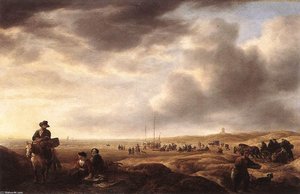
Portret Simon De Vlieger

Obrazy: 93 najsłynniejszych dzieł artysty Simon De Vlieger – spojrzenie galerii

Aktualizacja: Październik 2026 · ranking według naszego wskaźnika popularności (liczba wyszukiwań, wizyt i zamówień dla każdego dzieła) · 105 dzieł Simon De Vlieger w naszym katalogu

W skrócie

Według opinii kuratorów galerii, najsłynniejszym obrazem Simon De Vlieger jest The Northwest Side of the Rotterdam Gate at Delft in Winter (1645), którego oryginał znajduje się w Rijksmuseum w Amsterdam. A Calm Sea (1642) i Estuary at Day's End (1645) dopełniają trio, które zna każde oko. Z 105 dzieł Simon De Vlieger w naszym katalogu, galeria prezentuje poniżej 93 najsłynniejszych prac – każda z nich jest oryginałem z podaniem roku powstania, muzeum oraz cech wyróżniających ją na tle innych.

1601 – 1653, Rotterdam Dutch golden age Najwięcej dzieł: National Maritime Museum

10 najlepszych obrazów artysty Simon De Vlieger w galerii

1
The Northwest Side of the Rotterdam Gate at Delft in Winter (1645) autorstwa Simon De Vlieger

The Northwest Side of the Rotterdam Gate at Delft in Winter

1645 · Chalk · Rijksmuseum, Amsterdam

Simon De Vlieger’s The Northwest Side of the Rotterdam Gate at Delft in Winter presents a detailed winter scene centered on a bustling city gate. In the foreground, human activity defines a commercial area where people converse and load goods onto carts. Several horses, harnessed to these carts, anchor the lower plane of the composition. A small boat rests on the waterway, marking the importance of the canal for local…

2
A Calm Sea (1642) autorstwa Simon De Vlieger

A Calm Sea

1642 · Oil On Panel · Detroit Institute of Arts, Detroit

is a maritime landscape by the Dutch Golden Age painter Simon De Vlieger. Executed in 1642, the work captures a moment of maritime stillness. The composition focuses on a tranquil seascape characterized by calm weather and a steady horizon.

3
Estuary at Day's End (1645) autorstwa Simon De Vlieger

Estuary at Day's End

1645 · Oil On Canvas · National Gallery of Art, Waszyngton

In "Estuary at Day's End," Simon de Vlieger captures a quiet moment where the land meets the tide. The scene unfolds across a wide estuary, where the water reflects the fading light of the day. To the left, a rugged, rocky coastline breaks the edge of the water, providing a solid boundary to the shifting currents. Along this shore, fishermen go about their work, their presence grounding the vast landscape…

4
View of a Beach (1646) autorstwa Simon De Vlieger

View of a Beach

1646 · Oil On Canvas · Los Angeles County Museum of Art, Los Angeles

is an oil painting by the Dutch artist Simon De Vlieger. The work is dated 1646. This piece belongs to the period of the Dutch Golden Age, a time characterized by maritime dominance and artistic development in the Netherlands. The artist, Simon De Vlieger, was born in Rotterdam around 1601 and remained active in the region until his death in 1653.

5
Beach with fishermen (1650) autorstwa Simon De Vlieger

Beach with fishermen

1650 · Oil On Canvas · Rijksmuseum, Amsterdam

The artwork titled Beach with fishermen is an oil on canvas painting. This piece is attributed to the Dutch artist Simon De Vlieger. The work is dated about 1635 - 1640. It belongs to the period of the Dutch Golden Age, a time of maritime activity and artistic production in the Netherlands.

6
Sea Coast at Scheveningen (1653) autorstwa Simon De Vlieger

Sea Coast at Scheveningen

1653 · Oil On Canvas · Muzeum Narodowe w Warszawie, Warszawa

A wide expanse of beach stretches across the foreground, populated by scattered figures and several fishing boats. The horizon line divides the composition into three distinct zones: the sandy shore, the sea, and a vast, cloudy sky. To the left, a cluster of boats rests near the water's edge, their masts providing the only vertical interruptions to the dominant horizontal planes. In the distance, a faint cityscape traces the horizon,…

7
Seascape in the Morning (detail) (1640) autorstwa Simon De Vlieger

Seascape in the Morning (detail)

1640 · Oil On Panel · National Gallery of Art, Waszyngton

To gaze upon Simon de Vlieger's "Seascape in the Morning" is to be immediately swept away by the raw, untamed power of the ocean. This 1640 masterpiece, an oil on panel, does not offer a tranquil vista; rather, it plunges the viewer into a moment of profound maritime crisis. The scene is a breathtaking tableau of human vulnerability set against nature's overwhelming might. One can almost hear the creak of…

8
The falconer's homecoming (1637) autorstwa Simon De Vlieger

The falconer's homecoming

1637 · Oil On Panel · Rijksmuseum, Amsterdam

We are looking at The falconer's homecoming, a work from 1637 by the Dutch painter Simon De Vlieger. This oil on panel piece carries several identities within the collections of the Rijksmuseum. It is known by the title Gezicht op een vervallen gebouw met een fontein, and it is also referred to as L’Abreuvoir (The Watering Place). It is a quiet, atmospheric composition that reflects the artist's ability to handle…

9
A Dutch Man-of-War and Various Vessels in a Breeze (1642) autorstwa Simon De Vlieger

A Dutch Man-of-War and Various Vessels in a Breeze

1642 · Acrylic On Canvas · National Gallery, Londyn

Simon de Vlieger's "A Dutch Man-of-War and Various Vessels in a Breeze," painted in 1642, isn’t merely a depiction of ships at sea; it’s a visceral experience of the ocean’s raw power. This remarkable work transcends simple maritime record to become a profound meditation on human vulnerability against the immensity of nature. De Vlieger, a pivotal figure in the transition from the monochrome seascapes of Jan Porcellis and Willem van…

10
Visit of Frederick Hendriks II to Dordrecht in 1646 (1649) autorstwa Simon De Vlieger

Visit of Frederick Hendriks II to Dordrecht in 1646

1649 · Oil On Canvas · Kunsthistorisches Museum, Wiedeń

Simon de Vlieger’s “Visit of Frederick Hendriks II to Dordrecht in 1646” – A Masterpiece of Dutch Maritime Painting The year is 1646, and the bustling port city of Dordrecht plays host to a significant event: the arrival of Frederick Hendriks II. Captured with remarkable detail and imbued with a palpable sense of drama, Simon de Vlieger’s “Visit of Frederick Hendriks II to Dordrecht in 1646” is more than just…

Obrazy artysty Simon De Vlieger, uszeregowane od 11 do 93 miejsca

11Estuary Scene (1620) autorstwa Simon De VliegerEstuary Scene1620 12Calm Sea with Fishermen (1626) autorstwa Simon De VliegerCalm Sea with Fishermen1626 · Bawarskie Państwowe Zbiory Malarstwa 13Rough Sea (1635) autorstwa Simon De VliegerRough Sea1635 · Bawarskie Państwowe Zbiory Malarstwa 14Coast in Calm Sea (1626) autorstwa Simon De VliegerCoast in Calm Sea1626 · Bawarskie Państwowe Zbiory Malarstwa 15Coastal Landscape with Foraging Seafarers (1634) autorstwa Simon De VliegerCoastal Landscape with Foraging Seafarers1634 · Musée des Beaux-Arts de Lyon 16Edge of a Wood with a Stream and Cattle (1634) autorstwa Simon De VliegerEdge of a Wood with a Stream and Cattle1634 · Museum Boijmans Van Beuningen 17The entrance to a harbor (1634) autorstwa Simon De VliegerThe entrance to a harbor1634 18Seascape (1624) autorstwa Simon De VliegerSeascape1624 · Ermitaż 19Ships on a calm Sea (1634) autorstwa Simon De VliegerShips on a calm Sea1634 · Philadelphia Museum of Art 20Ships off the Dutch Coast (1634) autorstwa Simon De VliegerShips off the Dutch Coast1634 · Statens Museum for Kunst 21Marine with Dutch Shipping (1635) autorstwa Simon De VliegerMarine with Dutch Shipping1635 · Fine Arts Museums of San Francisco 22the shore near Scheveningen (1625) autorstwa Simon De Vliegerthe shore near Scheveningen1625 23Slightly waving sea with sailing ship (1634) autorstwa Simon De VliegerSlightly waving sea with sailing ship1634 · Gemäldegalerie 24Ships in Distress on a Rocky Coast (1630) autorstwa Simon De VliegerShips in Distress on a Rocky Coast1630 · Harvard Art Museums 25The storm (1631) autorstwa Simon De VliegerThe storm1631 · Yekaterinburg Museum of Fine Arts 26The Battle on the Slaak between the Dutch and Spanish Fleets during the Night of 12-13 September 1631, Simon de Vlieger, 1633 (1633) autorstwa Simon De VliegerThe Battle on the Slaak between the Dutch and Spanish Fleets during the Night of 12-13 September 1631, Simon de Vlieger, 16331633 · Rijksmuseum 27Storm with a Wreck (1635) autorstwa Simon De VliegerStorm with a Wreck1635 · Fitzwilliam College 28The Siege of Troy (1631) autorstwa Simon De VliegerThe Siege of Troy1631 29The Beach at Scheveningen (1633) autorstwa Simon De VliegerThe Beach at Scheveningen1633 · National Maritime Museum 30A Dutch Yacht from Zeeland (1629) autorstwa Simon De VliegerA Dutch Yacht from Zeeland1629 · National Maritime Museum 31Stormy Sea (1642) autorstwa Simon De VliegerStormy Sea1642 · Bawarskie Państwowe Zbiory Malarstwa 32Coast by the Zuyder Zee (1645) autorstwa Simon De VliegerCoast by the Zuyder Zee1645 · Nivaagaards Malerisamling 33Sea-piece, a breeze near a Dutch port (1640) autorstwa Simon De VliegerSea-piece, a breeze near a Dutch port1640 · Fitzwilliam Museum 34sea - scape at the shore (1636) autorstwa Simon De Vliegersea - scape at the shore1636 35Sea- scape sailing-boats (1639) autorstwa Simon De VliegerSea- scape sailing-boats1639 36Ship in Distress off a Rocky Coast (1645) autorstwa Simon De VliegerShip in Distress off a Rocky Coast1645 · Indianapolis Museum of Art 37Ships at the Beach at Scheveningen (1636) autorstwa Simon De VliegerShips at the Beach at Scheveningen1636 · Museum Rotterdam 38The Groothoofdspoort in Dordrecht (1648) autorstwa Simon De VliegerThe Groothoofdspoort in Dordrecht1648 · Hamburger Kunsthalle 39A herring fleet with a warship offshore in a light chop and gentle breeze (1645) autorstwa Simon De VliegerA herring fleet with a warship offshore in a light chop and gentle breeze1645 40Calming the storm (1637) autorstwa Simon De VliegerCalming the storm1637 41Frigate Giving a Salute (1648) autorstwa Simon De VliegerFrigate Giving a Salute1648 · Städel Museum 42Calm Sea (1640) autorstwa Simon De VliegerCalm Sea1640 43Fishing Boats in a Rough Sea (1644) autorstwa Simon De VliegerFishing Boats in a Rough Sea1644 · National Maritime Museum 44An Estuary Scene (1641) autorstwa Simon De VliegerAn Estuary Scene1641 45Ships Becalmed on a Rocky Coast (1640) autorstwa Simon De VliegerShips Becalmed on a Rocky Coast1640 · National Maritime Museum 46Dutch Ships Revictualling off a Rocky Coast (1637) autorstwa Simon De VliegerDutch Ships Revictualling off a Rocky Coast1637 · National Maritime Museum 47A View of an Estuary, with Dutch Vessels at a Jetty and a Dutch Man of War at Anchor (1645) autorstwa Simon De VliegerA View of an Estuary, with Dutch Vessels at a Jetty and a Dutch Man of War at Anchor1645 48A Squally Day in a Dutch Estuary (1640) autorstwa Simon De VliegerA Squally Day in a Dutch Estuary1640 · National Maritime Museum 49A Ship Wrecked off a Rocky Coast (1640) autorstwa Simon De VliegerA Ship Wrecked off a Rocky Coast1640 · National Maritime Museum 50A Dutch Ferry Boat before a Breeze (1640) autorstwa Simon De VliegerA Dutch Ferry Boat before a Breeze1640 · National Maritime Museum 51A Sea Piece (1660) autorstwa Simon De VliegerA Sea Piece1660 52Scheveningen (1650) autorstwa Simon De VliegerScheveningen1650 53Sleeping Peasants near Fields (Parable of the Weeds) (1651) autorstwa Simon De VliegerSleeping Peasants near Fields (Parable of the Weeds)1651 · Cleveland Museum of Art 54Dovecote on a broad river (1649) autorstwa Simon De VliegerDovecote on a broad river1649 55Ships in the River Maas off Rotterdam (1652) autorstwa Simon De VliegerShips in the River Maas off Rotterdam1652 · Statens Museum for Kunst 56Calm Water (1652) autorstwa Simon De VliegerCalm Water1652 · Museum Boijmans Van Beuningen 57Rocky coast (1650) autorstwa Simon De VliegerRocky coast1650 · Rijksmuseum 58The Battle of the Downs (1650) autorstwa Simon De VliegerThe Battle of the Downs1650 59The Fisherman (1653) autorstwa Simon De VliegerThe Fisherman1653 60Dutch Men of War at Anchor (1650) autorstwa Simon De VliegerDutch Men of War at Anchor1650 61Visit of Frederick Hendriks II to Dordrecht in 1646 (1650) autorstwa Simon De VliegerVisit of Frederick Hendriks II to Dordrecht in 16461650 · Szépművészeti Múzeum 62A Battle between Dutch Ships (the 'Texel', 'Domburch' and 'Arnemude') and Chinese Junks (1650) autorstwa Simon De VliegerA Battle between Dutch Ships (the 'Texel', 'Domburch' and 'Arnemude') and Chinese Junks1650 · National Trust 63Visit of Frederick Hendriks II to Dordrecht in 1646 (1649) autorstwa Simon De VliegerVisit of Frederick Hendriks II to Dordrecht in 16461649 · Szépművészeti Múzeum 64Hunters at Rest autorstwa Simon De VliegerHunters at RestStatens Museum for Kunst 65A calm estuary at dawn with a Dutch kaag autorstwa Simon De VliegerA calm estuary at dawn with a Dutch kaag 66Coastal Scene autorstwa Simon De VliegerCoastal Scene 67River Estuary with Shipping on a Windy Day autorstwa Simon De VliegerRiver Estuary with Shipping on a Windy Day 68Marée basse autorstwa Simon De VliegerMarée basseMusée Des Beaux 69Landscape with River and Trees autorstwa Simon De VliegerLandscape with River and TreesSzépművészeti Múzeum 70Dutch Men of War off a Craggy Coast (1640) autorstwa Simon De VliegerDutch Men of War off a Craggy Coast1640 · National Maritime Museum 71Low Tide (1652) autorstwa Simon De VliegerLow Tide1652 · Musée Des Beaux 72Seashore (1630) autorstwa Simon De VliegerSeashore1630 · Ermitaż 73Calm Sea (1645) autorstwa Simon De VliegerCalm Sea1645 · Metropolitan Museum of Art 74Shipping off the English Coast (1643) autorstwa Simon De VliegerShipping off the English Coast1643 · National Maritime Museum 75Beach near Scheveningen with Fish-Sellers (1643) autorstwa Simon De VliegerBeach near Scheveningen with Fish-Sellers1643 · Wallraf-Richartz-Museum 76Ships on Calm Water autorstwa Simon De VliegerShips on Calm WaterKrólewskie Muzeum Sztuk Pięknych Antwerpia 77Dutch Merchantmen in Rough Seas off a Rocky Coast autorstwa Simon De VliegerDutch Merchantmen in Rough Seas off a Rocky CoastLiechtenstein Museum 78Stormy Sea autorstwa Simon De VliegerStormy Sea 79Dutch Fishing Boats Shooting their Nets autorstwa Simon De VliegerDutch Fishing Boats Shooting their Nets 80Thunderstorm off the Coast autorstwa Simon De VliegerThunderstorm off the CoastThyssen-Bornemisza Museum 81A View of an Estuary autorstwa Simon De VliegerA View of an Estuary 82Port sur rivière autorstwa Simon De VliegerPort sur rivière 83Sea Piece, a Calm autorstwa Simon De VliegerSea Piece, a CalmFitzwilliam College 84Seascape Storm at Sea autorstwa Simon De VliegerSeascape Storm at SeaPetworth House 85Forest autorstwa Simon De VliegerForestMuseo del Prado 86Fishing Boats off a Jetty autorstwa Simon De VliegerFishing Boats off a JettyThe National Trust For Scotland 87The 'Brederode' off Hellevoetsluis autorstwa Simon De VliegerThe 'Brederode' off HellevoetsluisNational Maritime Museum 88A Boat off Shore autorstwa Simon De VliegerA Boat off ShoreThe National Trust For Scotland 89Shipping before Dordrecht (1651) autorstwa Simon De VliegerShipping before Dordrecht1651 · Fitzwilliam College 90Beach View (1643) autorstwa Simon De VliegerBeach View1643 · Mauritshuis 91Smallschip and frigate in stormy waters. (1630) autorstwa Simon De VliegerSmallschip and frigate in stormy waters.1630 · Muzeum Narodowe w Warszawie 92Stormy Sea with Sailing Ships (1640) autorstwa Simon De VliegerStormy Sea with Sailing Ships1640 · Ermitaż 93Arrival of William of Orange in Rotterdam (1642) autorstwa Simon De VliegerArrival of William of Orange in Rotterdam1642 · Ermitaż

Tematy, które przyciągnęły wzrok Simon De Vlieger

Cztery motywy najczęściej powracające w tych oryginałach, z których każdy doczekał się swojego najdoskonalszego przykładu.

Muzea przechowujące oryginały Simon De Vlieger

8 muzeów, w których znajduje się najwięcej obrazów z tej strony.

Muzea Miasto Dzieła artysty Simon De Vlieger Obrazy z tej listy
National Maritime Museum, LondynNational Maritime Museum Londyn 11 The Beach at Scheveningen, A Dutch Yacht from Zeeland, Fishing Boats in a Rough Sea
Rijksmuseum, AmsterdamRijksmuseum Amsterdam 5 The Northwest Side of the Rotterdam Gate at Delft in Winter, Beach with fishermen, The falconer's homecoming
Bawarskie Państwowe Zbiory Malarstwa, MonachiumBawarskie Państwowe Zbiory Malarstwa Monachium 4 Calm Sea with Fishermen, Rough Sea, Coast in Calm Sea
Ermitaż, Sankt PetersburgErmitaż Sankt Petersburg 4 Seascape, Seashore, Stormy Sea with Sailing Ships
Statens Museum for Kunst, KopenhagaStatens Museum for Kunst Kopenhaga 3 Ships off the Dutch Coast, Ships in the River Maas off Rotterdam, Hunters at Rest
Fitzwilliam College, CambridgeFitzwilliam College Cambridge 3 Storm with a Wreck, Sea Piece, a Calm, Shipping before Dordrecht
Szépművészeti Múzeum, BudapesztSzépművészeti Múzeum Budapeszt 3 Visit of Frederick Hendriks II to Dordrecht in 1646, Visit of Frederick Hendriks II to Dordrecht in 1646, Landscape with River and Trees
National Gallery of Art, WaszyngtonNational Gallery of Art Waszyngton 2 Estuary at Day's End, Seascape in the Morning (detail)

Simon De Vlieger, jedno kultowe dzieło na dekadę

Dzieła według dekad

Wybierz dekadę, aby zobaczyć dzieło, które ją definiuje.

Obrazy artysty Simon De Vlieger: odpowiedzi galerii

Który obraz Simon De Vlieger jest najsłynniejszy ze wszystkich?Odkryj odpowiedź

The Northwest Side of the Rotterdam Gate at Delft in Winter (1645), Rijksmuseum, Amsterdam. Następne są A Calm Sea (1642) oraz Estuary at Day's End (1645).

Ile lat miał Simon De Vlieger, gdy ukończył The Northwest Side of the Rotterdam Gate at Delft in Winter?Odkryj odpowiedź

44 lat: The Northwest Side of the Rotterdam Gate at Delft in Winter pochodzi z 1645, a Simon De Vlieger urodził(a) się w 1601.

Które to 10 najlepszych obrazów Simon De Vlieger?Odkryj odpowiedź

The Northwest Side of the Rotterdam Gate at Delft in Winter, A Calm Sea, Estuary at Day's End, View of a Beach, Beach with fishermen, Sea Coast at Scheveningen, Seascape in the Morning (detail), The falconer's homecoming, A Dutch Man-of-War and Various Vessels in a Breeze i Visit of Frederick Hendriks II to Dordrecht in 1646. Powyższy ranking zawiera rok powstania oraz muzeum dla każdego z nich.

Ile dzieł stworzył/a Simon De Vlieger?Odkryj odpowiedź

Nasz katalog zawiera 105 dzieł artysty Simon De Vlieger, datowanych od 1620 do 1653.

Gdzie można znaleźć najsłynniejsze oryginały autorstwa Simon De Vlieger?Odkryj odpowiedź

W większości znajdują się w National Maritime Museum (Londyn), Rijksmuseum (Amsterdam) i Bawarskie Państwowe Zbiory Malarstwa (Monachium). Powyższa tabela muzeów zawiera ich pełną listę.

Kiedy Simon De Vlieger stworzył swoje najsłynniejsze obrazy?Odkryj odpowiedź

W 1640s: 31 z 93 dzieł na tej stronie powstało w tym czasie, w tym The Northwest Side of the Rotterdam Gate at Delft in Winter.

Które z najsłynniejszych dzieł Simon De Vlieger należą do jego najwcześniejszych i najpóźniejszych prac?Odkryj odpowiedź

Na tej stronie najwcześniejszy to Estuary Scene (1620), a najpóźniejszy Sea Coast at Scheveningen (1653).

Do jakich tematów Simon De Vlieger powracał najczęściej?Odkryj odpowiedź

Beach (14), Boats (8) i Maritime (4), w ramach 93 dzieł na tej stronie.

W jakiej technice najczęściej tworzył Simon De Vlieger?Odkryj odpowiedź

Oil On Canvas, dla 5 z 93 dzieł na tej stronie.

Z jakim nurtem związany jest Simon De Vlieger?Odkryj odpowiedź

Dutch golden age i Baroque, sądząc po oryginałach na tej stronie.

Które oryginały artysty Simon De Vlieger znajdują się w zbiorach National Maritime Museum?Odkryj odpowiedź

The Beach at Scheveningen, A Dutch Yacht from Zeeland i Fishing Boats in a Rough Sea: National Maritime Museum, Londyn posiada 11 dzieł widocznych na tej stronie.

Simon De Vlieger: artysta

Wczesne lata i nauka w dobie holenderskiego złotego wieku

Simon de Vlieger, urodzony w Rotterdamie około 1601 roku, pojawił się na scenie artystycznej w samym zenicie holenderskiego złotego wieku – epoki zdefiniowanej przez bezprecedensowy dobrobyt, morską dominację i rozkwit sztuki. Choć szczegóły dotyczące jego wczesnego szkolenia pozostają nieuchwytne, wiadomo, że swoją artystyczną podróż rozpoczął w tętniącym życiem środowisku swojego rodzinnego miasta. To gwarne portowe miasto dostarczyło młodemu malarzowi natychmiastowego i pociągającego tematu: statków. W przeciwieństwie do wielu artystów, którzy początkowo różnicowali swoje umiejętności poprzez sceny rodzajowe czy portrety, de Vlieger zdaje się skupiać niemal wyłącznie na tematach morskich już od stosunkowo młodego wieku, co sugeruje wczesną fascynację morzem i jego jednostkami.

Jego początkowy styl prawdopodobnie czerpał inspirację z wcześniejszych malarzy morskich, takich jak Jan Porcellis, którego prace często przedstawiały dramatyczne, wzburzone krajobrazy morskie. Jednak de Vlieger szybko zaczął się wyróżniać, odchodząc od bardziej monochromatycznych palet preferowanych przez jego poprzedników. Dążył do większego stopnia realizmu i świetlistości w swoich przedstawieniach, celując w dokładną reprezentację światła odbijającego się na wodzie oraz misternych detali konstrukcji okrętowej.

Kariera nawigująca między Delft a Amsterdamem

Kariera de Vliegera rozwijała się w kilku kluczowych holenderskich miastach, z których każde przyczyniło się do jego rozwoju artystycznego. W 1627 roku poślubił Annę Gerridts van Willige, związek, który zapewnił mu stabilizację w procesie budowania pozycji zawodowej. W 1634 roku wstąpił do cechu Świętego Łukasza w Delft, co oznaczało jego akceptację przez ugruntowaną społeczność artystyczną. Ten okres był czasem doskonalenia umiejętności i budowania reputacji kogoś, kto potrafi uchwycić samą esencję holenderskiego życia morskiego.

Około 1638 roku de Vlieger przeniósł się do Amsterdamu, serca holenderskiego rynku sztuki oraz głównego ośrodka szkutnictwa i handlu. Tutaj spotkał szerszą publiczność i znalazł większe możliwości rozwoju. Mimo że zachował rezydencję w Rotterdamie aż do 1650 roku – kiedy to ostatecznie osiadł w Weesp, mniejszym miasteczku niedaleko Amsterdamu – to właśnie Amsterdam stał się jego główną bazą operacyjną. To właśnie w tym czasie de Vlieger prawdziwie ugruntował swoją pozycję jako jednego z czołowych malarzy morskich epoki.

Innowacja i styl artystyczny

Artystyczna innowacja de Vliegera tkwiła w jego skrupulatnej uwadze poświęconej detalom oraz mistrzowskim wykorzystaniu koloru. Wyszedł on poza proste przedstawianie statków na morzu; pragnął uchwycić uczucie przebywania na wodzie – rozprysk fal, blask słońca na żaglach czy skomplikowany olinowanie jednostki. Jego obrazy charakteryzują się niezwykle szczegółowymi przedstawieniami konstrukcji okrętowej, co odzwierciedla głębokie zrozumienie architektury navalnej.

Nie był on jedynie kronikarzem statków; był interpretatorem życia morskiego. Malował sceny portowe, jednostki na pełnym morzu podczas spokojnej pogody oraz te uwięzione w uściskach gwałtownych sztormów. Jego morskie krajobrazy burzowe są szczególnie poruszające, przekazując zarówno potęgę natury, jak i kruchość ludzkich starań. Poza malarstwem de Vlieger wykazał się niezwykłą wszechstronnością, projektując gobeliny, ryciny, a nawet witraże dla amsterdamskiego Nieuwe Kerk oraz dekoracje organowe dla St. Laurenskerk w Rotterdamie.

Dziedzictwo i wpływ na malarstwo morskie

Wpływ Simona de Vliegera na kolejne pokolenia malarzy morskich był głęboki. Przeszkolił kilku uczniów, w tym Willema van de Velde Młodszego, Adriena van de Velde oraz Jana van der Cappelle – z których każdy osiągnął znaczące uznanie na własną rękę. Van der Cappelle, w szczególności, darzył de Vliegera wielkim szacunkiem, posiadając dziewięć oryginalnych obrazów i ponad 1300 grafik swojego mistrza.

Nawet po śmierci de Vliegera w 1653 roku, jego twórczość nadal krążyła i inspirowała. W jego pracowni pozostało wiele niedokończonych dzieł, co stanowi świadectwo nieustannego popytu na jego sztukę. Jeden z takich obrazów – przedstawiający rybaków wyciągających sieci na brzeg – został sprzedany przez Van der Cappelle Joannie Six, żonie Simona van der Stel, i wysłany do Przylądka Dobrej Nadziei, gdzie został wystawiony w Groot Constantia, posiadłości rodziny Van der Stel. Akt ten podkreśla trwały urok dzieł de Vliegera oraz ich związek z szerszym holenderskim przedsięwzięciem kolonialnym.

Dziedzictwo de Vliegera wykracza poza jego biegłość techniczną; uchwycił on kluczowy aspekt holenderskiej tożsamości – jej relację z morzem. Jego obrazy nie są po prostu pięknymi przedstawieniami statków; są oknami na świat zdefiniowany przez handel, eksplorację i nieustanną interakcję między człowiekiem a naturą. Pozostaje on kluczową postacią w historii malarstwa morskiego, celebrowaną za swój realizm, świetlistość i nieprzemijającą zdolność do przywoływania ducha holenderskiego złotego wieku.