Cubist Assemblage
Apolinère Enameled (Marcel Duchamp)
Marcel Duchamp (1887–1968) stworzył Apolinère Enameled. Należy do nurtu Cubist Assemblage. Wykonano w technice Assemblage.
- Assemblage

 Ręcznie malowany obraz olejny
 Wyślij jako kartkę
 Udostępnij
 Karta informacyjna


 Pobierz obraz
 Podobne obiekty
 Pokaz slajdów
 Pytania i odpowiedzi

 Statystyki
Apolinère Enameled w skrócie
- Tytuł
- Apolinère Enameled
- Artysta
- Marcel Duchamp (1887–1968)
- Miejsce urodzenia artysty
- Blainville-Crevon, Francja
- Technika wykonania
- Assemblage
- Epoka
- Modern
- Temat
- industrial advertising, conceptual art, typography, readymade critique, assemblage technique, dada influence
Co przedstawia Apolinère Enameled?
A Provocative Dialogue with Tradition
In the annals of modern art, few works possess the disruptive power of Marcel Duchamp’s "Apolinère Enameled." Created between 1916 and 1917, this masterpiece serves as a cornerstone of the Dadaist movement, acting less as a mere painting and more as a profound interrogation of what it means to create. At first glance, the viewer is met with a deceptively serene tableau: a young girl seated upon a bed, surrounded by the vibrant, almost playful hues of an industrial advertisement. Yet, beneath this tranquil surface lies a calculated rebellion against the very foundations of aesthetic beauty. Duchamp does not merely depict a scene; he deconstructs the act of seeing itself, inviting collectors and enthusiasts to look past the pigment and into the conceptual heart of the twentieth century's most radical era.
The artwork’s soul resides in its origin as an "assisted readymade." Duchamp took a mundane, commercial tin sign promoting Sapolin enamel—a product intended for industrial beautification—and intervened with pencil sketches and cardboard to subtly fracture the original's intent. This technique represents a seismic shift in art history, where the artist’s hand moves from the role of a craftsman to that of a philosopher. For the discerning interior designer or art lover, this piece offers a sophisticated tension; it brings the raw, intellectual energy of the Dadaist revolt into a space, challenging the viewer to find meaning within the intersection of mass production and individual expression.
The Architecture of Illusion and Language
Beyond its physical assemblage, "Apolinère Enameled" is a linguistic puzzle, a play on words that mirrors the fractured reality of a world at war. The title itself is a brilliant pun, referencing Duchamp’s close friend, the poet Guillaume Apollinaire. By manipulating language through this phonetic nod, Duchamp mirrors his manipulation of the physical object, suggesting that neither word nor image can be taken at face value. This layer of intellectual depth makes the piece an extraordinary conversational centerpiece, perfect for those who appreciate art that rewards deep contemplation and rewards the inquisitive mind.
Visually, the work is a masterclass in subtle expression and geometric intrigue. The color palette, though derived from commercial enamel, possesses a luminous quality that draws the eye toward the central figure. There is a haunting, almost surrealist quality to the composition, particularly in the way the bed frame presents conflicting perspective lines. This creates what many scholars call an "impossible object," a precursor to the optical illusions that would later define Surrealism. The interplay of the bright, primary-adjacent colors against the more muted, sketched elements creates a rhythmic visual experience that is both stimulating and intellectually grounding.
A Timeless Addition to the Modern Collection
For those seeking to curate a collection defined by innovation, "Apolinère Enameled" offers an unparalleled opportunity. As a high-quality reproduction, it brings the historical weight of the Philadelphia Museum of Art into the private home or gallery. It is a piece that transcends simple decoration; it is an invitation to participate in a century-old debate about the nature of creativity. Whether placed in a minimalist contemporary setting where its bold lines can stand alone, or within a more eclectic, curated space where its historical narrative can breathe, this artwork provides a sense of intellectual prestige and avant-garde elegance.
Owning a piece that embodies the spirit of Duchamp is to possess a fragment of the revolution that redefined modernity. It serves as a reminder that art need not be purely "retinal"—merely pleasing to the eye—but can instead be a profound, transformative experience that challenges our perceptions of reality, commerce, and the very essence of the human imagination.
Zdjęcia w wysokiej rozdzielczości dzieła Apolinère Enameled
Chronione prawem autorskim: pliki te służą wyłącznie do osobistego wglądu i nie stanowią licencji na ich powielanie.
Marcel Duchamp, Apolinère Enameled.
Odpowiedzi na pytania dotyczące Apolinère Enameled
W jakiej technice wykonano „Apolinère Enameled” – Marcel Duchamp?
Marcel Duchamp wykorzystał/a technikę Assemblage w pracy „Apolinère Enameled”. Technika ta definiuje materię oryginalnego dzieła.
Co przedstawia „Apolinère Enameled” – Marcel Duchamp?
„Apolinère Enameled” – Marcel Duchamp przedstawia: industrial advertising, conceptual art, typography, readymade critique, assemblage technique, dada influence, geometric composition.
Czy obraz „Apolinère Enameled” – Marcel Duchamp można swobodnie reprodukować?
Jeśli chodzi o prawa autorskie, "Apolinère Enameled" znajduje się w nadal objęte ochroną prawa autorskiego.
Kto jest autorem dzieła "Apolinère Enameled"?
„Apolinère Enameled” zostało stworzone przez Marcel Duchamp. Informacje na tej stronie dotyczą oryginalnego dzieła autorstwa Marcel Duchamp.
Do jakiego nurtu artystycznego należy „Apolinère Enameled” – Marcel Duchamp?
Nurt związany z „Apolinère Enameled” – Marcel Duchamp to Cubist Assemblage. Ta klasyfikacja sytuuje dzieło wśród pokrewnych artystów i dzieł sztuki.
Do którego okresu twórczości Marcel Duchamp należy dzieło „Apolinère Enameled”?
W dorobku artystycznym Marcel Duchamp dzieło „Apolinère Enameled” przypada na Dada Assemblage. Ten etap pozwala zestawić je z innymi pracami twórcy.
Co wyjaśnia sytuację prawną dotyczącą praw autorskich do „Apolinère Enameled” – Marcel Duchamp?
Status praw autorskich do dzieła „Apolinère Enameled” – nadal objęte ochroną prawa autorskiego – wynika z faktu, że artysta zmarł w 1968.
Co łączy "Apolinère Enameled" z resztą twórczości Marcel Duchamp?
"Apolinère Enameled" dzieli z innymi dziełami Marcel Duchamp styl właściwy dla Cubist Assemblage oraz powracające motywy: dada challenge to norms, industrial sign, apollinaire pun, geometric abstraction, critique, assemblage, duchamp’s conceptual stance, iconic readymade.
W jaki sposób tematyka dzieła "Apolinère Enameled" odnosi się do typowych motywów twórczości Marcel Duchamp?
„Apolinère Enameled” przedstawia industrial advertising, conceptual art, typography, readymade critique, assemblage technique, dada influence, geometric composition, podczas gdy powracające motywy u Marcel Duchamp to dada challenge to norms, industrial sign, apollinaire pun, geometric abstraction, critique, assemblage, duchamp’s conceptual stance, iconic readymade. Porównanie tych dwóch elementów ukazuje, jak dzieło nawiązuje do typowej dla tego artysty tematyki.
O artyście: Marcel Duchamp
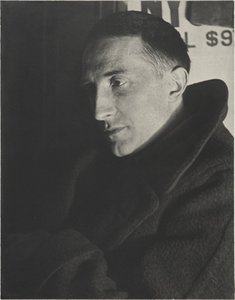
1887–1968, Francja
Marcel Duchamp
Życie i sztuka Marcela Duchampa Urodzony 28 lipca 1887 roku w Blainville w Normandii, we Francji, Marcel Duchamp wkroczył w świat, w którym impuls tworzenia był głęboko wpisany w jego własną krew. Był czwartym z siedmiu dzieci urodzonych przez Eugene’a i Lucie Duchamp. Był to dom pełen twórców i myślicieli; jego rodzeństwo dzieliło tę samą kreatywną niespokojność, gdyż jego bracia, Jacques Villon i Raymond Duchamp-Villon, wraz z siostrą Suzanne Duchamp-Crotti, wszyscy podążyli ścieżką artystyczną. Choć ostatecznie stał się postacią o niezwykłej złożoności, łączącą korzenie francuskie z amerykańskimi, jego początki pozostały zakorzenione w spokojnej atmosferze Normandii.
Inne prace Marcel Duchamp
 Nude Descending a Staircase, No.2 - Abstrakcja schody1912
 Sad young man in a train - Smutny młody mężczyzna w поезде1911
 Given: 1. Wodospad, 2. Gaz oświetlający1966
 Fontanna (Duchamp)1917
Eseje o Apolinère Enameled
 Dreams on Canvas: Understanding Automatist and Veristic SurrealismMaster the differences between Automatist and Veristic Surrealism. Explore the works of Dali and Miro to decode the dreamscape today.
 Timeless Elegance: A Curator's Guide to Collecting Classic MasterpiecesDiscover the art of collecting with our expert guide to timeless masterpieces. From Neoclassicism to Impressionism, learn to curate a legac…
 Marcel Duchamp: The Top 25 Masterpieces That Redefined Modern ArtExplore 25 iconic Marcel Duchamp masterpieces that redefined Dadaism. Discover the full collection online at OriginalUniqueArt.com.