Przełącz na wydania drukowane
 Rozwiń treść







































 W przypadku dzieł sztuki lub reprodukcji, których którykolwiek z boków przekracza 105 cm (około 41 cali), rama zostanie wysłana w formie zestawu do samodzielnego montażu. Metoda ta zapewnia bezpieczną dostawę i zapobiega uszkodzeniom podczas transportu.


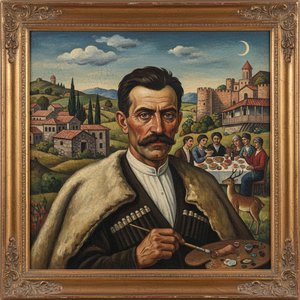
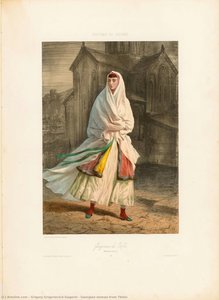
Kurd from Ararat – A Portrait of Georgian Identity
Grigory Grigorievich Gagarin (1810-1893) stands as a pivotal figure in 19th-century Russian art and culture, particularly renowned for his captivating depictions of Caucasian peoples. Born into the noble Rurikid princely family in Saint Petersburg, Gagarin’s artistic journey began with private lessons from Karl Briullov, establishing him firmly within the influential Circle of Sixteen artistic movement. This formative experience profoundly shaped his distinctive style—characterized by meticulous detail and a masterful command of color—influencing countless subsequent artists.- Subject Matter: Gagarin’s “Kurd from Ararat” transcends mere portraiture; it embodies a celebration of Georgian heritage and resilience. The subject, a Kurd – a nomadic ethnic group inhabiting the Caucasus region – is rendered with striking realism, capturing not only his physical appearance but also conveying an aura of dignity and strength.
- Style: The painting exemplifies Academic Romanticism, prioritizing idealized beauty and emotional expression alongside precise observation. Gagarin skillfully employs chiaroscuro—the dramatic interplay of light and shadow—to sculpt the Kurd’s form and imbue him with palpable presence.
- Technique: Executed in guache on paper, Gagarin's technique showcases remarkable precision and patience. The artist meticulously layered pigments to achieve subtle tonal variations, resulting in a luminous surface texture that captures the nuances of light reflecting off the Kurd’s robe and turban.
Historical Context – Tbilisi’s Artistic Renaissance
Created in 1855 during Tbilisi’s flourishing artistic period—a testament to Mikhail Vorontsov’s patronage—the artwork reflects the broader cultural ambitions of Georgian society at the time. Tbilisi was undergoing rapid modernization and sought to establish itself as a center for intellectual and artistic innovation, mirroring European trends. Gagarin's involvement in monumental projects like the Sioni Cathedral frescoing and theater construction underscores this commitment to civic engagement.
Symbolism – Dignity and Tradition
The Kurd’s attire—a turban signifying piety and authority—symbolizes Georgian traditions rooted in Islam. Gagarin's portrayal isn’t merely aesthetically pleasing; it serves as a visual record of cultural identity, conveying the enduring spirit of nomadic communities within the Caucasus landscape. The sword held by the Kurd represents courage and protection – values deeply ingrained in Georgian culture.
Emotional Impact – A Window into Georgian Soul
"Kurd from Ararat" resonates with viewers through its ability to evoke a sense of admiration for cultural heritage and unwavering fortitude. Gagarin’s masterful depiction captures not only the physical likeness of his subject but also conveys an inner nobility—a reflection of the Kurd's steadfast connection to his roots and traditions. It remains a poignant reminder of Tbilisi’s artistic legacy and Gagarin’s contribution to documenting Georgian culture.
Pytania i odpowiedzi
Czy dzieło „Kurd z Araratu” autorstwa Grigory Gagarin znajduje się w domenie publicznej i dlaczego?
„Kurd z Araratu” – Grigory Gagarin jest należy do domeny publicznej – autorskie prawa majątkowe wygasły. Okres ochrony praw autorskich liczony jest od śmierci artysty, która nastąpiła w 1893.
Do jakiego etapu kariery Grigory Gagarin odpowiada data powstania dzieła „Kurd z Araratu” (1855)?
Biorąc pod uwagę datę powstania (1855), dzieło „Kurd z Araratu” wpisuje się w Mature Period twórczości Grigory Gagarin.
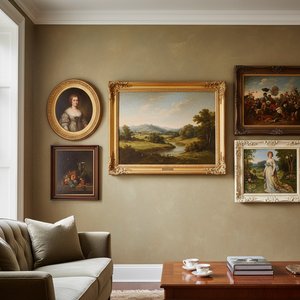
Jaki nastrój wprowadzi Kurd z Araratu do wnętrza?
Dzięki swojemu Elegancki styl nastrojowi, "Kurd z Araratu" idealnie sprawdzi się w Lobby hotelowe.
 Podgląd w skali 1:1
 Wyślij jako kartkę
 Udostępnij
 Szczegóły dzieła
 Przewodnik

 Pobierz obraz
 Podobne obiekty
 RTG
RTG Pokaz slajdów
 Q&A
Q&A Statystyki