Przełącz na wydania drukowane
 Rozwiń treść







































 W przypadku dzieł sztuki lub reprodukcji, których którykolwiek z boków przekracza 105 cm (około 41 cali), rama zostanie wysłana w formie zestawu do samodzielnego montażu. Metoda ta zapewnia bezpieczną dostawę i zapobiega uszkodzeniom podczas transportu.


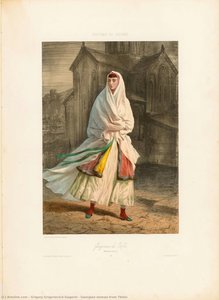
Grigory Gagarin’s “Circassian Woman”: A Portrait of Resilience Amidst Trauma
The painting "Circassian Woman" by Grigory Gagarin, completed in 1855, stands as a poignant testament to both artistic brilliance and the harrowing realities of the Caucasian War. More than just a depiction of two women—one holding a vase, the other gazing intently—it embodies a complex narrative woven into the fabric of Russian imperial history and infused with symbolic resonance that continues to captivate art historians today.- Subject Matter: Gagarin’s focus wasn't merely on capturing physical likeness; he aimed to convey an inner state, portraying two Circassian women facing adversity—a subtle allusion to the displacement and suffering endured by the Circassian people during the conflict. The woman with the vase symbolizes dignity and composure amidst hardship, while her companion embodies quiet contemplation and perhaps unspoken sorrow.
- Style: Gagarin adhered to Neoclassicism/Romanticism, a stylistic blend prevalent in Russian art during his era. This fusion reflects the period's fascination with idealized beauty juxtaposed with emotional depth—a deliberate choice that elevates the painting beyond mere visual representation. The artist skillfully employs chiaroscuro – dramatic contrasts of light and shadow – to sculpt form and imbue the scene with palpable atmosphere.
- Technique: Gagarin executed his work in watercolor on paper, a technique favored for its luminosity and ability to capture nuanced tonal variations. Watercolor allowed him to achieve remarkable subtlety, mirroring the delicate emotions he sought to convey. The meticulous layering of washes contributes to the painting's ethereal quality, enhancing its visual impact and conveying a sense of timelessness.
- Historical Context: Created during the Caucasian War (1846-1864), Gagarin’s artwork reflects the broader anxieties surrounding Russia’s expansion into the Caucasus region. The war fueled nationalist fervor and justified brutal policies against Circassian communities—policies that Gagarin implicitly critiques through his portrayal of vulnerability and resilience.
- Symbolism: Beyond its immediate depiction, “Circassian Woman” carries symbolic weight. The vase represents purity and grace – qualities valued in Circassian culture despite the devastation inflicted by Russian forces. The gaze of the woman embodies introspection and remembrance—a subtle reminder of the human cost of imperial ambition.
- Useful Links: Grigory Gagarin
- Internet Search: Get Art Reproductions Circassian Woman, 1855 by Grigory ...
- Georgian Context: Paintings of Georgian Women by Prince Grigory ...
- Wikipedia: Circassian genocide
Pytania i odpowiedzi
Jaki rozmiar "Circassian Women" jest sugerowany do Salon lub strefa dzienna?
Zalecane zestawienie dla „Circassian Women” – Grigory Gagarin: wydruk w formacie Duży format do Salon lub strefa dzienna.
Jaki jest ogólny nastrój dzieła „Circassian Women” – Grigory Gagarin?
Ogólny nastrój dzieła „Circassian Women” – Grigory Gagarin to Pełen spokoju. Nastrój ten oddaje ogólną atmosferę pracy.
Czy "Circassian Women" to słynne dzieło nurtu Romanticism?
„Circassian Women” – Grigory Gagarin jest klasyfikowane jako Uznany/a i należy do nurtu Romanticism.
 Podgląd w skali 1:1
 Wyślij jako kartkę
 Udostępnij
 Szczegóły dzieła
 Przewodnik

 Pobierz obraz
 Podobne obiekty
 RTG
RTG Pokaz slajdów
 Pytania i odpowiedzi
 Statystyki