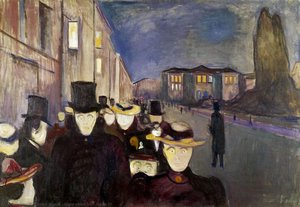
Wersja olejowa
 Wszystko o Evening







































 W przypadku dzieł sztuki lub reprodukcji, których którykolwiek z boków przekracza 105 cm (około 41 cali), rama zostanie wysłana w formie zestawu do samodzielnego montażu. Metoda ta zapewnia bezpieczną dostawę i zapobiega uszkodzeniom podczas transportu.


Edvard Munch's "Evening": A Study in Melancholy and Solitude
Edvard Munch’s “Evening,” painted in 1888, is an early work that foreshadows the artist’s later explorations of psychological depth and emotional intensity. This piece, housed within the Museo Nacional Thyssen-Bornemisza, offers a poignant glimpse into Munch's developing style as he transitioned from Impressionism towards Expressionism. The painting depicts a solitary figure, believed to be his sister Laura, seated in profile against a backdrop of a Norwegian fjord at dusk.
Style and Technique
“Evening” showcases a blend of Impressionistic techniques with emerging Symbolist tendencies. While the brushstrokes are looser than those found in purely academic works, they still retain a degree of naturalism in depicting the landscape. However, Munch’s use of color is far from objective; he employs dark, muted tones—primarily blues, greens, and browns—to evoke a sense of melancholy and introspection. The composition itself contributes to this mood: Laura's placement on the left side of the canvas, partially obscured and truncated, emphasizes her isolation. The original painting included two additional figures which Munch later removed, further amplifying the feeling of solitude.
Historical Context and Influences
Created during a period of significant artistic change in the late 19th century, “Evening” reflects a broader shift away from traditional representational art. Artists were increasingly interested in exploring subjective experiences and expressing inner emotions rather than simply depicting external reality. Munch was influenced by Symbolism and early Expressionist ideas, which sought to convey psychological states through symbolic imagery and distorted forms. The painting’s somber atmosphere aligns with the growing sense of alienation and anxiety that characterized modern life during this era.
Symbolism and Emotional Impact
The symbolism within “Evening” is subtle yet powerful. Laura's gaze directed towards the distant fjord suggests a longing or contemplation, while her detached posture conveys a profound sense of solitude. The darkening sky and tranquil waters contribute to an overall atmosphere of quiet melancholy. Munch’s choice to eliminate other figures from the scene underscores this feeling of isolation, drawing the viewer’s attention solely to Laura's introspective state. The painting resonates with viewers because it taps into universal human experiences of loneliness, reflection, and the passage of time.
A Precursor to Munch's Masterpieces
“Evening” serves as a crucial stepping stone in Munch’s artistic development, foreshadowing many of the themes and stylistic elements that would define his later masterpieces, including “The Scream.” It demonstrates his early mastery of conveying complex emotions through color, composition, and subtle symbolism. Owning a reproduction of this work allows one to appreciate not only its inherent beauty but also its significance within the broader context of modern art history.
Pytania i odpowiedzi
Czy Evening jest dziełem namalowanym ręcznie, czy wydrukiem?
Malowane ręcznie: wykwalifikowany artysta wykonuje olejną kopię Evening na płótnie lnianym.
Jaki rozmiar wybrać dla Evening?
Dostępne rozmiary obejmują zakres od 27.2 x 36.7 cm (zł784) do 181.4 x 244.4 cm (zł6425); tabela na tej stronie przedstawia główne warianty oraz ich ceny.
Ile trwa dostawa?
Czas dostawy wynosi od 4 do 5 tygodni, przy czym oferujemy bezpłatną ekspresową wysyłkę na cały świat; na tej stronie dostępna jest również opcja pilnej produkcji. Możesz dokonać zwrotu w ciągu 100 dni z pełnym zwrotem kosztów, bez żadnych dodatkowych warunków.
Gdzie znajduje się oryginał Evening?
Oryginał znajduje się w zbiorach Thyssen-Bornemisza Museum w Madryt.
Jakiej techniki użył/a Edvard Munch w pracy Evening?
Oil On Canvas
 Podgląd w skali 1:1

 Wyślij jako kartkę
 Udostępnij
 Szczegóły dzieła
 Karta informacyjna


 Pobierz obraz
 Podobne obiekty
 RTG
 Pokaz slajdów
 Pytania i odpowiedzi

 Statystyki