

 Se i rommet
 Del som digitalt kort
 Del
Del
 Detaljer
 Studentguide

 Last ned
 Liknende objekter
 Røntgen
 Lysbildefremvisning
 Besøksstatistikk
The Last Supper
 Oil On Canvas
- WallArt
- Mannerism Late Renaissance
 1592
1592- Renaissance
 350.0 x 2247.0 cm
 Onze-Lieve Vrouwekathedraal
 Les mer
Håndlaget oljereproduksjon
Håndmalt olje på lerret i din valgte størrelse og ramme, laget på bestilling av våre kunstnere. ( Bytt til trykkversjon Gå til digitalt bilde)




P118B Nkr10

P118H Nkr10

P118W Nkr10

P438Z Nkr10

P508JH Nkr12

P508YH Nkr12

P805H Nkr10

P805Z Nkr10

P919BZ Nkr10

P919G Nkr10

P919XJ Nkr10

P959ZH Nkr10

P968JZ Nkr12

W106C Nkr8

W218G Nkr10

W218JH Nkr8

W218Y Nkr10

W307PJ Nkr10

W316G Nkr10

W316PJ Nkr8

W316Y Nkr10

W398PJ Nkr8

W4111J Nkr10

W500HY Nkr15

W500JH Nkr15

W692G Nkr12

W849H Nkr8

W940BG Nkr15

W953PJ Nkr8




Velg mellom våre forhåndsdefinerte størrelser som bevarer kunstverkets opprinnelige proporsjoner.

Skriv inn bredden og høyden du trenger, slik at den passer til din ramme eller vegg. Dette er håndmalt, så for en størrelse med en annen form kan kunstneren male litt mer rundt bildet, eller beskjære det noe — du velger selv. Vi sender deg en digital mockup for godkjenning før maleriet påbegynnes. Bildet som vises på denne siden viser ikke det faktiske resultatet — kun mockuppen gjør det.
Etter bestilling vil OriginalUniqueArt.com-teamet sende e-post til kunden for instruksjoner og sende et utkast (mockup) som forhåndsvisning.
Verdensomspennende levering () på 3–4 uker i stedet for standard 5 uker. (23 October). Ingen kompromisser med kvaliteten.

Gratis ekspressfrakt over hele verden

Lerretsduk av høykvalitets lin

Full transportforsikring

Garanti for refusjon av toll og importavgifter

Garantert fargeekthet

100 dagers returrett ved fabrikasjonsfeil

100% pengene tilbake-garanti

Mengderabatt
 Glassalternativet er kun tilgjengelig i størrelser under 110 cm

The Last Supper
Reproduksjonsmetode
Format på reproduksjon
-


Totalpris
Nkr 2851
A Divine Gathering: Contemplating The Last Supper
To stand before this monumental depiction of The Last Supper is to be enveloped in an atmosphere thick with profound significance and hushed drama. It is more than merely a painting; it is a frozen moment of ultimate human reckoning, a tableau vivant capturing the solemnity of Christ’s final meal with his apostles. The sheer scale of the work, measuring an imposing 350 by 2247 centimeters, speaks to its monumental importance, demanding reverence from any space it graces. One cannot help but feel the weight of history pressing down, observing the twelve figures arranged around the vast table, each posture and gesture whispering tales of betrayal, devotion, and divine mystery.
Mastery in Northern Renaissance Technique
The technical execution points toward a sophisticated understanding of the Northern Renaissance aesthetic. Observe the meticulous detail; from the rich folds of drapery to the subtle textures suggested on the table and the architectural elements framing the scene—the high ceiling, the hanging chandeliers—the artist’s hand is evident in every stroke. The use of light itself becomes a narrative tool. The illumination is nothing short of dramatic, employing strong contrasts between deep shadow and brilliant highlights that serve not just to model form but to guide the viewer's eye inexorably toward the central figure. This masterful handling of chiaroscuro lends an almost palpable depth to the composition, making the scene feel immediate and deeply three-dimensional.
Historical Echoes and Symbolic Weight
Dating to 1592, this work emerges from a period of intense religious fervor and artistic transformation in Europe. The narrative itself—the institution of the Eucharist and the foreshadowing of sacrifice—is steeped in Christian symbolism that has fueled art for centuries. Every gaze exchanged across the table carries symbolic weight; some apostles recoil in shock, others lean forward in contemplation. The muted earth tones dominating the palette are punctuated by deliberate bursts of color, such as the deep red drapery, which draw the eye and amplify the emotional tension inherent in the scene. It is a visual sermon rendered with breathtaking skill.
Bringing Sacred Drama Home
For those who seek to infuse their interiors or devotional spaces with art that speaks volumes without uttering a word, this reproduction offers an unparalleled opportunity. While its original grandeur suggests placement within a grand cathedral setting, the enduring power of the composition allows it to serve as a breathtaking focal point in any sophisticated collector's home. Owning a piece echoing this scale and emotional depth means acquiring not just decoration, but a tangible connection to centuries of artistic devotion and human drama. It is an heirloom quality piece designed to inspire quiet contemplation amidst the bustle of modern life.
Spørsmål og svar
Er "The Last Supper" fri for opphavsrett?
Opphavsrettslig status for "The Last Supper" av Otto van Veen: verket er i det frie domene – opphavsretten har utløpt. Dette avgjør om reproduksjoner av bildet kan lages fritt.
Hvilken historisk periode stammer "The Last Supper" av Otto van Veen fra?
"The Last Supper" av Otto van Veen stammer fra Renaissance-perioden. Denne perioden gir verkets historiske kontekst.
Hvor lys eller mørk oppleves "The Last Supper" av Otto van Veen som?
Alt i alt er "The Last Supper" registrert som deep_shadow. Oppfattet lysstyrke beskriver hvor lyst eller mørkt verket fremstår.
Kunstnerbiografi
A Life Bridging Renaissance and Baroque: The World of Otto van Veen
Otto van Veen, a name resonating with the echoes of late 16th and early 17th-century artistry, occupies a fascinating position in art history. Born around 1556 in Leiden, Netherlands, into a family of prominence—his father served as burgomaster—Van Veen’s life was one of shifting allegiances and artistic evolution. The religious tensions gripping the Low Countries during his youth profoundly shaped his trajectory. The relocation of his family to Antwerp in 1572, driven by their Catholic faith amidst a rising tide of Protestantism, marked not just a geographical shift but also a turning point in his intellectual and artistic formation. This move brought him into contact with influential figures like Dominicus Lampsonius and Jean Ramée, laying the groundwork for a career steeped in humanist ideals and classical learning. His subsequent journey to Rome around 1574 or 1575 proved pivotal; immersing himself in the heart of the Italian Renaissance, he absorbed the stylistic nuances that would define his mature work—the elegance, the refined compositions, and the emphasis on idealized forms characteristic of Mannerism. The precise extent of his Roman tutelage remains debated, with some scholars suggesting a period under Federico Zuccari, but its impact is undeniable.Patronage, Pedagogy, and the Shaping of a Master
Upon returning from Italy, Van Veen swiftly established himself as a sought-after artist. His talent secured him a position as court painter to Alexander Farnese, Duke of Parma, governor of the Southern Netherlands, in Brussels. This patronage provided not only financial stability but also access to a sophisticated artistic milieu and opportunities for large-scale commissions. He became a master within Antwerp’s Guild of St. Luke in 1593, solidifying his professional standing. However, Van Veen's legacy extends far beyond his own paintings; it is inextricably linked to the career of one of art history’s most celebrated masters: Peter Paul Rubens. From approximately 1594 or 1595 until 1598, Van Veen served as Rubens’ teacher, instilling in the young artist a rigorous classical education and a deep appreciation for humanist principles. This mentorship was crucial in shaping Rubens' intellectual framework and artistic sensibilities, laying the foundation for his future triumphs. Van Veen didn’t merely impart technical skills; he cultivated a worldview that emphasized the integration of art, literature, and philosophy—a hallmark of Rubens’ own prolific output. During this period, Van Veen also undertook numerous religious commissions, adorning churches with altarpieces and chapels, demonstrating his versatility and growing reputation as a skilled and reliable artist.Mannerist Sensibility and the Language of Emblems
Van Veen’s artistic style is firmly rooted in Mannerism, an aesthetic characterized by elongated figures, graceful poses, sophisticated compositions, and a refined palette. His paintings often exude an air of elegance and intellectual contemplation. He was known as a *pictor doctus* – a learned painter – and this designation reflects his commitment to incorporating humanist themes into his work. Beyond painting, Van Veen made significant contributions to the burgeoning field of emblem books—a popular genre that combined images with text to convey moral and philosophical messages. His *Quinti Horatii Flacci Emblemata* (1607), *Amorum Emblemata* (1608), and *Amoris Divini Emblemata* (1615) are prime examples of this form, showcasing his skill as both an artist and a scholar. The *Amorum Emblemata*, in particular, achieved widespread influence, serving as a model for subsequent emblem books and inspiring artists across various disciplines. Its depictions of putti enacting scenes from classical literature and mythology, accompanied by witty mottos, captured the spirit of Renaissance humanism and its fascination with love—both earthly and divine.Major Works and Artistic Themes
Van Veen’s oeuvre encompasses a diverse range of subjects, reflecting his versatility as an artist. He produced numerous religious paintings, often characterized by their meticulous detail and refined compositions. His depictions of the Virgin Mary are particularly noteworthy, showcasing her serene beauty and embodying the ideals of Christian piety. Furthermore, he excelled in allegorical works, exploring themes of virtue, vice, and human nature through symbolic imagery. The *Batavians Defeating Romans* (circa 1605-1607), a monumental painting commissioned by the Dutch States General, exemplifies his ability to synthesize classical mythology with contemporary political concerns. His work also includes portraits—both formal and informal—that capture the likenesses of prominent figures from the Low Countries. The *Brinno Raised upon Shield* (circa 1590) is a prime example of his skill in portraying human emotion and psychological depth. Throughout his career, Van Veen consistently demonstrated an ability to blend technical mastery with intellectual sophistication, creating works that are both visually stunning and conceptually rich.Later Years and Enduring Influence
Even as artistic tastes began to shift towards the dynamism of the Baroque, Van Veen continued to thrive. He maintained connections with the Archdukes Albert and Isabella, though without holding a formal court appointment. A significant undertaking during this period was a series of twelve paintings depicting battles between Romans and Batavians, commissioned by the Dutch States General based on earlier engravings he had produced. This project demonstrates his ability to adapt to changing political landscapes and cater to diverse artistic demands. Throughout his career, Van Veen remained actively involved in Antwerp’s artistic community, serving as dean of both the Guild of St. Luke (1602) and the Romanists (1606). He came from a family with considerable artistic talent; his brother Gijsbert was an accomplished engraver, his daughter Gertruid also pursued painting, and several nephews worked as pastel artists. Otto van Veen died in Brussels in 1629, leaving behind a legacy that extended far beyond his own oeuvre. Arnold Houbraken, the renowned Dutch art historian, recognized him as the most impressive artist and scholar of his time, even featuring his portrait on the title page of his influential *De Groote Schouburgh der Nederlantsche Konstschilders en Schildersessen*. His enduring significance lies not only in his own artistic achievements but also in his pivotal role as a teacher and mentor—most notably to Peter Paul Rubens—and his contribution to the intellectual and artistic currents of his era. He stands as a compelling figure, bridging the gap between the Renaissance and Baroque periods, embodying the ideals of the humanist artist, and leaving an indelible mark on the history of Flemish painting.
Otto van Veen
1556 - 1629 , Nederland
Kort om kunstneren
- Artistic Movement Or Style: Mannerisme
- Artists Or Movements Influenced By This Artist: ['Peter Paul Rubens']
- Artists Who Influenced This Artist: ['Federico Zuccari']
- Date Of Birth: 1556
- Date Of Death: 1629
- Full Name: Otto van Veen
- Nationality: Flemish
- Notable Artworks:
- Slaget mellom Romere
- Fredsforhandlinger
- Brinno på skjold
- Place Of Birth: Leiden, Nederland
Relaterte artikler

Rembrandts Mesterverk: Topp 25 Kunstverk for Din Vegg | OriginalUniqueArt.no
Utforsk Rembrandts 25 mest ikoniske kunstverk! Oppdag historiene bak mestermalerier, portretter og bibelske scener fra den nederlandske barokken. Finn museumskvalitets reproduksjoner & interiørinspirasjon på OriginalUniqueArt.com.
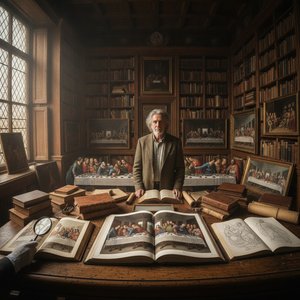
Masterpieces of the Last Supper: An Art Historian's Journey Through Iconic Depictions of a Sacred Moment
Explore the profound artistry of The Last Supper through an art historian's lens. From Leonardo da Vinci’s genius to diverse Renaissance interpretations, discover the symbolism and technique behind history's most iconic sacred depictions.

Maerten van Heemskerck: Bridging Mannerism & Renaissance Ideals
Explore the captivating world of Maerten van Heemskerck, a pivotal Dutch Renaissance painter bridging Mannerism & Italian influence. Discover his masterpieces and legacy with OriginalUniqueArt.

De 10 Mesterverkene Som Definerte Tidlig Nederlandsk Renessanse | Kunst & Interiør
Utforsk de 10 ikoniske mesterverkene fra tidlig nederlandsk renessanse! Jan van Eyck, Bosch & Van der Weyden – lær om historien og teknikken bak disse flotte oljemaleriene. Finn kunst til ditt hjem på OriginalUniqueArt.com.

De 10 Mesterverkene Som Definerte Tidlig Nederlandsk Maleri | Kunst og Interiør
Utforsk de 10 mest ikoniske verkene fra tidlig nederlandsk maleri! Lær om Jan van Eyck, Robert Campin og renessansens mestere. Finn kunsttrykk av høy kvalitet og interiørinspirasjon på OriginalUniqueArt.com – ditt hjem fortjener et mesterverk.