
 Forhåndsvisning
 Send
Send Del
Del
 Vis detaljer
 Utskriftsvennlig guide

 Last ned bilde
 Liknende objekter
 Røntgenundersøkelse
 Lysbildefremvisning
 Q&A
Q&A Statistikk
COUPE DE CERISES, PRUNES ET MELON


 Vis hele teksten
Giclée / Kunsttrykk
Giclée- eller lerretsprint av museumskvalitet med rask produksjon og fleksible valgmuligheter for etterbehandling. ( Kjøp håndmalt maleri Bytt til digitalt bilde)




P118B Nkr10

P118H Nkr10

P118W Nkr10

P438Z Nkr10

P508JH Nkr12

P508YH Nkr12

P805H Nkr10

P805Z Nkr10

P919BZ Nkr10

P919G Nkr10

P919XJ Nkr10

P959ZH Nkr10

P968JZ Nkr12

W106C Nkr8

W218G Nkr10

W218JH Nkr8

W218Y Nkr10

W307PJ Nkr10

W316G Nkr10

W316PJ Nkr8

W316Y Nkr10

W398PJ Nkr8

W4111J Nkr10

W500HY Nkr15

W500JH Nkr15

W692G Nkr12

W849H Nkr8

W940BG Nkr15

W953PJ Nkr8




Velg mellom våre forhåndsdefinerte størrelser som bevarer kunstverkets opprinnelige proporsjoner.

Skriv inn ønsket bredde og høyde for å tilpasse trykket til din ramme eller vegg. Et trykk kan kun beskjæres, aldri skaleres opp utover motivets opprinnelige størrelse, noe som betyr at et format med andre proporsjoner vil føre til tap av deler av bildet. Vi sender deg en digital mockup for godkjenning før vi starter trykkeprosessen. Bildet som vises på denne siden viser ikke den faktiske beskjæringen — det er kun mockuppen som viser dette.
Verdensomspennende levering () på 2 uker i stedet for standard 4/5 uker. (1 November)

Gratis ekspressfrakt over hele verden

Lerretsduk av lin av høy kvalitet

Full transportforsikring

Garanti for refusjon av toll og importavgifter

Garantert fargegjengivelse

100 dagers returrett ved fabrikasjonsfeil

100% pengene tilbake-garanti

Rabatt ved flere kjøp
 Glassalternativet er kun tilgjengelig i størrelser under 110 cm

COUPE DE CERISES, PRUNES ET MELON
Giclée / Kunsttrykk
Størrelse på reproduksjon
-


Totalpris for valgte alternativer
Nkr 770
Louise Moillon’s “Coupe de Cerises, Prunes et Melon”: A Baroque Still Life of Quiet Abundance
The painting "Coupe de cerises, prunes et melon" by Louise Moillon, completed around 1633, is more than just a depiction of fruit; it's a meticulously crafted meditation on beauty, abundance, and the fleeting nature of pleasure. Within its deceptively simple composition lies a wealth of Baroque artistry – a masterful blend of Flemish realism, French elegance, and subtle symbolism that continues to captivate viewers centuries later. This intimate still life, now residing within the hallowed halls of the Louvre Museum in Paris, offers a rare glimpse into the world of a pioneering female artist operating within a traditionally male-dominated field.
Moillon’s artistic journey unfolded against the backdrop of 17th-century France, a period marked by religious upheaval and burgeoning artistic innovation. Born into a Huguenot family – refugees fleeing persecution in Holland – her upbringing instilled a deep appreciation for naturalism and symbolic representation, qualities that profoundly shaped her distinctive style. Unlike many of her contemporaries who favored grand historical or mythological scenes, Moillon focused on the quiet beauty of everyday objects, elevating them to an almost sacred level through her painstaking attention to detail and masterful use of light and shadow.
A Symphony of Color and Texture
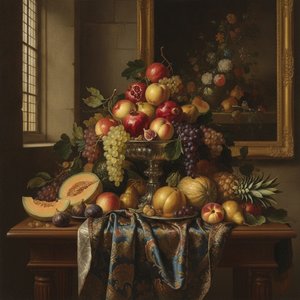
The painting’s immediate impact is one of serene elegance. Moillon employs a carefully orchestrated palette – a harmonious blend of deep browns, rich reds, vibrant yellows, and muted greens – that draws the eye into the heart of the composition: a gleaming porcelain bowl overflowing with an array of fruits. The cerises, bursting with juicy red color, are strategically placed to command attention, their brightness contrasted against the darker tones of the plums and melon. Moillon’s technique is characterized by an extraordinary level of detail; each fruit – from the velvety texture of the melon rind to the delicate veins on a plum leaf – is rendered with astonishing precision.
The artist's mastery extends beyond mere representation. Moillon skillfully manipulates light and shadow, creating a dramatic chiaroscuro effect that adds depth and volume to the scene. The strong directional lighting, originating from an unseen source above and slightly to the left, casts long, elegant shadows that define the forms of each object, lending them a tangible presence. This masterful use of light not only enhances the visual impact but also evokes a sense of stillness and contemplation – inviting the viewer to linger and appreciate the beauty before them.
Symbolism and Context
Still lifes during the Renaissance and Baroque periods were often imbued with symbolic meaning, representing concepts such as wealth, prosperity, and mortality. In "Coupe de cerises," the abundance of fruit can be interpreted as a symbol of earthly delights – a reminder of the pleasures of life but also a poignant acknowledgment of their transient nature. The carefully arranged composition itself suggests an order and harmony that reflects the ideals of classical art and Renaissance thought.
Furthermore, Moillon’s work is rooted in the artistic traditions of the Netherlands, particularly the Flemish school of painting, which was highly influential in France during this period. The use of trompe l'oeil – a technique designed to create an illusion of three-dimensionality – is evident in the subtle details and realistic textures that contribute to the painting’s overall sense of depth and realism. The placement of the bowl on a dark wooden table, extending into the background, further enhances this effect, blurring the boundaries between the painted world and the viewer's perception.
A Timeless Masterpiece
"Coupe de cerises, prunes et melon" stands as a testament to Louise Moillon’s artistic skill and her ability to capture the essence of beauty in a single image. It is a painting that rewards repeated viewing, revealing new details and nuances with each encounter. More than just a still life, it's a profound meditation on art, nature, and the human experience – a timeless masterpiece that continues to inspire and delight viewers today. Reproductions of this iconic work offer an accessible way to bring its serene elegance into any space, allowing one to appreciate the artistry and symbolism within.
Spørsmål og svar
Hvilken kunstner kan "COUPE DE CERISES, PRUNES ET MELON" tilskrives?
"COUPE DE CERISES, PRUNES ET MELON" ble skapt av Louise Moillon. Informasjonen på denne siden beskriver Louise Moillon sitt originale verk.
Hvilken atmosfære ville en reproduksjon av "COUPE DE CERISES, PRUNES ET MELON" av Louise Moillon tilføre et rom?
Med sin Elegant stemning anbefales "COUPE DE CERISES, PRUNES ET MELON" for et Living Room.
Hvor kjent er "COUPE DE CERISES, PRUNES ET MELON" av Louise Moillon?
"COUPE DE CERISES, PRUNES ET MELON" er klassifisert som Recognized.
Om kunstneren
Louise Moillons stille briljans
I barokkens storslåtte og dramatiske fortellinger, der bevegelse og teatralsk kraft ofte dominerer lerretet, tilbyr arbeidene til Louise Moillon et dyptpløyende og meditativt alternativ. Moillon ble født i Paris i 1610 og vokste opp i en verden formet av de intense religiøse og kulturelle omveltningene i 17. århundrets Frankrike. Hennes egen slektshistorie forteller en historie om motstandskraft og kunstnerisk arv; som etterkommer av hugenottflyktninger fra Nederland, var hun dypt forankret i en tradisjon som verdsatte den nitidige observasjonen av naturen. Denne bakgrunnen ga henne mer enn bare en familiehistorie – den tilbød et stilistisk vokabular rotfestet i den nederlandske mestringen av lys, tekstur og symbolsk realisme.
Moillons tidlige liv var preget av både tap og dyp kunstnerisk veiledning. Da hennes far, landskapsmaleren og kunsthandleren Nicolas Moillon, døde da hun bare var ti år gammel, kunne det ha endret hennes vei, men oppveksten forble dypt integrert i kunsten. Under veiledning av sin stedfar, François Garnier, en dyktig kunstner og dealer, foredlet hun en teknikk som skulle bli hennes varemerke. Hennes utdannelse handlet ikke bare om påføring av pigment på lerret, men var en fordypelse i sin tids humanistiske verdier, der hun lærende å se det guddommelige i de minste detaljer – i en modnende frukt eller den delikate kurven på et kronblad.
En mestring av tekstur og lys
Moillons sanne geni ligger i hennes evne til å forvandle det hverdagslige til det ekstraordinære. Komposisjonene hennes kjennetegnes av en seren stillhet, en ro som inviterer betrakteren til å dvele og observere. Hun besatt en nesten overnaturlig evne til å fange motivenes taktile kvaliteter – den voksaktige huden på en sitron, det myke dunet på en fersken, eller den gjennomsiktige saften fra et knust bær. I verk som Stilleben med sitroner og curaçao-appelsiner i et hvitt polylobat fat, kan man fornemme fruktens kjølige fuktighet mot porselenets harde, glaserte overflate, noe som skaper en sanselig opplevelse som transcenderer det todimensjonale planet.
Teknikken hennes var dypt påvirket av de naturalistiske tradisjonene i de protestantiske kretsene hun beveget seg i. Denne tilnærmingen prioriterte klarhet og presisjon fremfor de teatralske skyggene hos de mer prangende barokkmestrene. I stedet brukte Moillon lyset til å forme sine motiver, med subtile fargenyanser for å skape volum og dybde. Paletten hennes, selv om den ofte fokuserte på naturens levende farger, ble brukt med en slik beherskelse at hver farge føltes lysende, som om de var opplyst innenfra. Denne mestringen gjorde det mulig for henne å bygge bro mellom ren botanisk illustrasjon og høyere kunst, og besjeler hvert verk med en følelse av liv og vitalitet.
Ettermæle og historisk betydning
Gjennom sitt lange liv, som strakte seg over nesten ni tiår, oppnådde Moillon en anerkjennelse som var sjelden for kvinnelige kunstnere i hennes tid. Hennes evne til å sikre oppdrag fra prestisjetunge mægener, inkludert medlemmer av det kongelige hoffet, vitner om den ubestridelige kvaliteten og sofistikasjonen i hennes virke. Selv om arbeidene hennes ofte fokuserte på stillebenets intime skala, var deres innvirkning omfattende og bidro betydelig til utviklingen av den franske stilleben-tradisjonen.
Louise Moillons historiske betydning strekker seg utover hennes tekniske ferdigheter; hun representerer et vitalt bindeledd mellom den nederlandske naturalistiske tradisjonen og den fremvoksende franske estetikken i det 17. århundre. Maleriene hennes fungerer som vinduer inn til en tapt verden av parisiske markeder og private hager, og fanger en følelse av overflod og forgjengelig skjønnhet. I dag forblir verkene hennes dyrebare skatter i institusjoner som Louvre, som varige vitnesbyrd om et liv dedikert til å finne det ekstraordinære i det ordinære. Hennes arv finnes i hvert penselstrøk som feirer den stille, pustløse prakt i naturens verden.

Louise Moillon
1610 - 1696 , Frankrike
Kort om kunstneren
- Artistic Movement Or Style: Barokk stilleben
- Artists Or Movements Influenced By This Artist:
- Michelangelo
- Rafael
- Tizian
- Artists Who Influenced This Artist:
- Isaac Moillon
- François Garnier
- Date Of Birth: Paris, Frankrike (1610)
- Date Of Death: 1696
- Full Name: Louise Moillon
- Nationality: Fransk
- Notable Artworks:
- Kurv med aprikoser
- SKÅL MED KIRSEBÆR, PLOMMER OG MELON
- Kurv med fersken, kvinner og plommer
- Place Of Birth: Paris
Relaterte artikler
Nature's Bounty: The Art History of Fruit Arrangement Masterpieces and the Baroque Still Life Tradition
Explore the profound beauty of fruit arrangement masterpieces. From Dutch Golden Age opulence to Baroque chiaroscuro, discover the art history, symbolism, and timeless elegance of classical still life paintings for the discerning collector.

Barokkens storhet: En autoritativ guide til drama, lys og emosjonell dybde i 1600-tallets kunst
Lær om barokkens drama, lys og mestre som Caravaggio i denne autoritative guiden. Oppdag 1600-tallets emosjonelle kraft her.

Baroque Classicism: The Grandeur of Order and Drama in 17th-Century Art History
Explore the profound elegance of Baroque Classicism. Discover how 17th-century masters synthesized dramatic emotion with classical order through the lens of the Counter-Reformation and the works of legends like Carlo Maratta and Andrea Sacchi.

Barokkens Mesterverk: Topp 10 Kunstverk som Definerte en Epoke | OriginalUniqueArt.no
Opplev barokkens prakt! Utforsk Rembrandts, Caravaggios og Rubenses mest ikoniske verk. Lær om historien bak disse mesterverkene og finn inspirasjon til din interiørdekor på OriginalUniqueArt.com. Museums kvalitet kunsttrykk.

The Bountiful Still Life: Symbolism & Artistic Representation of Fruit Across Art History
Explore the rich history of still life painting & the symbolism of fruit across art movements. Discover masterpieces from Caravaggio to Cézanne with OriginalUniqueArt – expert guidance & museum-quality reproductions.