Bytt til trykk
 Vis hele teksten







































 For kunstverk eller reproduksjoner som er større enn 105 cm (ca. 41 tommer) på noen side, vil rammen bli sendt som et sett som må monteres. Denne metoden sikrer trygg levering og forhindrer skader under transport.


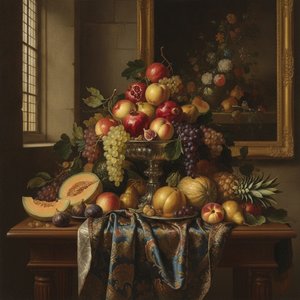
Louise Moillon’s “Coupe de Cerises, Prunes et Melon”: A Baroque Still Life of Quiet Abundance
The painting "Coupe de cerises, prunes et melon" by Louise Moillon, completed around 1633, is more than just a depiction of fruit; it's a meticulously crafted meditation on beauty, abundance, and the fleeting nature of pleasure. Within its deceptively simple composition lies a wealth of Baroque artistry – a masterful blend of Flemish realism, French elegance, and subtle symbolism that continues to captivate viewers centuries later. This intimate still life, now residing within the hallowed halls of the Louvre Museum in Paris, offers a rare glimpse into the world of a pioneering female artist operating within a traditionally male-dominated field.
Moillon’s artistic journey unfolded against the backdrop of 17th-century France, a period marked by religious upheaval and burgeoning artistic innovation. Born into a Huguenot family – refugees fleeing persecution in Holland – her upbringing instilled a deep appreciation for naturalism and symbolic representation, qualities that profoundly shaped her distinctive style. Unlike many of her contemporaries who favored grand historical or mythological scenes, Moillon focused on the quiet beauty of everyday objects, elevating them to an almost sacred level through her painstaking attention to detail and masterful use of light and shadow.
A Symphony of Color and Texture
The painting’s immediate impact is one of serene elegance. Moillon employs a carefully orchestrated palette – a harmonious blend of deep browns, rich reds, vibrant yellows, and muted greens – that draws the eye into the heart of the composition: a gleaming porcelain bowl overflowing with an array of fruits. The cerises, bursting with juicy red color, are strategically placed to command attention, their brightness contrasted against the darker tones of the plums and melon. Moillon’s technique is characterized by an extraordinary level of detail; each fruit – from the velvety texture of the melon rind to the delicate veins on a plum leaf – is rendered with astonishing precision.
The artist's mastery extends beyond mere representation. Moillon skillfully manipulates light and shadow, creating a dramatic chiaroscuro effect that adds depth and volume to the scene. The strong directional lighting, originating from an unseen source above and slightly to the left, casts long, elegant shadows that define the forms of each object, lending them a tangible presence. This masterful use of light not only enhances the visual impact but also evokes a sense of stillness and contemplation – inviting the viewer to linger and appreciate the beauty before them.
Symbolism and Context
Still lifes during the Renaissance and Baroque periods were often imbued with symbolic meaning, representing concepts such as wealth, prosperity, and mortality. In "Coupe de cerises," the abundance of fruit can be interpreted as a symbol of earthly delights – a reminder of the pleasures of life but also a poignant acknowledgment of their transient nature. The carefully arranged composition itself suggests an order and harmony that reflects the ideals of classical art and Renaissance thought.
Furthermore, Moillon’s work is rooted in the artistic traditions of the Netherlands, particularly the Flemish school of painting, which was highly influential in France during this period. The use of trompe l'oeil – a technique designed to create an illusion of three-dimensionality – is evident in the subtle details and realistic textures that contribute to the painting’s overall sense of depth and realism. The placement of the bowl on a dark wooden table, extending into the background, further enhances this effect, blurring the boundaries between the painted world and the viewer's perception.
A Timeless Masterpiece
"Coupe de cerises, prunes et melon" stands as a testament to Louise Moillon’s artistic skill and her ability to capture the essence of beauty in a single image. It is a painting that rewards repeated viewing, revealing new details and nuances with each encounter. More than just a still life, it's a profound meditation on art, nature, and the human experience – a timeless masterpiece that continues to inspire and delight viewers today. Reproductions of this iconic work offer an accessible way to bring its serene elegance into any space, allowing one to appreciate the artistry and symbolism within.
Spørsmål og svar
Hvilken kunstner kan "COUPE DE CERISES, PRUNES ET MELON" tilskrives?
"COUPE DE CERISES, PRUNES ET MELON" ble skapt av Louise Moillon. Informasjonen på denne siden beskriver Louise Moillon sitt originale verk.
Hvilken atmosfære ville en reproduksjon av "COUPE DE CERISES, PRUNES ET MELON" av Louise Moillon tilføre et rom?
Med sin Elegant stemning anbefales "COUPE DE CERISES, PRUNES ET MELON" for et Living Room.
Hvor kjent er "COUPE DE CERISES, PRUNES ET MELON" av Louise Moillon?
"COUPE DE CERISES, PRUNES ET MELON" er klassifisert som Recognized.
 Forhåndsvisning
 Send
Send Del
Del
 Vis detaljer
 Utskriftsvennlig guide

 Last ned bilde
 Liknende objekter
 Røntgenundersøkelse
 Lysbildefremvisning
 Spørsmål og svar
 Statistikk