Romanticism
Alpine Landscape (Alexandre Calame)
Alexandre Calame (1810–1864) sukūrė Alpine Landscape. Šis kūrinys priklauso Romanticism kieruliui. Pagaminta naudojant Oil On Canvas. Matmenys – 45 × 31 cm.
- Oil On Canvas
- 45 × 31 cm

 Peržiūrėti

 Rankinio darbo aliejinės imitacijos paveikslas
 Pasidalinti
 Dalintis
 Informacinė lLapelė


 Atsisiųsti
 Panašūs eksponatai
 Rentgeno spindulių nuotrauka
 Automatinė diorama
 Klausimai ir atsakymai

 Statistika
Alpine Landscape, trumpai
- Pavadinimas
- Alpine Landscape
- Autorius
- Alexandre Calame (1810–1864)
- Autorius gimęs
- Vevė, Šveicarija
- Technika
- Oil On Canvas
- Dalių matmenys
- 45 × 31 cm
- Judėjimas
- Romanticism
- Laikotarpis
- 19th Century
- Tema
- alpine landscape, mountain scenery, swiss alps view, river valley scene, atmospheric perspective, landscape painting
Ką vaizduoja Alpine Landscape?
Identification of the Alpine Landscape
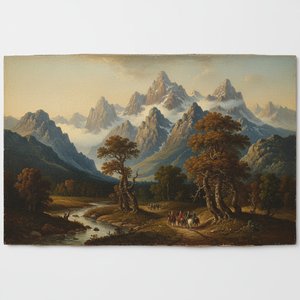
Alpine Landscape is an oil painting by the Swiss artist Alexandre Calame. The canvas captures a mountainous valley where a river winds through the terrain. A rocky outcrop anchors the left side of the scene, leading the eye toward distant, receding peaks. This work reflects the artist's lifelong preoccupation with the rugged topography of his homeland.
Alexandre Calame was born in 1810 in Vevey, Switzerland. He spent much of his life observing the textures of the Alps, from the weight of granite to the movement of mountain streams. The artist eventually passed away in 1864 in Menton, France. In this specific composition, the light remains diffused, as if filtered through an overcast sky or the soft glow of early morning.
The scene focuses on the scale of the natural world. Trees and shrubs ground the foreground, providing a sense of texture against the vastness of the background. The mountains rise in geometric triangles, their forms softening as they vanish into the atmospheric distance. A quiet stillness settles over the valley.
Composition and Visual Elements
A rocky outcrop anchors the left side of the frame, its jagged edges catching the light to pull the eye into the scene. From this stone threshold, the gaze follows a river as it winds through a mountainous valley. In the foreground, the earth is textured with the presence of shrubs and trees, grounding the viewer amidst the wild vegetation. These small, detailed forms provide a tactile entry point before the eye moves toward the vastness of the background.
The composition relies on a steady use of perspective to carve out a sense of immense depth. The mountains recede into the distance, their scale dwarfing the river and the greenery below. This arrangement emphasizes the sheer magnitude of the alpine terrain. The verticality of the peaks meets the horizontal flow of the water, creating a structured balance within the natural chaos. The light remains diffused, casting soft shadows across the mountain slopes and the valley floor. A quiet stillness settles over the stone and the stream.
Technique and Artistic Materials
Oil paint meets canvas in this landscape. The artist applied thin, translucent washes of pigment, layering them one after another in a sequence of glazes. This meticulous process builds a luminous depth, allowing light to settle within the layers. It is a slow accumulation of color. The surface holds the weight of the mountain and the softness of the air.
The brushwork captures the physical reality of the terrain. Roughness defines the stone of the rocky outcrop, while the texture of the foliage is rendered with precise, tactile strokes. Light enters the scene as a diffused glow, suggesting the quiet of an overcast day or the pale clarity of early morning. Shadows settle into the mountain crevices, creating a sense of immense scale through tonal modulation. The atmosphere feels heavy with moisture, as if the light itself is filtered through a mountain mist.
The Artistic Style of Calame
A sense of the sublime anchors this work, a hallmark of the Romanticism movement. Calame was a pivotal figure within the Düsseldorf School of Painting, bringing a disciplined eye to the untamed wilderness. He treats the mountains not as static stone, but as living, breathing entities. Through a mastery of atmospheric perspective, the distant peaks recede into a soft, hazy light, creating a profound sense of depth. This tonal modulation allows the viewer to feel the weight of the air between the rocky foreground and the far horizon.
The brushwork is expressive, capturing the rugged textures of the landscape. He uses these strokes to convey the emotional impact of nature, translating the scale of the valley into a felt experience. There is a palpable emotion in the way light hits the river and the cliffs, suggesting the solitude of the high Alps. His connection to these mountains is evident in the precise, almost tactile rendering of the terrain. The scene remains quiet, held in a delicate balance of light and shadow.
Related Works by Alexandre Calame
The artist’s hand often returned to the weight of the mountains and the movement of the air. In 1838, he captured the tension of a storm at Handeck, where the sky meets the jagged rock. This energy persists in his 1856 work, Storm in the Alps, a scene of chaotic weather and turbulent clouds. He also documented the specific topography of the Valley of Lauterbrunnen in 1856, rendering the deep clefts of the Swiss terrain. These works reflect a lifelong preoccupation with the raw power of the high passes.
Water remains a constant presence in his compositions, shifting from the violent to the still. He painted the Lake of the Four Cantons, near Brunnen, in 1853, finding a different rhythm in the alpine waters. His vision extended beyond the peaks to the warmth of the south, seen in Pozzuoli and the Bay of Naples, 1844. Even in more quiet studies, such as Landscape with Oaks, about 1859, the meticulous observation of nature remains central. The light continues to shift across the stone.
Alpine Landscape dididraudžios kokybės vaizdai
Viešoji domenė: suregalis mirė 1864 m.
Alexandre Calame, Alpine Landscape.
Alexandre Calame (1810–1864), Alpine Landscape, oil on canvas. Viešoji domenė Vaizdas: OriginalUniqueArt.com.
Atsakimai į klausimus apie Alpine Landscape
Kokia technika panaudota kūriniui „Alpine Landscape"]?
„Alpine Landscape“ technika – Oil On Canvas.
Kokie yra „Alpine Landscape“ – Alexandre Calame realūs matmenys?
Originalaus dydžio kūrinys „Alpine Landscape“ yra 45 x 31 cm. Originalūs matmenys padeda lengviau išsirinkti tinkamą reprodukcijos dydį.
Ką vaizduoja „Alpine Landscape“ – Alexandre Calame?
„Alpine Landscape“ – Alexandre Calame temos apima alpine landscape, mountain scenery, swiss alps view, river valley scene, atmospheric perspective, landscape painting, nature’s grandeur”. Kartu jie apibendrina šio kūrinio tematiką.
Ar „Alpine Landscape“ yra viešosios teisės kūrinys?
„Alpine Landscape“ – Alexandre Calame yra yra viešosios erdvės dalis – jo autorinė teisė pasibaigusi. Šis statusas nustato, kaip galima reprodukcijaus šio kūrinio vaizdą.
Kas yra „Alpine Landscape“ kūrybos autorius?
Kūrinį „Alpine Landscape“ sukūrė Alexandre Calame. Darbas katalogizuojamas Alexandre Calame vardu.
Kokiam meno stiliui priklauso „Alpine Landscape“ – Alexandre Calame?
„Alpine Landscape“ yra Romanticism stiliaus kūrinys. Šis dailos kryptis nurodo meninę tradiciją, kurios šis darbas yra dalis.
Kokio Alexandre Calame kūrybos laikotarpio priklauso „Alpine Landscape“?
Alexandre Calame kūrybos enceklopedijoje kūrinys „Alpine Landscape“ priskiriamas Mature Period laikotarpiui. Šis etapas leidžia palyginti jį su kitais šio autoriaus kūriniais.
Ar Alexandre Calame kūrinys „Alpine Landscape“ yra viešosios nuoslegos ir kodėl?
„Alpine Landscape“, kurį sukūrė Alexandre Calame, yra yra viešosios erdvės dalis – jo autorinė teisė pasibaigusi. Autorinės teisės apsaugos terminai skaičiuojami nuo autoriaus mirties, o Alexandre Calame mirė 1864 m.
Ką „Alpine Landscape“ turi bendro su visa Alexandre Calame kūryba?
„Alpine Landscape“ priklauso Alexandre Calame Romanticism kūrybai, kurios įrašytoms temoms priskiriamas romantic nature's beauty, düsseldorf school influence, swiss landscape focus", alpine sublime ideal, detailed observation, calame's signature style, nature as spiritual space.
Apie menininką Alexandre Calame

1810–1864, Šveicarija
Alexandre Calame
Alexandre Calame (1810 – 1864): Capturing Alpine Majesty Alexandre Calame, born in Arabie (modern Vevey), Switzerland, in 1810, was a Swiss landscape painter who achieved considerable renown during the Romantic era and is considered a pivotal figure within the Düsseldorf School of Painting. His artistic journey began amidst challenging circumstances—his father’s financial ruin precluded him from pursuing formal education, forcing him to work as a bank clerk from adolescence. Yet, this pragmatic necessity fueled his passion for art, nurtured by an encounter with banker Diodati who secured him invaluable tuition under François Diday, a celebrated Düsseldorf landscape painter. Recognizing his innate talent and dedication, Calame swiftly abandoned clerical duties for the pursuit of artistic excellence.
Taip pat Alexandre Calame darbai
 Torrent in the Alps1849
 Valley of Lauterbrunnen1856
 The Mythen1861
 Landscape1837
Esdai apie Alpine Landscape
 Apertures of Perspective: The Window as a Compositional Device in Landscape ArtExplore how masters use windows to frame landscapes and depth. Master the art of composition now.
 19th century Swiss paintersLouis Buvelot left Switzerland for Melbourne in 1864 to become the father of Australian landscape painting. How did his Swiss training chan…
 Majestic Peaks on Canvas: A Historical & Artistic Exploration of Mountains in Fine ArtExplore the history of mountain painting! Discover Romantic masterpieces & key artists like Dahl & Calame. Learn about the Sublime & Pictur…