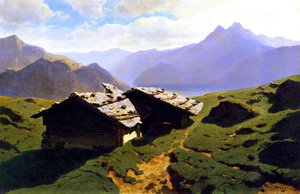
Alexandre Calame, born in Arabie (modern Vevey), Switzerland, in 1810, was a Swiss landscape painter who achieved considerable renown during the Romantic era and is considered a pivotal figure within the Düsseldorf School of Painting. His artistic journey began amidst challenging circumstances—his father’s financial ruin precluded him from pursuing formal education, forcing him to work as a bank clerk from adolescence. Yet, this pragmatic necessity fueled his passion for art, nurtured by an encounter with banker Diodati who secured him invaluable tuition under François Diday, a celebrated Düsseldorf landscape painter. Recognizing his innate talent and dedication, Calame swiftly abandoned clerical duties for the pursuit of artistic excellence.
Early Years & Patronage: Calame’s formative years were marked by diligent sketching of Swiss landscapes—primarily views of Bernese Oberland—a practice honed under Diday's guidance. This early focus established a lifelong preoccupation with Alpine scenery, reflecting the Romantic fascination for untamed wilderness and sublime beauty.
The Düsseldorf School Connection: Calame’s association with the Düsseldorf School cemented his reputation as a master of atmospheric perspective and tonal modulation. Artists like Wilhelm Leibl and Anton Richter championed Calame's style, emphasizing meticulous observation and expressive brushwork to convey the emotional impact of nature.
Artistic Style & Technique
Calame’s artistic signature lay in his ability to translate the grandeur of the Alps onto canvas with remarkable accuracy and sensitivity. He employed a technique characterized by layered glazes—thin, translucent washes of pigment applied sequentially—to achieve luminous color palettes and capture subtle variations in light and shadow. This meticulous approach mirrored Diday's influence and distinguished Calame from many of his contemporaries who favored looser brushstrokes. His landscapes weren’t merely representations; they were imbued with palpable emotion, conveying the drama of storms, the serenity of glacial lakes, and the vibrant hues of alpine meadows. Notable works include “Handeck Fall,” “Torrent in the Alps,” and “Storm at Handeck,” each demonstrating his mastery of tonal harmony and compositional balance.
Lithography: Calame’s contribution extended beyond painting; he excelled as a lithographer, producing stunning prints that further disseminated his vision of Alpine landscapes.
Notable Achievements & Legacy
Calame gained considerable acclaim in Germany during the 1830s and 40s, becoming a favorite among collectors and critics alike. Exhibitions in Paris showcased his talent to a wider audience, solidifying his position as one of Switzerland’s foremost landscape artists. He taught at Geneva University, fostering the artistic development of students like Adolf Mosengel, who continued Calame's legacy. His journey to Italy yielded invaluable inspiration—particularly from Rome and Naples—resulting in paintings that captured the essence of Italian natural beauty alongside his beloved Alpine vistas. The enduring fascination with Calame’s depictions of glaciers and mountain streams testifies to their timeless appeal and continues to inspire artists today.
Illustrative Works & Artistic Influence
Calame's artistic influence resonated throughout the Romantic movement, shaping the aesthetic sensibilities of subsequent generations. His meticulous observation and expressive technique served as a model for landscape painters striving to capture the sublime grandeur of nature. Furthermore, his lithographic prints played a crucial role in popularizing Alpine scenery and disseminating Romantic ideals across Europe. The enduring beauty and emotional depth of Calame’s paintings ensure that his contribution to art history remains firmly established.
OriginalUniqueArt.com redakcijos komanda
Viktorina
Kiekviename klausime yra tik vienas teisingas atsakymas.