Cubism
Interior (스튜어트 데이비스)
스튜어트 데이비스 (1892–1964) 작가의 Interior Cubism 운동에 속합니다.

 미리보기

 수작업 유화 작품
 공유하기
 공유하기
 가이드 보기


 다운로드
 유사 작품 더 보기
 X-레이
 슬라이드 쇼 보기
 질의응답

 통계 정보
Interior: 핵심 정보
Interior은(는) 무엇을 묘사하고 있나요?
A Dynamic Vision of Modernity: Exploring Stuart Davis’s “Interior”
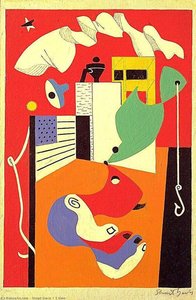
Stuart Davis's “Interior” is a captivating example of American Modernism, pulsating with energy and reflecting the artist’s unique response to the burgeoning urban landscape and the rhythms of jazz. Created sometime during his prolific career (1892-1964), this work embodies Davis’s commitment to developing a distinctly American visual language, moving beyond European influences towards a bold, independent style.
Deconstructing Space: Style & Technique
- The artwork is immediately striking for its geometric abstraction. Davis employs fragmented forms and flattened perspectives – hallmarks of both Cubism and Constructivism – but infuses them with a uniquely American sensibility.
- A vibrant palette dominates, anchored by the stark contrast between the white background, bold reds, blues, and greys, and punctuated by energetic black lines. The orange border further intensifies this visual impact.
- Davis’s technique is evident in the visible brushstrokes and layering of paint, creating a subtle texture that adds depth despite the overall flattened composition. This suggests an active process of building up form and color on the canvas, likely using oil paints as his primary medium.
- The arrangement isn't simply random; it’s carefully orchestrated into distinct zones – a tower-like structure in blue-grey, a dynamic red section with a vertical ‘sail’ or flag element, and a central area of interwoven geometric shapes. This zoning creates a sense of controlled chaos.
Echoes of Jazz & the Machine Age: Context & Symbolism
Davis was deeply influenced by jazz music, which he saw as embodying the spirit of modern America – improvisational, energetic, and uniquely its own. While “Interior” isn’t a direct representation of musical notes, the dynamic interplay of shapes and colors evokes the same sense of rhythm and syncopation found in jazz compositions.
- The architectural elements, particularly the stylized tower, could be interpreted as representing aspiration or the burgeoning skyscrapers of American cities. Davis frequently engaged with urban themes throughout his career.
- The ‘sail’ or flag-like form introduces a sense of movement and direction, perhaps symbolizing progress or the forward momentum of modern life.
- His early exposure to the Armory Show in 1913 was pivotal. While his initial works reflected the Ashcan School style, he quickly absorbed and transformed European avant-garde ideas into something distinctly American.
Emotional Resonance & Lasting Impact
“Interior” is not a tranquil scene; it’s charged with energy and tension. The fragmented forms and bold colors create a sense of dynamism, while the lack of traditional perspective can be slightly unsettling. This emotional complexity reflects the anxieties and excitements of a rapidly changing world.
- The artwork invites viewers to actively engage with its abstract language, prompting individual interpretations and fostering a personal connection.
- As a pioneering figure in American Modernism, Stuart Davis paved the way for subsequent generations of artists. His work continues to inspire those seeking to break free from convention and explore new forms of visual expression.
고해상도 Interior
스튜어트 데이비스, Interior.
Interior에 관한 질문
"Interior"을(를) 정의하는 팔레트와 주요 색상은 무엇인가요?
스튜어트 데이비스의 "Interior"의 저작권 상태는 어떻게 되나요?
"Interior"에는 어떤 색상들이 사용되었나요?
스튜어트 데이비스의 "Interior"은(는) 어떤 미술 사조에 속하나요?
스튜어트 데이비스의 "Interior"의 색채 구성은 어떻게 이루어져 있나요?
"Interior"에서는 Statement 대비와 Strong Color Unity 조화가 어우러져 있습니다.
아티스트 스튜어트 데이비스 소개

1892–1964, 미국
스튜어트 데이비스
스튜어트 데이비스: 아메리카 모더니즘의 선구자 1892년 12월 7일 필라델피아에서 태어난 스튜어트 데이비스는 어린 시절부터 예술적인 환경 속에서 성장했습니다. 그의 아버지 에드워드 와이어트 데이비스는 필라델피아 프레스의 미술 편집자였고, 어머니 헬렌 스튜어트 데이비스는 조각가였습니다. 이러한 가정환경은 의심할 여지 없이 그의 초기 예술적 관심을 키웠습니다. 데이비스는 1909년부터 1912년까지 뉴욕시의 로버트 헨리 미술학교에서 로버트 헨리의 지도를 받으며 정식 교육을 받았습니다.
스튜어트 데이비스의 다른 작품들
 오돌
 Lucky Strike1924
 T View1951
 Blue Café1928
Interior 관련 에세이
 Stuart Davis: Modernist Abstraction & the Vibrant Spirit of the Jazz AgeExplore the vibrant world of Stuart Davis, a pioneer of American Modernism. Discover his jazz-inspired paintings, signature style & investm…
 The Geometry of Elegance: Elevating Modern Villa Interiors with Cubist-Inspired ArtDiscover how Cubist-inspired art elevates modern villa interiors. Explore the intersection of geometric precision and luxury design through…
 Steel & Soul: The Rhythmic Geometry and Industrial Resonance of the Machine AgeExplore the rhythmic geometry of Fernand Leger and the Machine Age. Discover the power of industrial art today.