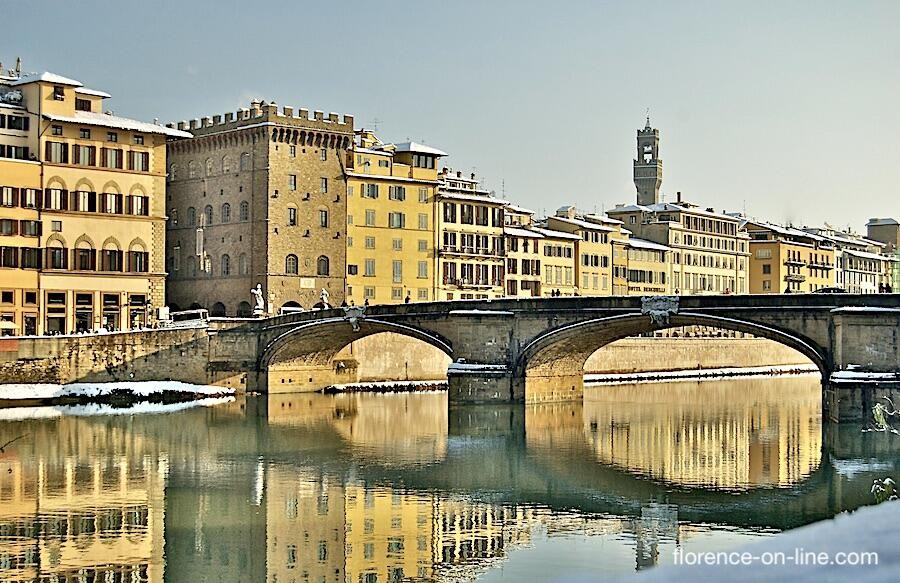


A Florentine Grace: The Story of Ponte Santa Trinità
Standing upon the Ponte Santa Trinita is an experience that transcends a simple crossing over the Arno River; it’s an immersion into the very heart of Florence, a city synonymous with Renaissance brilliance. More than just a vital artery connecting the Oltrarno and the historic center, this elegant structure embodies a remarkable confluence of engineering innovation, artistic vision, and enduring resilience – a testament to Florentine determination and aesthetic sensibility. The bridge whispers tales of repeated challenges overcome, each iteration rising from the river’s turbulent embrace, culminating in the graceful masterpiece we see today.
The story begins not with stone and mortar, but with wood. As early as 1252, a rudimentary wooden bridge spanned this crucial point on the Arno, providing essential passage for Florentines. However, the river’s capricious nature – its frequent and devastating floods – quickly rendered this initial construction obsolete. Repeated rebuilds followed, each succumbing to the Arno's power until, between 1567 and 1569, Bartolomeo Ammannati conceived of a structure that would finally stand the test of time. His design wasn’t merely about brute strength; it was an audacious statement of grace. Ammannati’s bridge is celebrated as the world's oldest elliptic arch bridge – a groundbreaking achievement in structural engineering. The three flattened ellipses, subtly curved and meticulously proportioned, aren’t simply aesthetically pleasing; they distribute weight with remarkable efficiency, creating a harmonious balance between form and function that speaks to the Renaissance ideal of *proporzione*.
The artistic embellishments further elevate Ponte Santa Trinita beyond mere functionality. In 1608, four magnificent statues representing the Seasons were added as a celebratory gesture marking the marriage of Cosimo II de’ Medici and Maria Magdalena of Austria. Each sculpture – Spring by Pietro Francavilla, Summer and Autumn by Giovanni Caccini, and Winter by Taddeo Landini – embodies the character of its respective season with nuanced detail and classical beauty. These figures aren't simply decorative additions; they are integral to the bridge’s identity, adding a layer of allegorical richness that invites contemplation and subtly reinforces the cyclical nature of life itself. Notably, the head of Spring was tragically lost during World War II but painstakingly recovered from the Arno in 1961, a poignant symbol of Florence's commitment to preserving its heritage.
However, the story of Ponte Santa Trinita isn’t solely one of triumph. The 20th century brought unimaginable devastation when, during World War II, retreating German troops destroyed the bridge on August 4th, 1944. This act was a profound loss for Florence, severing not just a physical connection but also a vital link to its cultural heritage. Yet, from the rubble arose an extraordinary testament to Florentine determination. Meticulously reconstructed between 1958 and 1961 under the guidance of Riccardo Gizdulich and Emilio Brizzi, the bridge was reborn using salvaged stones recovered from the Arno River alongside new stone quarried from the Boboli Gardens. The reconstruction wasn’t simply a rebuilding; it was an act of cultural preservation, a defiant statement that beauty and history would endure even in the face of destruction – a powerful demonstration of Florentine resilience.
Today, Ponte Santa Trinita stands as a symbol of Florence's enduring spirit. It offers panoramic views of the Arno River, the iconic Ponte Vecchio, and the city’s breathtaking skyline – a vista that has captivated artists and travelers for generations. The bridge is more than just a crossing; it’s a living artwork, a testament to human ingenuity, artistic vision, and unwavering dedication to preserving beauty in the face of adversity. For those seeking inspiration, whether as art lovers, collectors, or interior designers, Ponte Santa Trinita embodies a timeless elegance and a profound sense of place – qualities that resonate deeply and continue to inspire.
Architectural Marvels: The Elliptical Design
The brilliance of Ponte Santa Trìnita lies not just in its survival but in the innovative engineering behind its design. Bartolomeo Ammannati’s decision to employ an elliptic arch – a technique relatively novel for bridge construction at the time – was revolutionary. Unlike circular arches, ellipses distribute weight more evenly, allowing for greater spans and a lighter structure. This ingenious solution minimized the need for massive supporting piers within the river, contributing significantly to the bridge's graceful appearance and its ability to withstand the Arno’s powerful currents. The three flattened ellipses, each measuring approximately 29 meters on the outer spans and 32 meters at the center, are a testament to Ammannati’s understanding of structural mechanics and his commitment to creating a visually stunning and structurally sound bridge.
Seasonal Allegories: The Statues of the Seasons
Adding another layer of artistic richness to Ponte Santa Trìnita are the four statues representing the Seasons, commissioned in 1608 to commemorate the marriage of Cosimo II de’ Medici. Each sculpture – Spring by Pietro Francavilla, Summer and Autumn by Giovanni Caccini, and Winter by Taddeo Landini – is a masterpiece of Renaissance sculpture, capturing the essence of its respective season with remarkable detail and classical beauty. The figures are not merely decorative; they embody allegorical themes, representing the cyclical nature of time and the bounty of the natural world. The choice of materials—marble for the statues—further enhances their visual impact, creating a harmonious blend of form and substance.
A Testament to Resilience: Reconstruction After WWII
The destruction of Ponte Santa Trìnita during World War II stands as a poignant reminder of Florence’s vulnerability. However, the subsequent reconstruction between 1958 and 1961 is a remarkable story of perseverance and cultural preservation. Utilizing salvaged stones recovered from the Arno River – a deliberate act to honor the bridge's history – alongside new stone quarried from the Boboli Gardens, the engineers and architects meticulously rebuilt the structure, ensuring that it retained its original character and beauty. This painstaking process not only restored the bridge but also served as a powerful symbol of Florence’s determination to safeguard its cultural heritage in the face of devastation.
Viewing Points & Inspiration
Ponte Santa Trìnita offers unparalleled vantage points for appreciating Florence's architectural splendor. From its elevated position, visitors can capture breathtaking panoramic views of the Arno River, the iconic Ponte Vecchio with its glittering shops, and the city’s skyline – a vista that has captivated artists and travelers for generations. The bridge itself is a work of art, inviting contemplation and inspiring creativity. Its elegant curves, harmonious proportions, and rich history make it a truly unforgettable landmark—a place to pause, reflect, and appreciate the seamless integration of art, architecture, and history.